
Free Pre-Start Checklist (PCR Machine) Template
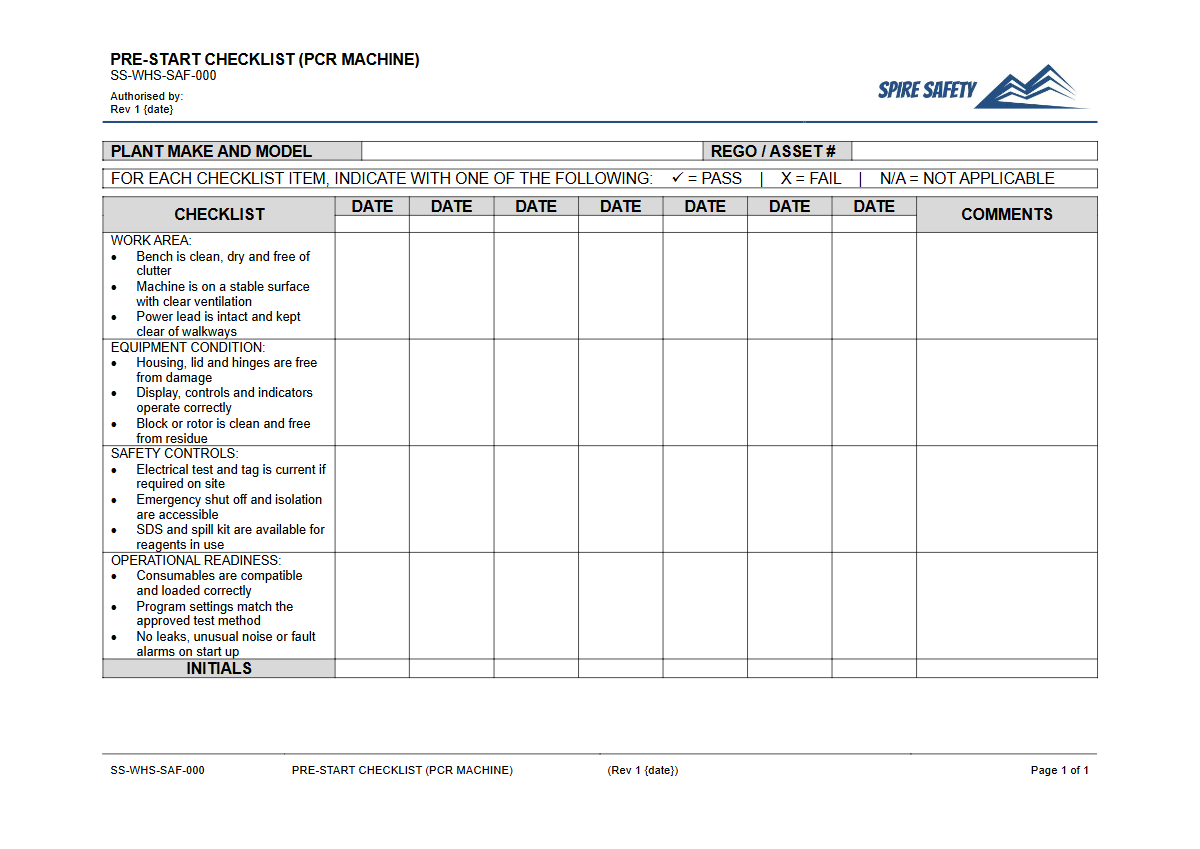
Download our free Pre-Start Checklist (PCR Machine) template in DOCX & PDF. A structured starting point for identifying hazards before operating PCR machines.
Free Pre-Start Checklist (PCR Machine) Template
DOCX • 125 KB + PDF
Updated Oct 2026
No signup required
Purpose of the Free Pre-Start Checklist (PCR Machine) Template
Operating laboratory equipment like a Polymerase Chain Reaction (PCR) machine requires precision, care, and a systematic approach to safety. Our Free Pre-Start Checklist (PCR Machine) Template provides a structured framework for operators to conduct essential safety and operational checks before commencing work.
Using this checklist helps formalise the inspection process, ensuring the equipment is in safe working order, minimising the risk of malfunction, and protecting both the operator and the integrity of the scientific process. Regular pre-start checks are a fundamental component of proactive hazard management in a laboratory environment.
By documenting these checks, organisations create a verifiable record of due diligence, demonstrating a commitment to maintaining plant and equipment in a safe condition. This is crucial for identifying potential faults before they escalate into costly repairs or, more importantly, safety incidents.
Similar to checks performed on other complex equipment, such as our Free Pre-Start Checklist for 3D Printers, this process embeds a safety-first culture into daily lab routines.
Video walkthrough
How to Use the Free Pre-Start Checklist (PCR Machine) Template
This template is available as a fully editable DOCX file and a print-ready PDF. The DOCX version allows for complete customisation to align with the specific make, model, and configuration of the PCR machines used in your facility.
It's designed to be a robust starting point, capturing common inspection points relevant to most PCR equipment.
Important: This document is a template only. For it to be effective, you must customise it to reflect the unique hazards, controls, and operating procedures of your specific workplace and the particular PCR machine(s) in use.
We recommend a competent person, such as a lab manager or senior technician, reviews and adapts the checklist before implementation. Incorporating these tailored checks is a key part of developing robust WHS management systems that are practical and effective.
When to Use It
A pre-start check for a PCR machine should be completed by the operator before the first use on any given day or shift. For equipment that is used infrequently, a check should be performed before each use.
The goal is to make these inspections a non-negotiable part of the standard operating procedure. This routine helps reinforce safe work habits and ensures that any changes in the equipment's condition—such as worn seals, frayed electrical cords, or error messages on the display—are identified and addressed immediately, before the machine is put into service. This principle is reinforced in our Pre-Start Checks and Plant Maintenance Toolbox Talk.
Who Should Use It
This checklist is intended for use by any person who operates PCR machines, including laboratory technicians, research assistants, scientists, and students under supervision. The user must be trained and deemed competent not only in the operation of the PCR machine but also in the process of conducting the pre-start inspection itself.
Lab managers or Principal Investigators are responsible for ensuring that operators are adequately trained and that completed checklists are reviewed and stored as part of the facility's safety records. These records can be an important piece of evidence during a WHS compliance auditing process to demonstrate proactive equipment maintenance and safety management.
Verifying operator competence is a critical step that complements the use of a pre-start checklist. While this template focuses on the equipment, ensuring the user has the required skills is equally important.
For other types of machinery, a document like a Verification of Competency (Portable Welding Machine) template is used to formally assess an operator's ability. This same principle of verification applies to operators of sophisticated lab equipment. For a wider selection of safety documents, you can browse our complete free WHS resources library.
Common mistakes
Common mistakes to avoid
- Using a generic checklist that doesn't cover the specific risks of your PCR machine model.
- Pencil-whipping the form without physically inspecting each item.
- Failing to report and tag out faulty equipment identified during the check.
- Not retaining completed checklists as a record of maintenance and safety diligence.
Legal references
Legal considerations
The following legal requirements may be relevant to this type of work.
- Work Health and Safety Act (Harmonised) — Provides the primary duties for protecting workers and other people from work health and safety risks.
- Work Health and Safety Regulations (Harmonised) — Sets out requirements supporting the management of workplace hazards and risks.
The following codes may be relevant to this type of work.
- Managing WHS Risks Code of Practice — Provides practical guidance on identifying hazards, assessing risks and applying effective controls.
- Work Health and Safety Consultation, Cooperation and Coordination Code of Practice — Provides practical guidance on consulting workers and coordinating with other duty holders.
- Managing the Work Environment and Facilities Code of Practice — Provides practical guidance on safe work environments, workplace facilities and related controls.
Did you know
Thermal Accuracy
The thermal block of a PCR machine can heat and cool at rates of up to 5-10°C per second. A pre-start check helps ensure the lid seal is intact, which is critical for maintaining temperature uniformity and preventing sample evaporation.
A Powerful Technique
PCR technology can amplify a single copy of a DNA segment into billions of copies in just a few hours. Ensuring the machine is functioning correctly is paramount to prevent contamination and ensure the amplified DNA is the correct target.
FAQ
Frequently asked questions
01Why is a pre-start check necessary for a PCR machine?
02Is using this template enough to be WHS-aligned?
03What are some common hazards with PCR machines?
04How often should a PCR machine be professionally serviced?
Share this resource
Free Pre-Start Checklist (PCR Machine) Template
Browse Categories
How To Use It
- 1Download and open in Word or PDF.
- 2Replace the placeholders with your business details.
- 3Get it reviewed by a WHS specialist before rollout.
Need it customised?
Our WHS consultants can adapt this template to your site, run a gap analysis, or audit what you already have in place.
Book a Free Consultation WHS consulting servicesor call 1300 156 382