
Free Pre-Start Checklist (Pelletiser) Template
Formalise your equipment safety checks with our free Pre-Start Checklist (Pelletiser) Template. This DOCX & PDF helps identify hazards before operation.
Free Pre-Start Checklist (Pelletiser) Template
DOCX • 125 KB + PDF
Updated Oct 2026
No signup required
Purpose of the Free Pre-Start Checklist (Pelletiser) Template
A pelletiser is a powerful piece of plant that requires rigorous safety checks before each use. Implementing a consistent inspection process is crucial for preventing incidents and ensuring operational reliability.
This Free Pre-Start Checklist (Pelletiser) Template provides a structured starting point for your organisation to formalise these essential daily checks, helping operators identify and report potential hazards before they lead to breakdowns or injuries.
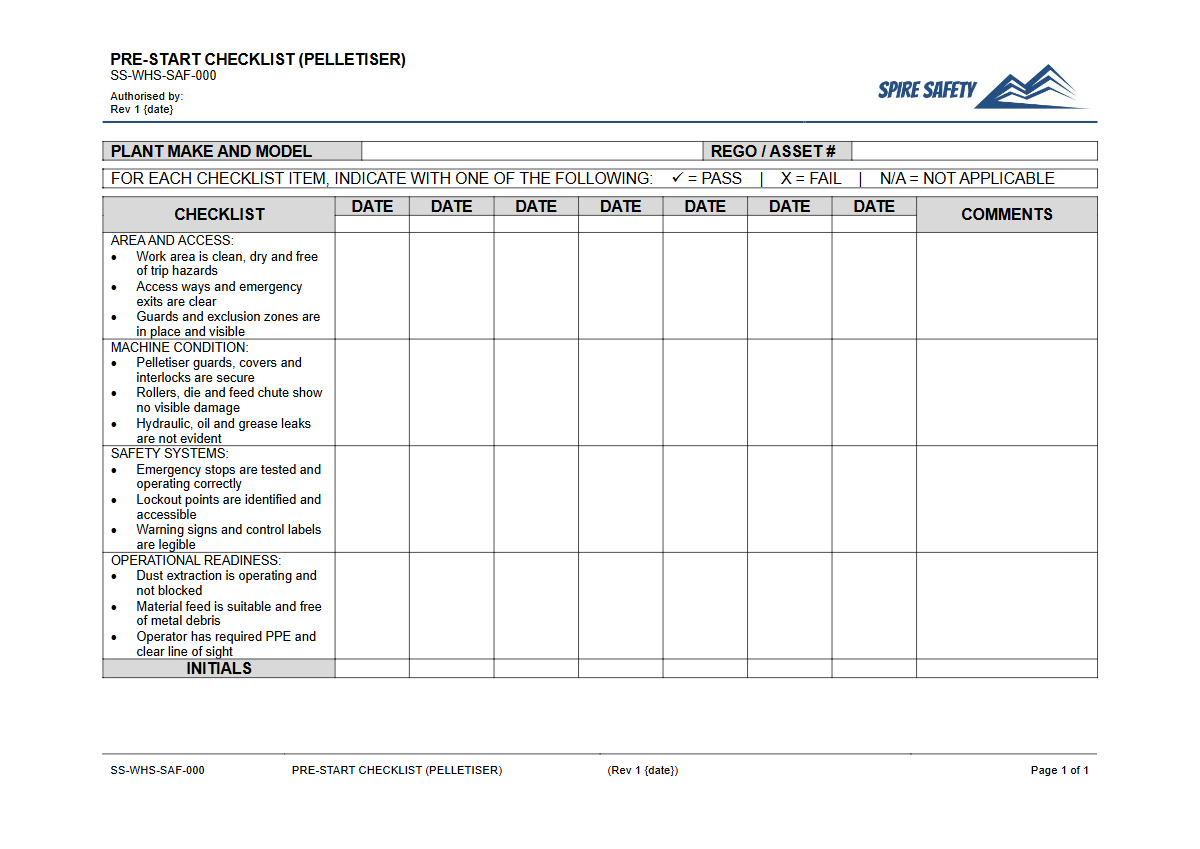
The primary purpose of this checklist is to provide a documented, repeatable process for verifying the safe condition of the equipment before operation. It guides operators through a series of critical checks covering mechanical, electrical, and safety components.
Consistent use helps to identify developing faults early, prevent unexpected failures, minimise downtime, and most importantly, protect workers from harm. It also creates a tangible record of due diligence, demonstrating a commitment to proactive safety management.
For broader discussions on equipment readiness, our Pre-Start Checks and Plant Maintenance toolbox talk can help reinforce these principles with your team.
Video walkthrough
How to use the Free Pre-Start Checklist (Pelletiser) Template
This resource is available as a fully editable DOCX file for easy customisation and a print-ready PDF for immediate use. To begin, download the template and open the DOCX version.
You can then add your company branding, specific machine details (make, model, serial number), and site-specific information. It is essential to review and adapt the checklist items to reflect the unique configuration and risks of your particular pelletiser.
Important Note: This template provides a general framework aligned with Australian WHS practice. We strongly recommend you conduct a specific risk assessment on your equipment and customise the checklist to address all identified hazards.
This is not a one-size-fits-all solution.
After customisation, the checklist can be printed for manual completion or integrated into a digital system. For comparison, you can see how a similar structure is applied in our free CNC Router pre-start checklist.
Key Items on the Checklist
While you must customise the checklist, a comprehensive inspection typically covers several key areas:
- Guarding: Ensure all guards and safety covers are in place, secure, and free from damage. Check that any interlock switches are functioning correctly.
- Emergency Stops: Physically test all emergency stop buttons and pull-cords to confirm they cut power to the machine instantly.
- Feed & Discharge Areas: Check for blockages, damage, or excessive wear in the feed hopper, auger, die, and discharge chute.
- Drive System: Inspect belts, chains, and gearboxes for correct tension, lubrication, and signs of wear or damage. Listen for unusual noises during a brief, no-load test run if safe to do so.
- General Condition: Look for fluid leaks (hydraulic, oil), loose bolts, cracks in the frame, and ensure the surrounding area is clean and free of trip hazards. The principles of inspecting machinery are similar across different plant, such as those covered in our pre-start checklist for agitators.
When to use it
A pre-start check should be completed by the operator at the beginning of every shift or before using the pelletiser for the first time on any given day. It should also be performed after any maintenance or repair work has been carried out to ensure the equipment has been returned to a safe operational state. Integrating these checks into daily operating procedures is a key component of effective WHS management systems.
Who should use it
This checklist is designed for use by trained and competent operators who are authorised to use the pelletiser. The person conducting the check must understand the machine's functions and be able to recognise the hazards associated with it, often confirmed through a Verification of Competency (VOC).
Supervisors or managers are responsible for ensuring these checks are completed consistently and that any reported defects are addressed promptly. Defining these roles and ensuring staff have the necessary skills is a core part of your safety obligations.
If your organisation needs support in establishing these frameworks, consider engaging WHS consulting services.
Integrating into Your Safety System
This pre-start checklist is just one part of a comprehensive safety management approach. The findings from these checks should inform your maintenance schedules and can be used as evidence during safety audits.
The checklist works alongside other critical safety documents, such as a Safe Work Method Statement (SWMS) which outlines the high-risk work associated with the machine's operation. For an example of how these documents are structured, you can review our template SWMS for Concrete Truck Operation. By connecting these elements, you create a more robust system for managing risk. For more tools to support your safety program, browse our complete free WHS resources library.
Common mistakes
Common mistakes to avoid
- Failing to customise the generic template for the specific machine.
- Operators 'pencil-whipping' the form without physically inspecting the items.
- Not immediately reporting or isolating the machine when a defect is found.
- Poor record-keeping, making it difficult to track recurring faults or prove due diligence.
Legal references
Legal considerations
The following legal requirements may be relevant to this type of work.
- Work Health and Safety Act (Harmonised) — Provides the primary duties for protecting workers and other people from work health and safety risks.
- Work Health and Safety Regulations (Harmonised) — Sets out requirements supporting the management of workplace hazards and risks.
The following codes may be relevant to this type of work.
- Managing WHS Risks Code of Practice — Provides practical guidance on identifying hazards, assessing risks and applying effective controls.
- Work Health and Safety Consultation, Cooperation and Coordination Code of Practice — Provides practical guidance on consulting workers and coordinating with other duty holders.
- Managing the Work Environment and Facilities Code of Practice — Provides practical guidance on safe work environments, workplace facilities and related controls.
Did you know
A Common Hazard
Inadequate machinery guarding is one of the most persistent safety issues identified by inspectors, with entanglement in moving parts leading to severe injuries like amputations and fractures.
Pelletising Pressure
The pelletising process works by forcing raw material through a die under immense pressure and heat, which can exceed several tonnes of force. This energy makes regular inspection of components critical.
FAQ
Frequently asked questions
01Why is a pre-start check necessary for a pelletiser?
02How often should a pelletiser pre-start check be completed?
03Can this template be used for any type of pelletiser?
04Who is responsible for ensuring pre-start checks are done?
Share this resource
Free Pre-Start Checklist (Pelletiser) Template
Browse Categories
How To Use It
- 1Download and open in Word or PDF.
- 2Replace the placeholders with your business details.
- 3Get it reviewed by a WHS specialist before rollout.
Need it customised?
Our WHS consultants can adapt this template to your site, run a gap analysis, or audit what you already have in place.
Book a Free Consultation WHS consulting servicesor call 1300 156 382