
Free Pre-Start Checklist (Piling Rig) Template
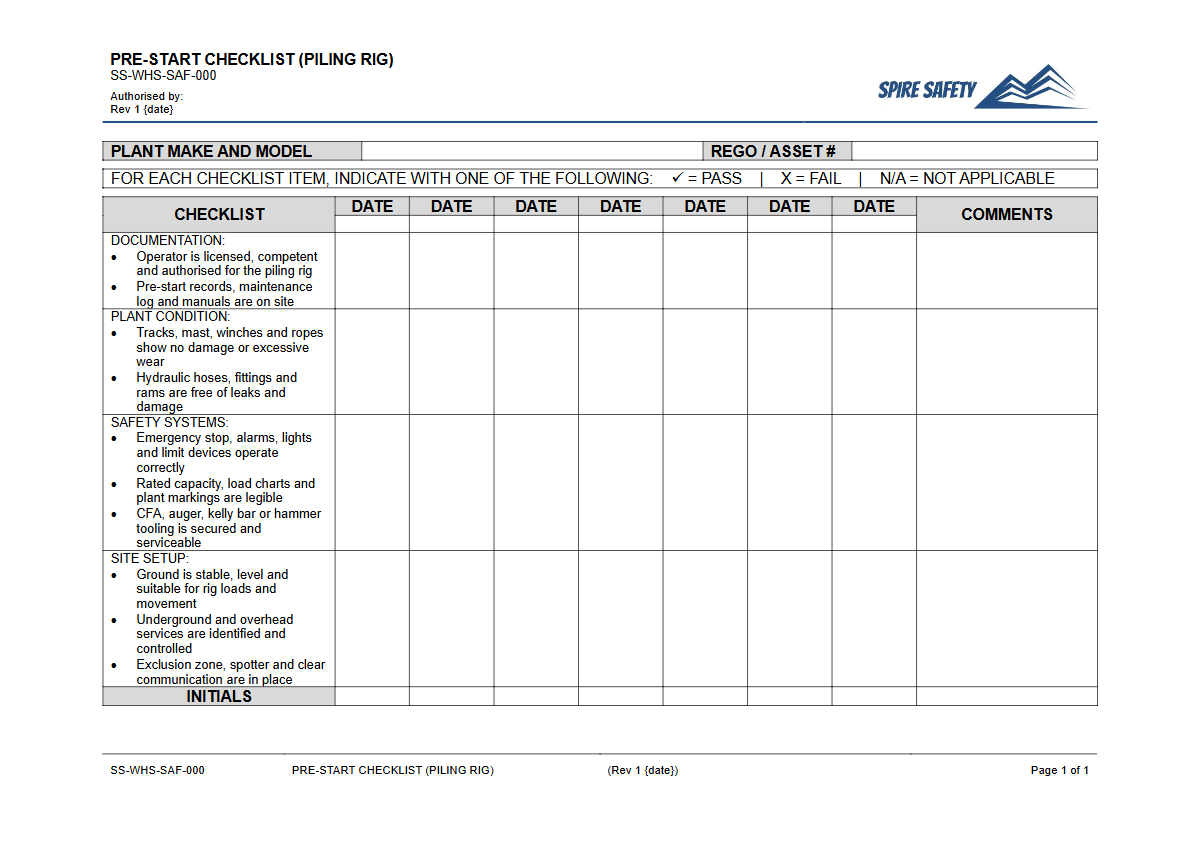
Download our Free Pre-Start Checklist for Piling Rigs. This customisable template helps formalise equipment safety checks and identify hazards.
Free Pre-Start Checklist (Piling Rig) Template
DOCX • 125 KB + PDF
Updated Oct 2026
No signup required
Purpose of the Free Pre-Start Checklist (Piling Rig) Template
A consistent pre-start inspection process is essential for operating piling rigs safely. This Free Pre-Start Checklist (Piling Rig) Template provides a structured starting point for your organisation to formalise daily equipment checks, identify potential hazards before operation, and maintain a record of inspections.
Using a standardised checklist helps ensure that operators do not overlook critical safety components, from hydraulic systems and wire ropes to emergency stops and structural integrity.
Regular and thorough inspections are a key part of proactive plant maintenance and are fundamental to meeting your duties as a Person Conducting a Business or Undertaking (PCBU) under Australian WHS laws. By systematically identifying and reporting defects, you can prevent equipment failure, reduce the risk of serious incidents, and create a safer working environment. Reinforcing these concepts is crucial, which can be supported with a dedicated Pre-Start Checks and Plant Maintenance toolbox talk.
Video walkthrough
How to use the Free Pre-Start Checklist (Piling Rig) Template
This document, available in both DOCX and PDF formats, is designed to be straightforward. Operators or other competent personnel should use the checklist to conduct a physical and visual inspection of the piling rig before the start of each shift or before it is used for the first time on a given day.
The checklist guides the user through key areas of the machine, prompting them to check items like fluid levels, safety guards, controls, and alarms.
Any faults, damage, or concerns identified during the check must be recorded in the designated section and reported immediately according to your organisation's procedures. The rig should not be operated until any identified safety-critical defects have been rectified by a qualified person.
Integrating this process into your broader WHS management systems ensures that inspections are not just a tick-box exercise, but a functional part of your risk management strategy.
Customisation is Key
Piling rigs vary significantly by manufacturer, model, and configuration. It is crucial to remember that this template is a starting point.
We strongly recommend you customise it to reflect the specific piling rig models, site conditions, and operational procedures at your workplace. Add or remove items to ensure the checklist is relevant and comprehensive for your unique equipment and operating environment.
When to conduct a pre-start check
A pre-start check on a piling rig should be performed at the beginning of every shift or before the machine is operated for the first time each day. It should also be conducted if a new operator takes over the machine mid-shift.
This frequency ensures that any issues that may have developed overnight or during a previous operation are caught before work commences.
These routine checks are often discussed as part of a site's daily pre-work briefing. You can use our free Pre-Start Meeting Template to help structure and document these important daily safety conversations with your team.
Who should use this checklist
The pre-start checklist should be completed by a person who is competent to operate the piling rig. This means they must have the necessary training, experience, and knowledge to both operate the machine and understand the function of its various components and safety features.
While the operator typically performs the check, a supervisor should periodically review completed checklists to ensure they are being filled out correctly and that reported faults are being addressed.
Verification of these procedures is an important oversight function, which can be formalised through activities like WHS compliance auditing to confirm that safety processes are being followed in practice. This checklist is one component of a site's overall safety documentation, which also includes critical documents like a Safe Work Method Statement for Concrete Truck Operation when working with other high-risk plant.
By implementing this checklist, your organisation can better manage the risks associated with heavy machinery and demonstrate a commitment to workplace health and safety. For more downloadable tools, browse our complete free WHS resources library.
Common mistakes
Common mistakes to avoid
- Ticking all boxes without physically or visually inspecting the items ('pencil-whipping').
- Ignoring seemingly 'minor' issues like small leaks or worn components that could lead to major failure.
- Using a generic checklist that doesn't cover the specific features or known failure points of the rig model in use.
- Failing to report identified defects or continuing to operate the rig with known safety issues.
Legal references
Legal considerations
The following legal requirements may be relevant to this type of work.
- Work Health and Safety Act (Harmonised) — Provides the primary duties for protecting workers and other people from work health and safety risks.
- Work Health and Safety Regulations (Harmonised) — Sets out requirements supporting the management of workplace hazards and risks.
The following codes may be relevant to this type of work.
- Managing WHS Risks Code of Practice — Provides practical guidance on identifying hazards, assessing risks and applying effective controls.
- Work Health and Safety Consultation, Cooperation and Coordination Code of Practice — Provides practical guidance on consulting workers and coordinating with other duty holders.
- Managing the Work Environment and Facilities Code of Practice — Provides practical guidance on safe work environments, workplace facilities and related controls.
Did you know
Ground Conditions are Critical
A leading cause of piling rig instability and collapse is inadequate assessment of ground conditions. The rig's working platform must be properly designed and prepared to support the immense weight and dynamic loads of the machine during operation.
FAQ
Frequently asked questions
01What should be included in a piling rig pre-start check?
02How often should piling rig pre-start checks be done?
03Who is responsible for completing a piling rig pre-start checklist?
04Is a digital pre-start checklist better than a paper one?
Share this resource
Free Pre-Start Checklist (Piling Rig) Template
Browse Categories
How To Use It
- 1Download and open in Word or PDF.
- 2Replace the placeholders with your business details.
- 3Get it reviewed by a WHS specialist before rollout.
Need it customised?
Our WHS consultants can adapt this template to your site, run a gap analysis, or audit what you already have in place.
Book a Free Consultation WHS consulting servicesor call 1300 156 382