
Free Pre-Start Checklist (Pipe Threader) Template
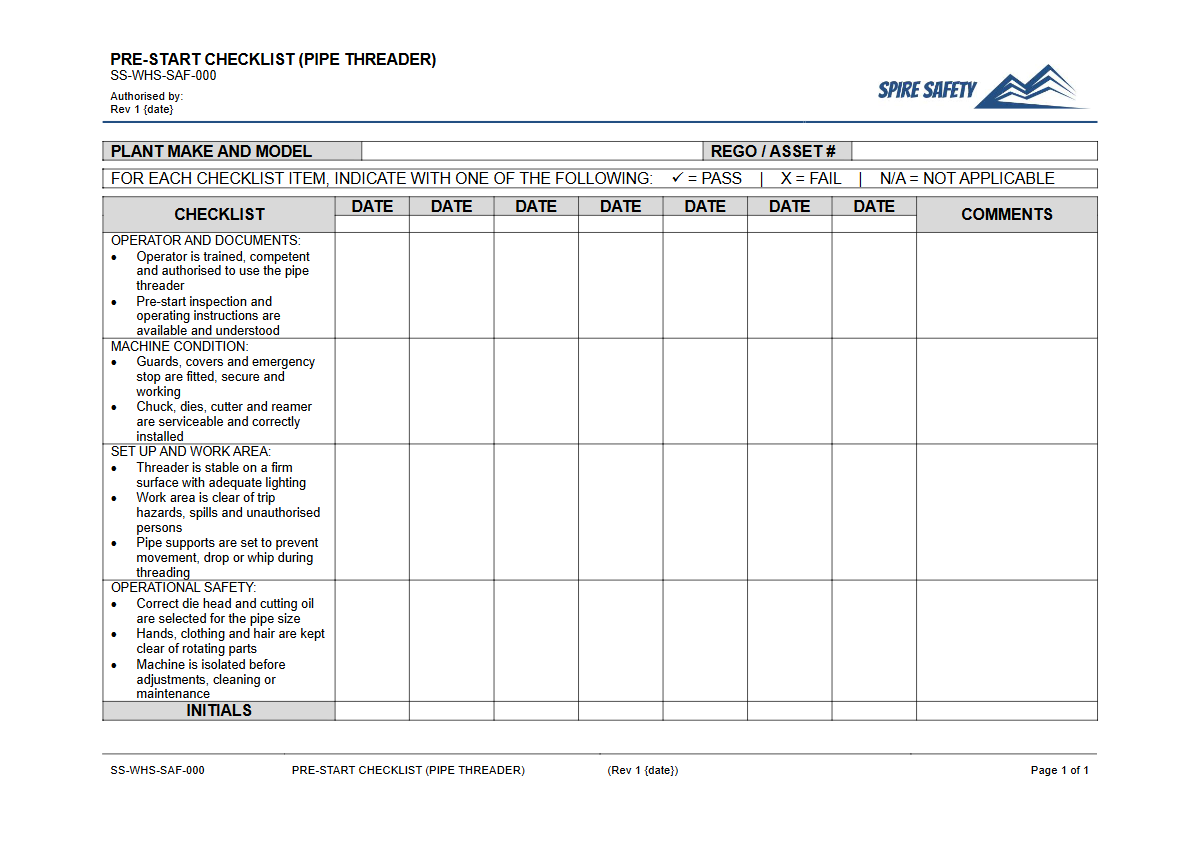
Download our free Pre-Start Checklist (Pipe Threader) Template to formalise daily equipment inspections.
Free Pre-Start Checklist (Pipe Threader) Template
DOCX • 125 KB + PDF
Updated Oct 2026
No signup required
Purpose of the Free Pre-Start Checklist (Pipe Threader) Template
A pipe threader is a powerful piece of equipment essential in plumbing, pipefitting, and construction. However, like any plant, it presents significant risks if not properly maintained and inspected.
Using our free Pre-Start Checklist (Pipe Threader) Template helps formalise the process of checking the equipment before each use. This simple but critical step allows operators to systematically identify potential hazards, mechanical faults, or missing safety features before they can lead to an incident, injury, or costly downtime.
Implementing regular pre-start checks is a fundamental component of proactive risk management. It demonstrates a commitment to workplace safety and helps maintain the equipment in a safe operating condition, extending its service life.
These documented checks form a valuable part of your overall WHS management systems, providing records that can be reviewed during safety audits and incident investigations.
Video walkthrough
How to Use the Free Pre-Start Checklist (Pipe Threader) Template
This template provides a structured starting point for developing a site-specific checklist. To use it effectively:
- Download the DOCX file and open it.
- Review the items and add, remove, or modify them to match the specific make and model of the pipe threader used in your workplace. Consider your unique operational environment and any specific hazards present.
- Add your company branding and specific site details.
- Train operators on how to properly complete the checklist, what each item means, and the procedure for reporting faults.
- Implement the checklist as a mandatory step before any worker operates the pipe threader.
Important: This is a template only. You must customise it to suit the specific equipment, risks, and procedures of your workplace.
We are not liable for any incidents that may occur from the use of this document.
A checklist is only effective when the person using it is competent to operate the machinery. You can use our Verification of Competency (Pipe Threader) Template to assess and confirm operator skills and knowledge.
When to Use This Pre-Start Checklist
A pipe threader pre-start checklist should be completed before every shift or before the first use of the equipment on any given day. It should be a non-negotiable part of the daily routine for anyone operating the machine.
This frequency ensures that any damage or faults that may have occurred overnight, during transport, or during the previous shift are identified before the equipment is energised.
Consistent use of pre-start checks helps build a stronger safety culture. Reinforce their importance during team meetings using resources like our Pre-Start Checks and Plant Maintenance Toolbox Talk Template, which helps explain the 'why' behind the process.
Who Should Use It
The pre-start check should be conducted by the person who will be operating the pipe threader. This must be a worker who is trained, competent, and has been deemed capable of safely using the equipment.
Supervisors or maintenance personnel may also use the checklist to conduct periodic spot-checks or more detailed inspections. It is crucial that anyone performing the check understands the machine's functions and potential failure points.
Assessing competence is a key duty for any PCBU (Person Conducting a Business or Undertaking). For related equipment, a tool like our Verification of Competency (Pipe Cutter) Template can serve as a useful model for structuring assessments.
Key Inspection Areas
While your customised checklist will be more detailed, a thorough pipe threader inspection should always cover several critical areas, including:
- Guards & Shields: Ensure all safety guards, particularly around the chuck and moving parts, are in place, secure, and undamaged.
- Power Cord & Plug: Check for any cuts, abrasions, or exposed wires. The plug should be in good condition with no bent or missing pins. Test the RCD (safety switch) if applicable.
- Dies & Die Head: Inspect for wear, damage, or chips. Ensure the die head locks securely in place.
- Oiling System: Verify there is sufficient cutting oil and that the pump and delivery system are functioning correctly to prevent overheating and ensure a clean thread.
- Emergency Stop: Test the emergency stop button or foot switch to ensure it functions correctly and immediately cuts power to the machine.
- General Condition: Look for any loose bolts, cracks in the housing, or other visible signs of damage or wear.
Integrating these checks into daily operations is a key control measure. For guidance on implementing and verifying such safety processes across your organisation, consider engaging our WHS consulting services for expert advice tailored to your needs.
This document is one of many tools designed to support your safety management efforts. Explore our complete free WHS resources library for more templates, checklists, and toolbox talks to help you manage risk in your workplace.
Common mistakes
Common mistakes to avoid
- Using a generic checklist without customising it for the specific pipe threader model.
- Pencil-whipping the form without physically inspecting each item.
- Failing to tag out and report faulty equipment immediately after a failed check.
- Operators viewing the checklist as a meaningless task rather than a critical safety function.
Legal references
Legal considerations
The following legal requirements may be relevant to this type of work.
- Work Health and Safety Act (Harmonised) — Provides the primary duties for protecting workers and other people from work health and safety risks.
- Work Health and Safety Regulations (Harmonised) — Sets out requirements supporting the management of workplace hazards and risks.
The following codes may be relevant to this type of work.
- Managing WHS Risks Code of Practice — Provides practical guidance on identifying hazards, assessing risks and applying effective controls.
- Work Health and Safety Consultation, Cooperation and Coordination Code of Practice — Provides practical guidance on consulting workers and coordinating with other duty holders.
- Managing the Work Environment and Facilities Code of Practice — Provides practical guidance on safe work environments, workplace facilities and related controls.
Did you know
Standardisation of Threads
The effort to standardise screw threads, critical for pipe fitting, was pioneered by Joseph Whitworth in Britain in 1841. This standardisation was a major advancement in the Industrial Revolution, allowing for interchangeable parts.
Torque and Injuries
Pipe threaders generate significant rotational force (torque). A major hazard is entanglement or musculoskeletal injuries if the operator or the workpiece is not properly secured, causing the machine or pipe to spin unexpectedly.
FAQ
Frequently asked questions
01Why is a documented pre-start check better than a verbal or mental one?
02What happens if a fault is found during a pipe threader pre-start check?
03How often should we review and update our pre-start checklists?
04Is this template suitable for all types and models of pipe threaders?
Share this resource
Free Pre-Start Checklist (Pipe Threader) Template
Browse Categories
How To Use It
- 1Download and open in Word or PDF.
- 2Replace the placeholders with your business details.
- 3Get it reviewed by a WHS specialist before rollout.
Need it customised?
Our WHS consultants can adapt this template to your site, run a gap analysis, or audit what you already have in place.
Book a Free Consultation WHS consulting servicesor call 1300 156 382