
Free Pre-Start Checklist (Plant Trailer) Template
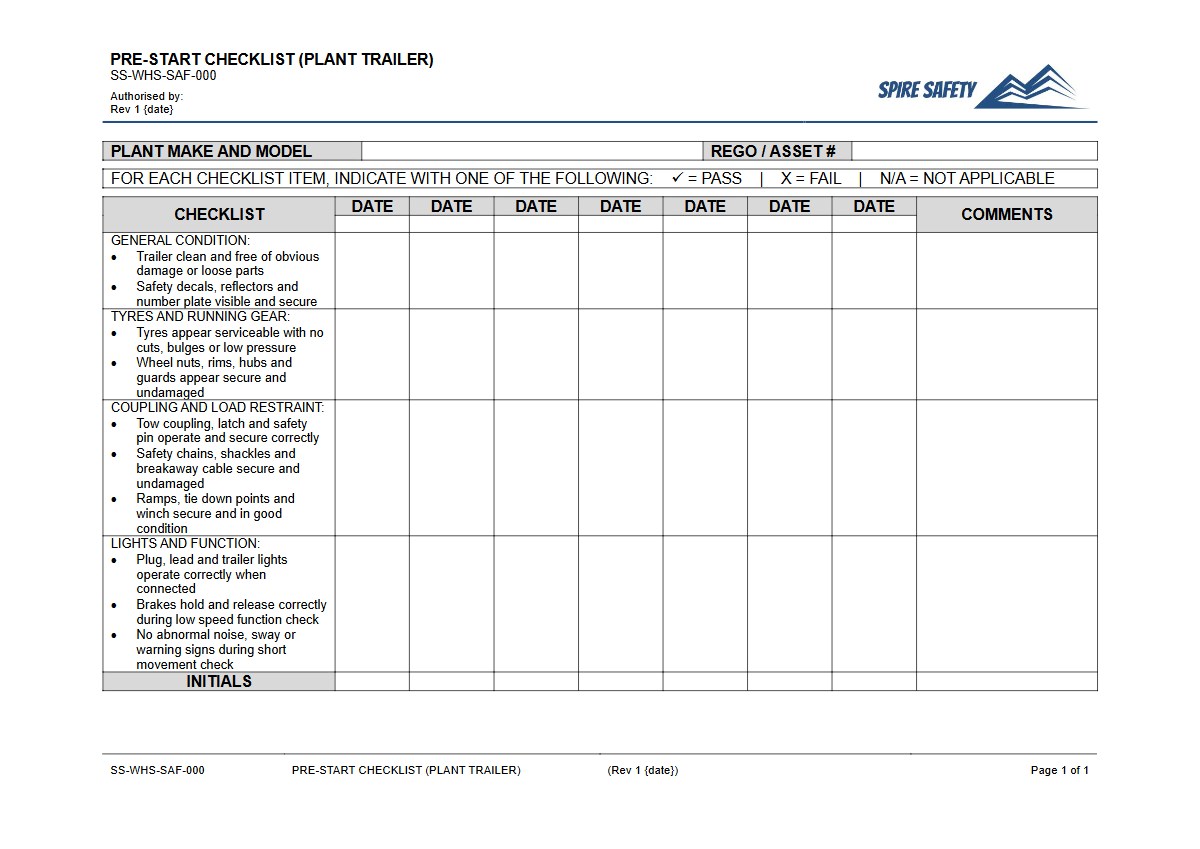
Formalise plant trailer inspections with our free Pre-Start Checklist. This template helps manage WHS risks for construction and civil works. Download it today.
Free Pre-Start Checklist (Plant Trailer) Template
DOCX • 125 KB + PDF
Updated Oct 2026
No signup required
Purpose of the Free Pre-Start Checklist (Plant Trailer) Template
Regularly inspecting plant and equipment is a fundamental requirement under Australian WHS legislation. This free Pre-Start Checklist (Plant Trailer) Template provides a structured starting point for organisations to formalise their daily safety checks.
Using a checklist ensures that key components like hitches, brakes, tyres, and lights are systematically inspected before use, significantly reducing the risk of on-site incidents, road accidents, or equipment failure. It helps a Person Conducting a Business or Undertaking (PCBU) meet their primary duty of care by providing a safe working environment and safe systems of work.
A completed checklist also serves as a critical record, demonstrating that due diligence has been followed. This documentation is essential for tracking equipment condition over time, identifying recurring maintenance issues, and providing evidence of safety procedures during an incident investigation or audit.
Integrating such checks is a key part of an overarching strategy for developing effective WHS management systems, promoting a proactive safety culture where potential hazards are identified and controlled before they can cause harm.
Video walkthrough
How to use the Free Pre-Start Checklist (Plant Trailer) Template
This template is provided in both DOCX and PDF formats for your convenience. The DOCX version is fully editable, allowing you to tailor the checklist to your specific needs.
The process is straightforward: download the file, add your company branding, and adjust the inspection items to match the make, model, and configuration of the plant trailers used in your operations. The structure is similar to our Free Pre-Start Checklist (Dump Trailer) Template, providing a consistent format for various equipment types.
It is crucial that you customise this document. No two worksites or pieces of equipment are identical.
Consider the specific hazards associated with your workplace, the tasks for which the trailer is used, and the equipment it transports, which could include items like a floor saw or other small plant. We have provided a comprehensive list of common inspection points, but you should add, remove, or modify items to ensure the checklist is entirely relevant to your context.
Once customised, the checklist should be integrated into your Safe Work Method Statement (SWMS) or daily operational procedures.
When to use it
A pre-start check should be completed before the plant trailer is used for the first time each day or at the beginning of each shift. If the trailer is used by multiple operators during a single shift, it is good practice for the incoming operator to conduct their own check to verify its condition.
This ensures continuous oversight and accountability.
The completed checklists should be collected and stored securely, either as physical copies or digital scans. These records are invaluable during a WHS compliance auditing process, as they demonstrate a consistent and documented approach to equipment safety management.
They also provide vital data for your maintenance team to schedule preventative repairs.
Who should use it
The pre-start checklist should be completed by a competent person who is trained and authorised to operate the plant trailer. This is typically the equipment operator, who has the most direct interaction with the machinery.
They are best placed to notice subtle changes in condition or performance that might indicate a developing fault.
Supervisors and managers also have a role to play. They are responsible for ensuring that operators are completing the checks correctly and diligently, not just 'pencil-whipping' the form.
They must also ensure that a clear process is in place for reporting defects and that any identified faults are rectified promptly, including taking unsafe equipment out of service until it is repaired. This template is just one of many practical tools available in our extensive free WHS resources library to support your safety initiatives.
Common mistakes
Common mistakes to avoid
- Failing to customise the generic template to match the specific make and model of the plant trailer.
- Operators 'pencil-whipping' the checklist without physically inspecting each item.
- Not having a clear procedure for reporting faults and removing defective trailers from service immediately.
- Poor record-keeping, where completed checklists are lost or not reviewed by supervisors for action.
Legal references
Legal considerations
The following legal requirements may be relevant to this type of work.
- Work Health and Safety Act (Harmonised) — Provides the primary duties for protecting workers and other people from work health and safety risks.
- Work Health and Safety Regulations (Harmonised) — Sets out requirements supporting the management of workplace hazards and risks.
The following codes may be relevant to this type of work.
- Managing WHS Risks Code of Practice — Provides practical guidance on identifying hazards, assessing risks and applying effective controls.
- Work Health and Safety Consultation, Cooperation and Coordination Code of Practice — Provides practical guidance on consulting workers and coordinating with other duty holders.
- Managing the Work Environment and Facilities Code of Practice — Provides practical guidance on safe work environments, workplace facilities and related controls.
Did you know
Towing Mass Rules
In Australia, any trailer with a Gross Trailer Mass (GTM) over 750kg must be fitted with a braking system. Trailers with a GTM over 2,000kg require a 'breakaway' system that automatically applies the brakes if the trailer detaches from the tow vehicle.
Cost of Failure
The National Road Safety Partnership Program (NRSPP) reports that heavy vehicle incidents, including those involving trailers, have a significant economic and social cost. Proactive maintenance and daily checks are among the most effective preventative measures.
FAQ
Frequently asked questions
01What should be included in a plant trailer pre-start checklist?
02How often should a plant trailer pre-start check be conducted?
03Who is responsible for completing a plant trailer pre-start checklist?
04Is this template compliant with Australian WHS laws?
Share this resource
Free Pre-Start Checklist (Plant Trailer) Template
Browse Categories
How To Use It
- 1Download and open in Word or PDF.
- 2Replace the placeholders with your business details.
- 3Get it reviewed by a WHS specialist before rollout.
Need it customised?
Our WHS consultants can adapt this template to your site, run a gap analysis, or audit what you already have in place.
Book a Free Consultation WHS consulting servicesor call 1300 156 382