
Free Pre-Start Checklist (Pole Saw) Template
Download our free Pre-Start Checklist (Pole Saw) Template in DOCX and PDF. A structured starting point for ensuring pole saw safety before each use.
Free Pre-Start Checklist (Pole Saw) Template
DOCX • 125 KB + PDF
Updated Oct 2026
No signup required
Purpose of the Free Pre-Start Checklist (Pole Saw) Template
Using a pole saw introduces significant risks, including cuts, falls, and injuries from kickback or falling branches. A systematic pre-start inspection is a critical control measure to ensure the equipment is safe to operate before any work begins.
This free Pre-Start Checklist (Pole Saw) Template provides a structured framework for operators to conduct these essential checks, helping to identify potential faults or damage that could lead to an incident. Formalising this process helps organisations demonstrate their commitment to safety and proactive risk management.
Regularly completing pre-start inspections is a fundamental aspect of maintaining a safe work environment, as it moves safety from a reactive to a proactive behaviour. To reinforce this principle with your teams, you can facilitate a discussion using our Pre-Start Checks and Plant Maintenance Toolbox Talk. Integrating this checklist into your daily routine helps create a culture where safety is prioritised and equipment integrity is consistently verified.
Video walkthrough
How to use the Free Pre-Start Checklist (Pole Saw) Template
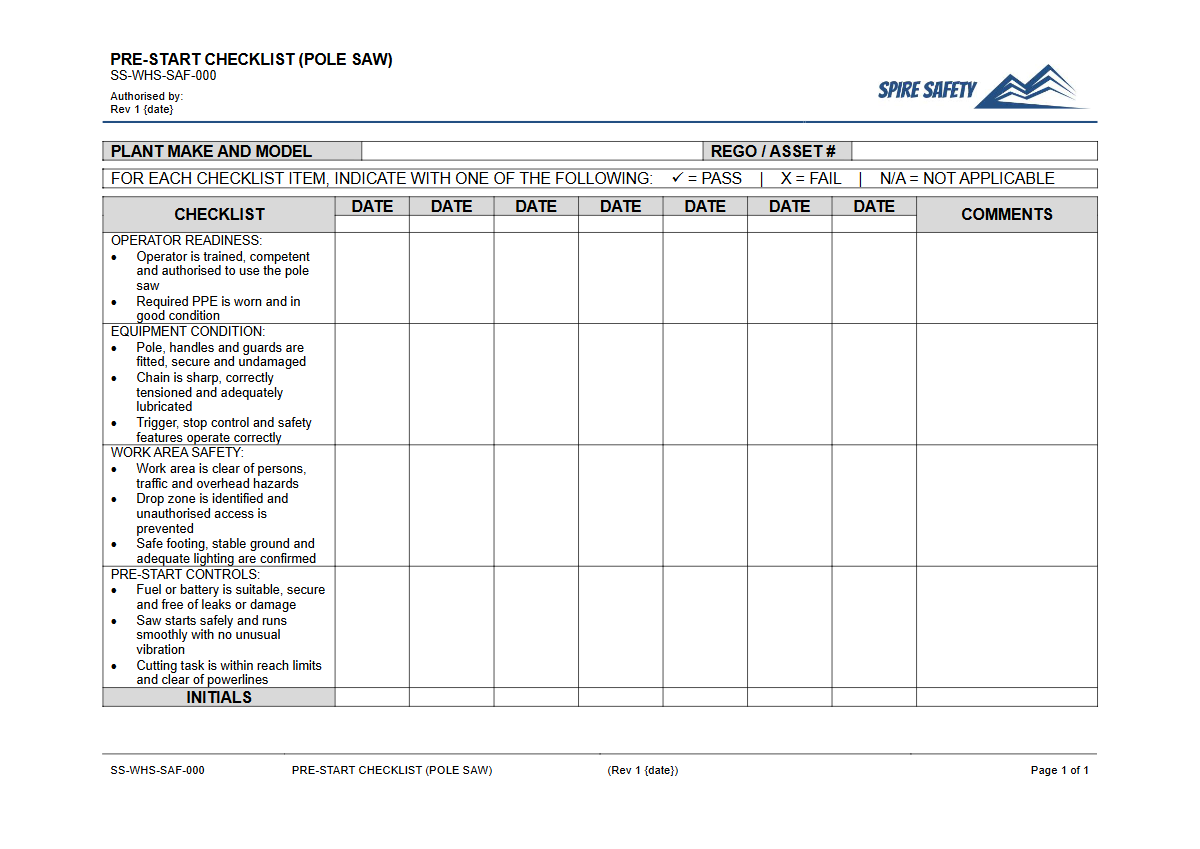
This template is provided as a DOCX file for easy customisation and a PDF for immediate use. The checklist guides the user through a logical sequence of visual and physical checks specific to a standard pole saw.
It covers critical components such as the cutting chain, guide bar, throttle trigger, safety guards, and the pole extension mechanism. There are also sections for recording operator details, date, time, and any corrective actions required.
Important: This document is a template and must be customised to your specific workplace. We recommend you add your company branding and review the checklist items to ensure they align with the specific makes and models of pole saws used by your team, your operational procedures, and the unique hazards of your work environment.
A generic document is a starting point, but an effective safety tool is one that is tailored to its specific application. A well-customised checklist becomes a valuable component within your broader WHS management systems.
When to use it
The Pre-Start Checklist for a pole saw should be completed by the operator before the first use of the equipment on every shift or day of work. If the pole saw is used by multiple operators in a single shift, each operator should perform their own pre-start check before they begin.
This consistent, high-frequency use ensures that any damage or faults that may have occurred during previous use or storage are identified before the equipment is put back into service. It's a quick process that provides a significant return on safety investment.
For many teams, this check can be integrated into the daily startup routine alongside other safety briefings. Documenting these briefings provides a record of communication, which can be done using a dedicated Pre-Start Meeting Template. The goal is to make the pre-start check a non-negotiable habit for all operators.
Who should use it
This checklist is designed for use by any worker or contractor tasked with operating a pole saw, regardless of their experience level. It empowers the operator to take direct responsibility for their own safety and the safety of those around them.
By signing off on the checklist, the operator confirms that they have inspected the equipment and found it to be in a safe condition for use.
Supervisors, team leaders, and managers also have a role to play. They are responsible for ensuring that operators are trained to use the checklist correctly, that the checks are being completed diligently, and that any reported faults are addressed in a timely manner.
The completed checklists serve as important safety records, providing evidence of due diligence and a paper trail for maintenance. These records are often a key focus during WHS compliance auditing to verify that safety procedures are being followed as required.
By implementing a robust pre-start inspection process, your organisation can significantly reduce the risk of equipment-related incidents and foster a stronger safety culture. For more tools to support your WHS framework, explore our complete free WHS resources library.
Common mistakes
Common mistakes to avoid
- Skipping the check entirely to 'save time', creating significant unmanaged risk.
- Using a generic checklist that doesn't match the specific model of pole saw being used.
- Failing to report or follow up on minor faults found during the inspection, which can develop into major failures.
- 'Pencil-whipping' the form – ticking boxes without physically inspecting the components.
Legal references
Legal considerations
The following legal requirements may be relevant to this type of work.
- Work Health and Safety Act (Harmonised) — Provides the primary duties for protecting workers and other people from work health and safety risks.
- Work Health and Safety Regulations (Harmonised) — Sets out requirements supporting the management of workplace hazards and risks.
The following codes may be relevant to this type of work.
- Managing WHS Risks Code of Practice — Provides practical guidance on identifying hazards, assessing risks and applying effective controls.
- Work Health and Safety Consultation, Cooperation and Coordination Code of Practice — Provides practical guidance on consulting workers and coordinating with other duty holders.
- Managing the Work Environment and Facilities Code of Practice — Provides practical guidance on safe work environments, workplace facilities and related controls.
Did you know
Kickback Risk
Rotational kickback, where the tip of the guide bar hits an object and causes the saw to pivot rapidly back towards the operator, is one of the most common causes of serious chainsaw-related injuries.
Vibration Exposure
Prolonged use of powered equipment like pole saws can lead to Hand-Arm Vibration Syndrome (HAVS). Regular maintenance and using anti-vibration gloves can help mitigate this long-term health risk.
FAQ
Frequently asked questions
01What should a pre-start check for a pole saw include?
02Why is it important to document pre-start checks?
03How often should a pole saw pre-start check be conducted?
04Can this template be used for other types of chainsaws?
Share this resource
Free Pre-Start Checklist (Pole Saw) Template
Browse Categories
How To Use It
- 1Download and open in Word or PDF.
- 2Replace the placeholders with your business details.
- 3Get it reviewed by a WHS specialist before rollout.
Need it customised?
Our WHS consultants can adapt this template to your site, run a gap analysis, or audit what you already have in place.
Book a Free Consultation WHS consulting servicesor call 1300 156 382