
Free Pre-Start Checklist (Pool Pump) Template
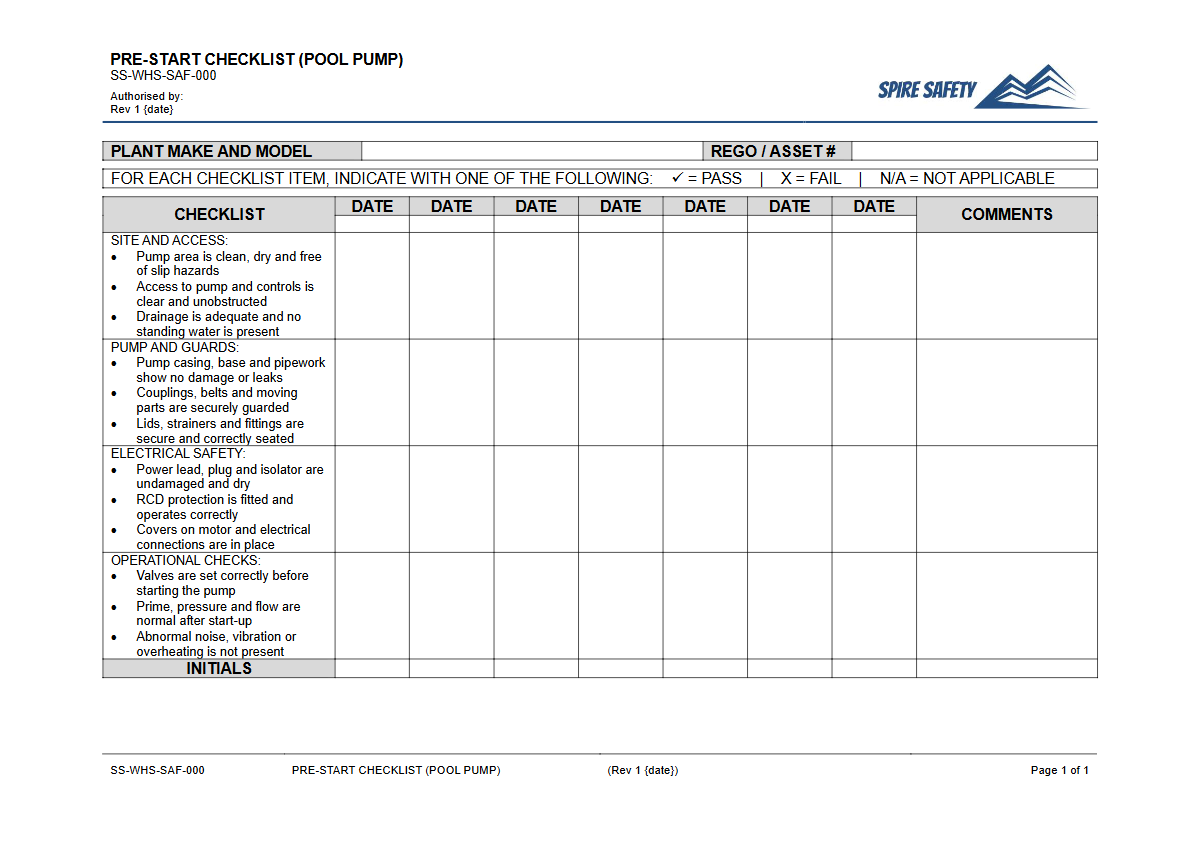
Formalise your pool pump safety inspections. Download our Free Pre-Start Checklist (Pool Pump) Template to identify and control hazards before use.
Free Pre-Start Checklist (Pool Pump) Template
DOCX • 125 KB + PDF
Updated Oct 2026
No signup required
Purpose of the Free Pre-Start Checklist (Pool Pump) Template
Regularly inspecting pool pumps before use is a critical safety measure in any commercial or public aquatic facility. Pool pumps operate at the nexus of water and electricity, creating significant inherent risks.
This Free Pre-Start Checklist (Pool Pump) Template provides a structured framework for operators to systematically identify potential hazards before they escalate into incidents involving electric shock, mechanical failure, or water damage.
Using a formal checklist helps standardise safety procedures, ensuring that no step is missed. It prompts the user to check for electrical integrity, signs of water leaks, structural damage, secure guards, and correct operational parameters.
This proactive approach not only protects workers and the public but also contributes to the longevity of the equipment by catching minor issues early. Formalising this process is a key step in managing workplace hazards, which should be informed by a comprehensive risk assessment.
For guidance on this initial process, you may find our Free Water Pump Risk Assessment Template a useful starting point.
Key Safety Checks
- Electrical Components: Inspecting cords, plugs, and control boxes for damage, wear, or exposure to water.
- Mechanical Integrity: Checking for cracks in the housing, secure bolts, and intact guards over moving parts.
- Leak Detection: Looking for drips or pooling water around the pump seals, housing, and connections.
- Operational Function: Listening for unusual noises (grinding, whining) and checking pressure gauges for correct readings.
- Surrounding Area: Ensuring the area is clear, free of slip hazards, and has adequate ventilation.
Video walkthrough
How to use the Free Pre-Start Checklist (Pool Pump) Template
This template is designed as a starting point to be adapted for your specific operational needs. Begin by downloading the document in your preferred format (DOCX for easy editing or PDF).
The checklist should then be customised to reflect the specific make and model of the pool pumps used at your facility, as well as any unique environmental or operational factors.
Once customised, the checklist should be integrated into your daily workflow. It should be used in conjunction with broader safety documentation, such as a formal Safe Operating Procedure.
If you don't have one, our FREE Pump SOP (Safe Operating Procedure) Template can help you outline the entire process for safe pump operation, from startup to shutdown.
Important Note: This document is a template only. To be effective, you must customise it to suit the specific equipment, tasks, and environment of your workplace.
We recommend a Person Conducting a Business or Undertaking (PCBU) consults with operators and relevant stakeholders during this customisation process.
When to use it
A pre-start checklist for a pool pump should be completed at the beginning of every shift or before the first use of the day. This frequency ensures that the equipment's condition is verified before it is put into operation, minimising the risk of failure during use.
If a pump is used intermittently, a check should be performed before each startup.
Completed checklists serve as a vital record of your organisation's safety diligence. They should be filed and stored according to your record-keeping policies.
These records are invaluable during safety audits and incident investigations. Reinforcing this routine can be achieved through regular training sessions, such as a brief workplace meeting using a Pre-Start Checks and Plant Maintenance Toolbox Talk to highlight its importance.
Who should use it
The pre-start checklist should be completed by a person who is trained, competent, and authorised to operate the specific pool pump. This is typically an aquatic facility operator, a maintenance technician, or a designated groundskeeper.
The operator must have sufficient knowledge to recognise the hazards listed on the checklist and understand the appropriate actions to take if a fault is identified.
Supervisors and managers also have a role. They are responsible for ensuring that the pre-start checks are being completed correctly and consistently.
They must also ensure that workers are adequately trained in both the pump's operation and the checklist procedure. Running targeted safety refreshers, like a Pool and Aquatic Safety Toolbox Talk template, helps maintain this competency across the team. This process of training, documentation, and verification is a cornerstone of effective WHS management systems.
Ultimately, a documented safety process helps an organisation demonstrate its commitment to safety and due diligence. Regular reviews of completed checklists can highlight recurring issues, informing maintenance schedules and providing evidence of proactive safety management during a WHS compliance auditing process.
If you need help developing or reviewing your safety documentation, Spire Safety's consultants are here to assist.
Common mistakes
Common mistakes to avoid
- Ignoring minor leaks, which can indicate failing seals and lead to major electrical or water damage.
- Failing to check the full length of the pump's electrical cord and connections for wear or damage.
- Not documenting the check or signing off, creating gaps in maintenance and safety records.
- "Pencil-whipping" the checklist without physically and thoroughly inspecting each item on the pump.
Legal references
Legal considerations
The following legal requirements may be relevant to this type of work.
- Work Health and Safety Act (Harmonised) — Provides the primary duties for protecting workers and other people from work health and safety risks.
- Work Health and Safety Regulations (Harmonised) — Sets out requirements supporting the management of workplace hazards and risks.
The following codes may be relevant to this type of work.
- Managing WHS Risks Code of Practice — Provides practical guidance on identifying hazards, assessing risks and applying effective controls.
- Work Health and Safety Consultation, Cooperation and Coordination Code of Practice — Provides practical guidance on consulting workers and coordinating with other duty holders.
- Managing the Work Environment and Facilities Code of Practice — Provides practical guidance on safe work environments, workplace facilities and related controls.
Did you know
Electrical Risk
Pool pumps combine electricity and water, making them a significant electrical hazard. Most incidents are preventable with proper installation, maintenance, and routine safety checks like a pre-start.
Cavitation Damage
A primary cause of premature pump failure is cavitation, often caused by blocked suction lines or clogged filters. A pre-start check helps identify these blockages before they cause costly internal damage to the pump.
FAQ
Frequently asked questions
01What specific hazards does a pool pump pre-start check identify?
02Is a digital pre-start checklist better than a paper one?
03How often should a pool pump be inspected?
04What should a worker do if a fault is found during a pre-start check?
Share this resource
Free Pre-Start Checklist (Pool Pump) Template
Browse Categories
How To Use It
- 1Download and open in Word or PDF.
- 2Replace the placeholders with your business details.
- 3Get it reviewed by a WHS specialist before rollout.
Need it customised?
Our WHS consultants can adapt this template to your site, run a gap analysis, or audit what you already have in place.
Book a Free Consultation WHS consulting servicesor call 1300 156 382