
Free Pre-Start Checklist (Portal Crane) Template
Download our Free Pre-Start Checklist (Portal Crane) Template (DOCX/PDF).
Free Pre-Start Checklist (Portal Crane) Template
DOCX • 125 KB + PDF
Updated Oct 2026
No signup required
Purpose of the Free Pre-Start Checklist (Portal Crane) Template
A thorough pre-start inspection is a critical safety procedure for any high-risk plant. This Free Pre-Start Checklist (Portal Crane) Template provides a structured format for operators to follow before commencing work, ensuring the crane is safe to use.
Consistent use of a checklist helps identify potential faults, prevent equipment failure, and reduce the risk of incidents that could cause serious injury or damage. Formalising this process demonstrates a commitment to workplace safety and helps a Person Conducting a Business or Undertaking (PCBU) meet their primary duty of care.
This document serves as a practical tool to integrate into your daily operational safety procedures. It encourages a systematic inspection of key components, including structural elements, hoisting mechanisms, electrical systems, and safety devices.
Documenting these checks creates a valuable record for safety audits and maintenance planning. You can reinforce these principles with regular team meetings using our Crane and Lifting Operations Safety Toolbox Talk Template to keep safety front of mind.
Video walkthrough
How to use the Free Pre-Start Checklist (Portal Crane) Template
This checklist is available for immediate download in both DOCX and PDF formats. The DOCX version is fully editable, allowing you to tailor it to your specific workplace requirements.
The PDF version is ideal for quick printing and immediate use.
Important: This is a template, not a finished document. To be effective, you must customise it.
We recommend you review and adapt the checklist to align with the specific make and model of your portal crane, the unique environmental conditions of your site (e.g., outdoor, marine), and the types of loads being handled. Effective safety documentation is a key component of robust WHS management systems, which provide a framework for managing risks across your entire organisation.
When to use it
The Portal Crane Pre-Start Checklist should be completed by a competent operator before the start of every shift or before the crane is used for the first time on a given day. It is a daily check designed to catch issues that may have developed overnight or during previous use.
This routine does not replace the need for scheduled periodic maintenance or major inspections, which must be carried out by a competent person according to manufacturer specifications and Australian Standards. Using this checklist consistently complements your broader maintenance strategy, a topic covered in our Pre-Start Checks and Plant Maintenance Toolbox Talk.
Who should use it
This checklist should be completed by the crane operator or another worker who is trained and competent in the operation of the specific portal crane. Competency means they have the necessary knowledge and skill, gained through training, qualification, and experience, to perform the task safely.
This includes understanding what each checklist item refers to and how to identify a potential defect or hazard. For certain roles, you may need a formal process to confirm these skills, similar to our Verification of Competency for overhead bridge cranes.
Supervisors and managers should also be familiar with the checklist's content to ensure it is being completed correctly and that any reported defects are actioned promptly. A checklist is only effective if it is part of a closed-loop system where issues are reported, tracked, and rectified.
Integrating these checks with other operational documents, such as a Safe Work Method Statement for vehicle loading crane operation, creates a more comprehensive safety approach for all lifting activities.
What the template covers
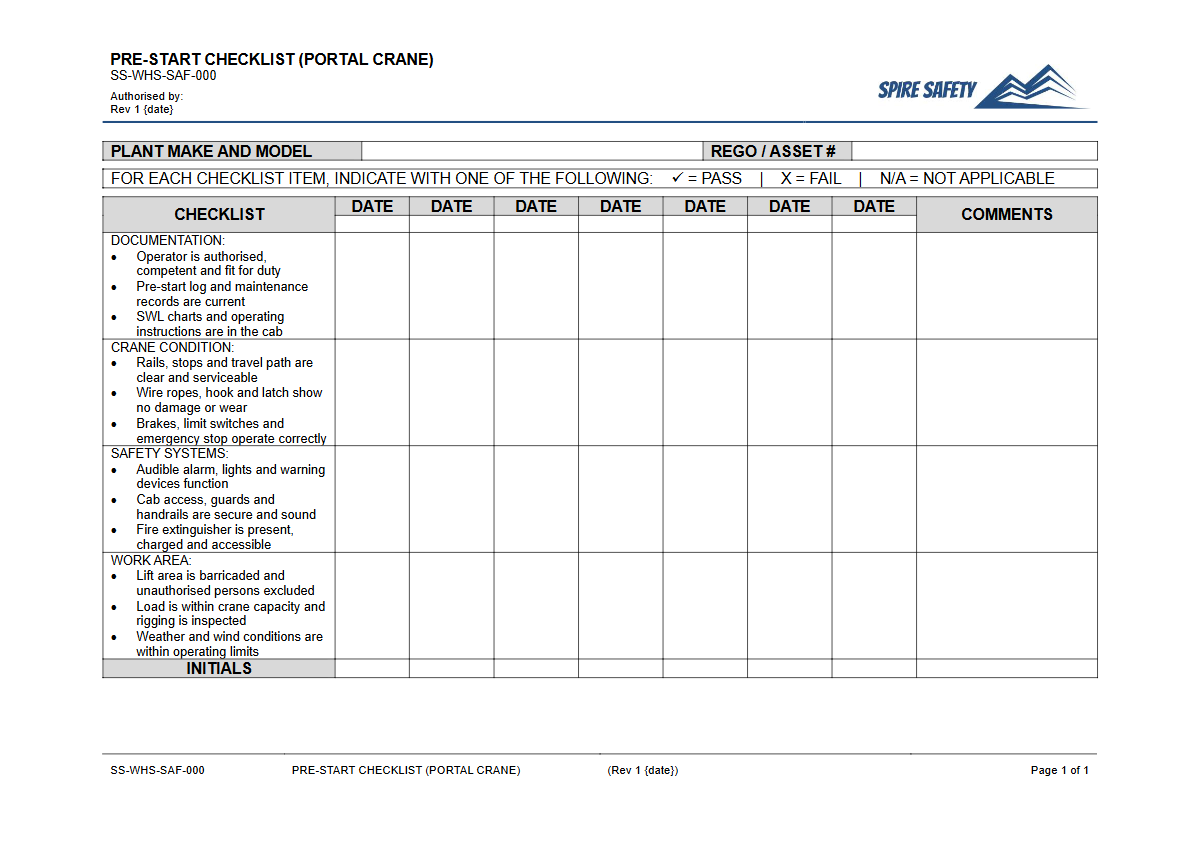
This template provides a starting point for inspecting key areas of a portal crane, including:
- Structural Components: Checks for damage or corrosion on the gantry, legs, beams, and rails.
- Mechanical Systems: Inspection of the hoist, trolley, wire ropes, hooks, and braking systems.
- Electrical Components: Verification of power supply, control pendants, emergency stops, and warning devices.
- General Safety: Checks for clear travel paths, correct signage, and the availability of operator manuals.
These checks help ensure the equipment is in sound condition before a lift is ever attempted. The effectiveness of these procedures can be periodically reviewed during internal or external WHS compliance audits. For more ready-to-use documents, explore our complete free WHS resources library.
Common mistakes
Common mistakes to avoid
- "Pencil-whipping" the form without physically inspecting the crane.
- Using a generic checklist not customised for the specific crane model and site conditions.
- Failing to report identified defects or remove the crane from service until it is repaired.
- The operator not being adequately trained to understand what they are looking for during the inspection.
Legal references
Legal considerations
The following legal requirements may be relevant to this type of work.
- Work Health and Safety Act (Harmonised) — Provides the primary duties for protecting workers and other people from work health and safety risks.
- Work Health and Safety Regulations (Harmonised) — Sets out requirements supporting the management of workplace hazards and risks.
The following codes may be relevant to this type of work.
- Managing WHS Risks Code of Practice — Provides practical guidance on identifying hazards, assessing risks and applying effective controls.
- Work Health and Safety Consultation, Cooperation and Coordination Code of Practice — Provides practical guidance on consulting workers and coordinating with other duty holders.
- Managing the Work Environment and Facilities Code of Practice — Provides practical guidance on safe work environments, workplace facilities and related controls.
Did you know
A Proactive Approach
According to Safe Work Australia data on crane incidents, a significant number are caused by mechanical failure or improper setup. Many of these issues could be identified and rectified through a diligent pre-start inspection.
Scale and Power
Portal cranes are essential in industries like shipping and manufacturing, with some of the largest 'goliath' cranes used in shipyards capable of lifting over 2,000 tonnes—the weight of more than 1,000 cars.
FAQ
Frequently asked questions
01Is a portal crane pre-start checklist a legal requirement in Australia?
02What is the difference between a portal crane and a gantry crane?
03How often should a portal crane be inspected?
04Can I use this template for a tower crane or mobile crane?
Share this resource
Free Pre-Start Checklist (Portal Crane) Template
Browse Categories
How To Use It
- 1Download and open in Word or PDF.
- 2Replace the placeholders with your business details.
- 3Get it reviewed by a WHS specialist before rollout.
Need it customised?
Our WHS consultants can adapt this template to your site, run a gap analysis, or audit what you already have in place.
Book a Free Consultation WHS consulting servicesor call 1300 156 382