
Free Pre-Start Checklist (Post Hole Dig) Template
Download our free Pre-Start Checklist (Post Hole Dig) Template.
Free Pre-Start Checklist (Post Hole Dig) Template
DOCX • 125 KB + PDF
Updated Oct 2026
No signup required
Purpose of the Free Pre-Start Checklist (Post Hole Dig) Template
Operating a post hole digger or auger introduces significant workplace hazards, including entanglement with the rotating auger, unexpected kickback, and the severe risk of striking underground services like gas lines, water pipes, or electrical cables. A systematic inspection before each use is a critical control measure to ensure the equipment is safe to operate.
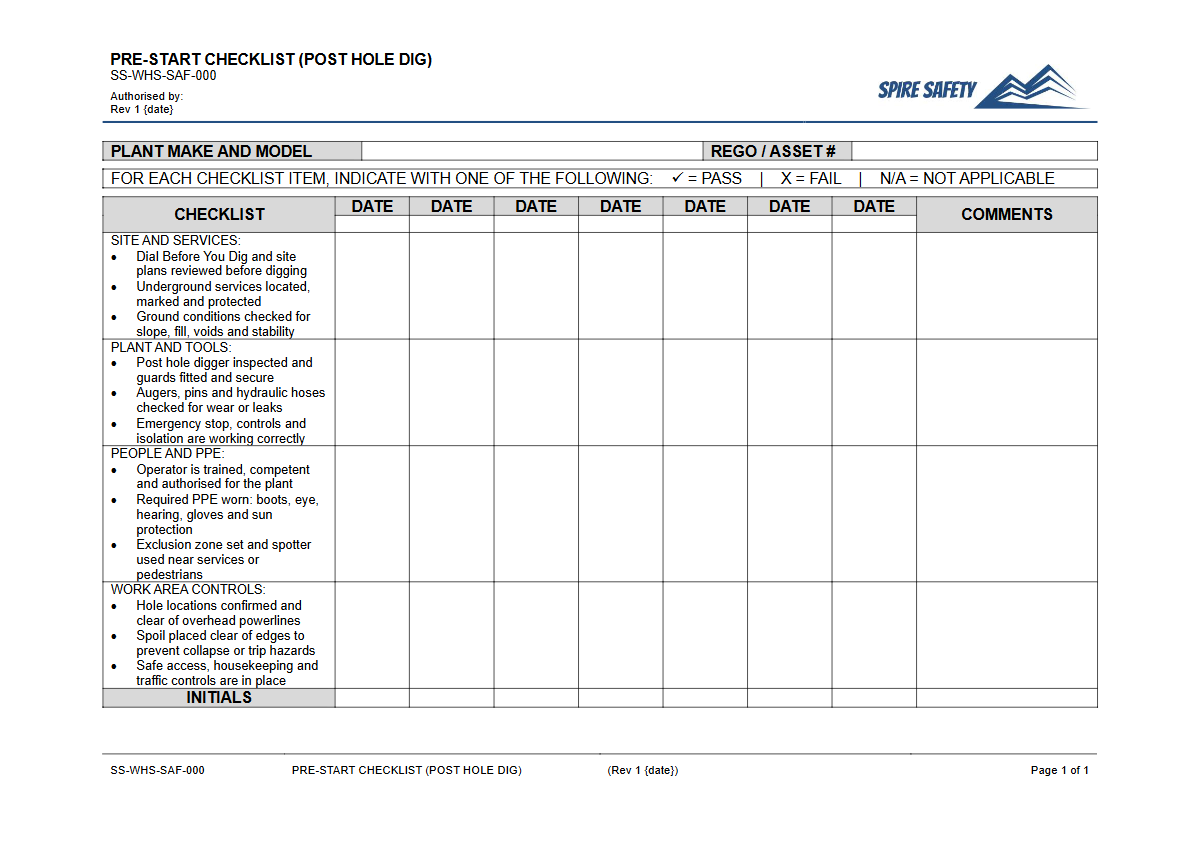
This free Pre-Start Checklist (Post Hole Dig) Template provides a structured starting point for organisations to formalise these essential safety checks.
Using a documented checklist helps operators verify that all safety features are in place and functioning correctly. It forms a key part of your safety management system, demonstrating due diligence and helping your organisation meet its primary duty of care under Australian WHS legislation.
It creates a consistent process for identifying mechanical faults, damage, or missing guards before they can lead to an incident. A well-maintained checklist also serves as a valuable record for maintenance scheduling and incident investigations.
Video walkthrough
How to use the Free Pre-Start Checklist (Post Hole Dig) Template
This resource is available as a DOCX file for easy customisation and a PDF for immediate use. The checklist is designed to be straightforward, allowing operators to quickly and efficiently work through the inspection items.
To get the most out of this template, download the DOCX version and modify it to reflect the specific make and model of your post hole digger, your site-specific hazards, and any unique company procedures.
Important: It is crucial that you customise this template for your specific workplace. We've provided a solid foundation based on common safety principles, but you must adapt it to the equipment and operational risks present at your site.
A generic checklist that doesn't match your equipment is not effective. This document should also be used in conjunction with a formal process for assessing operator skills, such as a Verification of Competency for post hole diggers, to ensure operators are not only using safe equipment but are also trained to use it correctly.
Key Items on the Checklist
While you should add your own site-specific items, a thorough post hole digger pre-start should generally include checks for:
- Guards & Shields: All guards, especially around the auger, power take-off (PTO) shafts, and engine components, are secure and undamaged.
- Controls: Levers, switches, and emergency stops are clearly labelled, accessible, and function correctly. The 'dead man' switch or operator presence control works as intended.
- Auger & Cutting Head: The auger is free from cracks or damage, cutting teeth are sharp and secure, and the locking pin is in place.
- Structural Integrity: The frame, handles, and connection points are free from cracks, bends, or excessive wear.
- Fluid Levels: Engine oil, hydraulic fluid, and fuel are at correct levels, with no signs of leaks.
- Work Area: The ground is stable, and the area is clear of personnel and obstacles. Most importantly, underground services have been identified and marked.
When to use the Pre-Start Checklist
The pre-start inspection must be completed before the post hole digger is used for the first time each day or at the beginning of every shift. If the equipment has been idle for an extended period or has been transported to a new location, another check should be performed.
The goal is to make this inspection a non-negotiable routine for every operator, embedding it as a standard part of the job. Reinforcing this behaviour can be achieved with regular training, such as a pre-start checks and plant maintenance toolbox talk.
Who should use the Pre-Start Checklist
The checklist is primarily for the equipment operator. They are the person most at risk and have the most immediate control over the equipment.
Supervisors also have a critical role; they must ensure that operators are diligently completing the checks and that procedures are in place to address any reported defects. This shared responsibility helps foster a proactive safety culture and ensures that checks are not just a paper-filling exercise.
Integrating this process into comprehensive WHS management systems ensures accountability and continuous improvement.
What happens if a defect is found?
Identifying a defect is the first step; taking action is the most important. If any item on the checklist fails, the operator must not use the equipment.
The machine should be immediately removed from service using a 'Do Not Operate' tag or a lock-out procedure. The defect must be reported to a supervisor or the responsible maintenance person according to your organisation's fault-reporting process.
The equipment must not be used again until it has been inspected, repaired by a competent person, and cleared for service. Documenting these steps is vital for demonstrating procedural integrity during a WHS compliance auditing process.
This checklist is one of many tools designed to help you build a safer workplace. For more templates, toolbox talks, and forms, browse our complete free WHS resources library.
Common mistakes
Common mistakes to avoid
- Failing to confirm the location of underground services before starting to dig.
- Using a generic checklist that hasn't been customised for the specific equipment model.
- Pencil-whipping the checklist without physically inspecting the items.
- Continuing to use the equipment after a fault has been identified, even for 'one last job'.
Legal references
Legal considerations
The following legal requirements may be relevant to this type of work.
- Work Health and Safety Act (Harmonised) — Provides the primary duties for protecting workers and other people from work health and safety risks.
- Work Health and Safety Regulations (Harmonised) — Sets out requirements supporting the management of workplace hazards and risks.
The following codes may be relevant to this type of work.
- Managing WHS Risks Code of Practice — Provides practical guidance on identifying hazards, assessing risks and applying effective controls.
- Work Health and Safety Consultation, Cooperation and Coordination Code of Practice — Provides practical guidance on consulting workers and coordinating with other duty holders.
- Managing the Work Environment and Facilities Code of Practice — Provides practical guidance on safe work environments, workplace facilities and related controls.
Did you know
Dial Before You Dig
In Australia, the Dial Before You Dig (DBYD) service is a free national referral service that provides information on the location of underground infrastructure. Failing to check for underground services is a leading cause of serious incidents during excavation work.
FAQ
Frequently asked questions
01What are the main hazards of using a post hole digger?
02Is a pre-start checklist legally required for a post hole digger in Australia?
03How often should a post hole digger pre-start check be done?
04Can I use this template for different types of post hole diggers and augers?
Share this resource
Free Pre-Start Checklist (Post Hole Dig) Template
Browse Categories
How To Use It
- 1Download and open in Word or PDF.
- 2Replace the placeholders with your business details.
- 3Get it reviewed by a WHS specialist before rollout.
Need it customised?
Our WHS consultants can adapt this template to your site, run a gap analysis, or audit what you already have in place.
Book a Free Consultation WHS consulting servicesor call 1300 156 382