
Free Pre-Start Checklist (Power Hacksaw) Template
Download our Free Pre-Start Checklist (Power Hacksaw) Template to improve workshop safety and formalise equipment inspections. Get your DOCX and PDF now.
Free Pre-Start Checklist (Power Hacksaw) Template
DOCX • 125 KB + PDF
Updated Oct 2026
No signup required
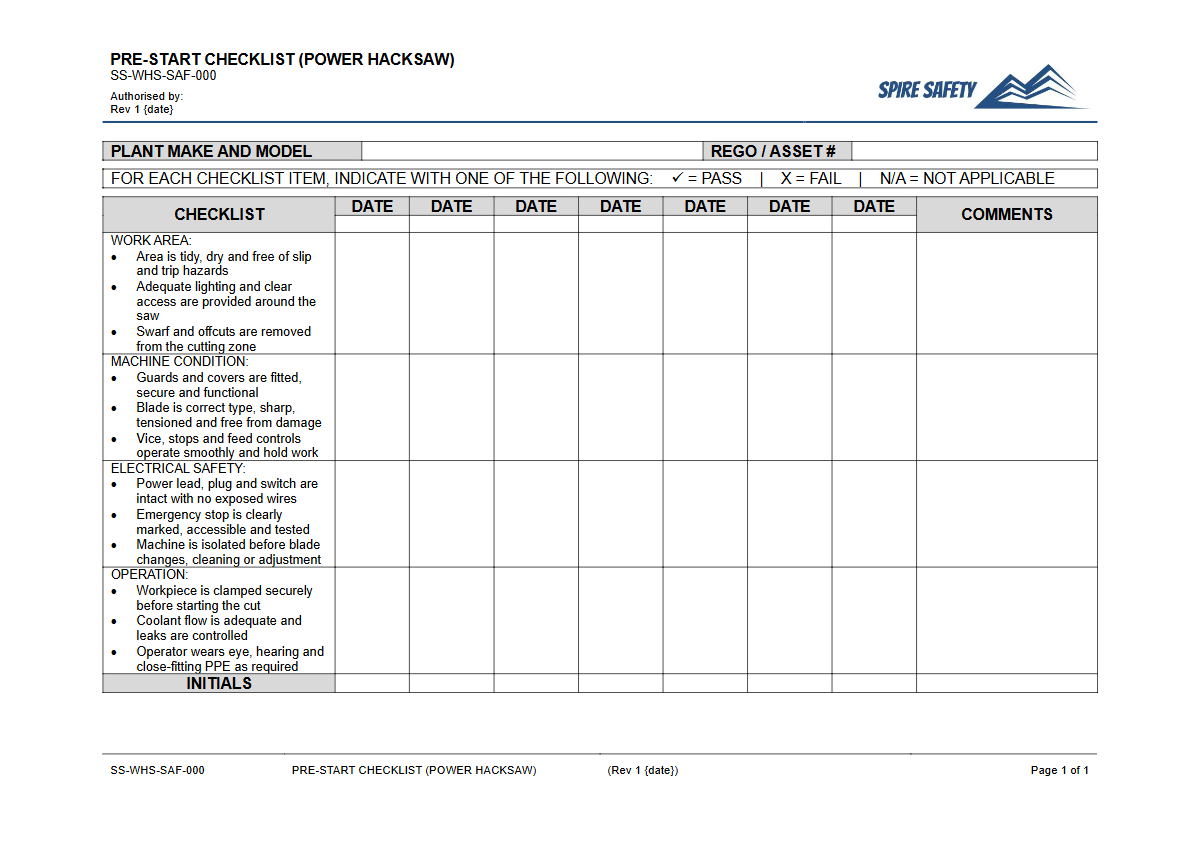
Purpose of the Free Pre-start Checklist (Power Hacksaw) Template
A power hacksaw is a fundamental tool in many workshops, but its moving parts, sharp blade, and powerful motor present significant WHS risks if not properly managed. This Free Pre-Start Checklist (Power Hacksaw) Template provides a structured starting point for operators to conduct thorough, documented inspections before use.
Systematically checking key components helps identify and control hazards like blade failure, entanglement, electrical faults, and inadequate guarding. Formalising this process is a key part of any effective plant and equipment safety program, demonstrating due diligence and fostering a proactive safety culture.
It transforms a routine inspection into a recordable safety action, which is essential for ongoing risk management.
Integrating these checks into your daily routine is a practical step towards preventing incidents. For broader training on this topic, our Power Tool Safety Toolbox Talk Template provides excellent supplementary material for your team meetings.
Consistent use of a pre-start checklist ensures that machinery is in safe working order before any task commences, protecting both the operator and others in the vicinity.
Video walkthrough
How to use the Free Pre-Start Checklist (Power Hacksaw) Template
Using this template effectively involves more than just downloading and printing. It requires integration into your existing safety procedures.
Start by downloading the DOCX file and adapting it to the specific models of power hacksaws used in your facility. The checklist is divided into logical sections covering critical components, from the blade and drive mechanism to guards and emergency stops.
The operator should physically inspect each item listed, marking it as satisfactory or identifying a fault. Any identified defects must be reported immediately through the channels defined in your organisation's safety procedures, and the equipment should be tagged out of service until it is repaired by a competent person.
Completed checklists should be filed as a record of your safety activities, which can be invaluable during safety reviews or audits. If you need assistance integrating this process into your broader safety framework, consider how it fits within your overall WHS management systems. This ensures a cohesive approach to workplace safety rather than isolated compliance activities.
Important Customisation Note
This document is a template and is not a complete, out-of-the-box solution. You must customise it to reflect the specific power hacksaw models, configurations, tasks, and unique risks present in your workplace.
We strongly recommend a consultation with operators, supervisors, and maintenance personnel during this customisation process to ensure all relevant checks are included.
When to use this Pre-Start Checklist
A pre-start checklist for a power hacksaw should be completed before every shift or before the first use of the day. If an operator changes during a shift, the incoming operator should also conduct their own pre-start check to verify the machine's condition.
The check should become a non-negotiable step before powering on the equipment. This routine is similar to processes for other machinery, such as those covered in our Free Pre-Start Checklist (CNC Router) Template, where consistency is key to preventing incidents.
Additional checks may also be warranted after maintenance or repairs have been carried out.
Who should use this Checklist
This checklist is designed to be used by trained and competent operators who are authorised to use the power hacksaw. The person conducting the check must have a thorough understanding of the machine's operation and its potential hazards.
Supervisors should also be familiar with the checklist to ensure they can effectively oversee its use and verify that inspections are being completed correctly. Verifying operator skill is a crucial part of the process.
While this checklist confirms equipment readiness, competency is confirmed through other means, such as a Verification of Competency (Pipe Threader) Template which can be adapted for various tools.
Ultimately, a robust safety system relies on both safe equipment and safe people. To ensure your processes are effective and aligned with regulatory expectations, periodic reviews are essential.
Engaging professional services for a WHS compliance auditing can provide valuable third-party insight into the health of your safety systems. These audits help identify gaps and opportunities for improvement across all your WHS activities, including your pre-start inspection program.
This document is just one example of the many tools available. For more templates covering a wide range of tasks and equipment, browse our complete free WHS resources library.
Common mistakes
Common mistakes to avoid
- Failing to physically check items and just 'ticking and flicking' the form.
- Using a generic checklist that doesn't cover the specific model of power hacksaw in use.
- Neglecting to report minor faults, which can escalate into major safety hazards.
- Not isolating the power source before physically inspecting the blade or drive mechanism.
Legal references
Legal considerations
The following legal requirements may be relevant to this type of work.
- Work Health and Safety Act (Harmonised) — Provides the primary duties for protecting workers and other people from work health and safety risks.
- Work Health and Safety Regulations (Harmonised) — Sets out requirements supporting the management of workplace hazards and risks.
The following codes may be relevant to this type of work.
- Managing WHS Risks Code of Practice — Provides practical guidance on identifying hazards, assessing risks and applying effective controls.
- Work Health and Safety Consultation, Cooperation and Coordination Code of Practice — Provides practical guidance on consulting workers and coordinating with other duty holders.
- Managing the Work Environment and Facilities Code of Practice — Provides practical guidance on safe work environments, workplace facilities and related controls.
Did you know
Machine Guarding
According to Safe Work Australia, contact with moving parts of machinery is a leading cause of serious injury. Properly fitted and maintained guards are the most effective way to prevent contact with blades, gears, and drive belts on equipment like power hacksaws.
FAQ
Frequently asked questions
01What are the most critical safety checks for a power hacksaw?
02What should an operator do if a fault is found during a pre-start check?
03How often should a power hacksaw pre-start check be performed?
04Is a pre-start checklist a legal requirement in Australia?
Share this resource
Free Pre-Start Checklist (Power Hacksaw) Template
Browse Categories
How To Use It
- 1Download and open in Word or PDF.
- 2Replace the placeholders with your business details.
- 3Get it reviewed by a WHS specialist before rollout.
Need it customised?
Our WHS consultants can adapt this template to your site, run a gap analysis, or audit what you already have in place.
Book a Free Consultation WHS consulting servicesor call 1300 156 382