
Free Pre-Start Checklist (Power Trowel) Template
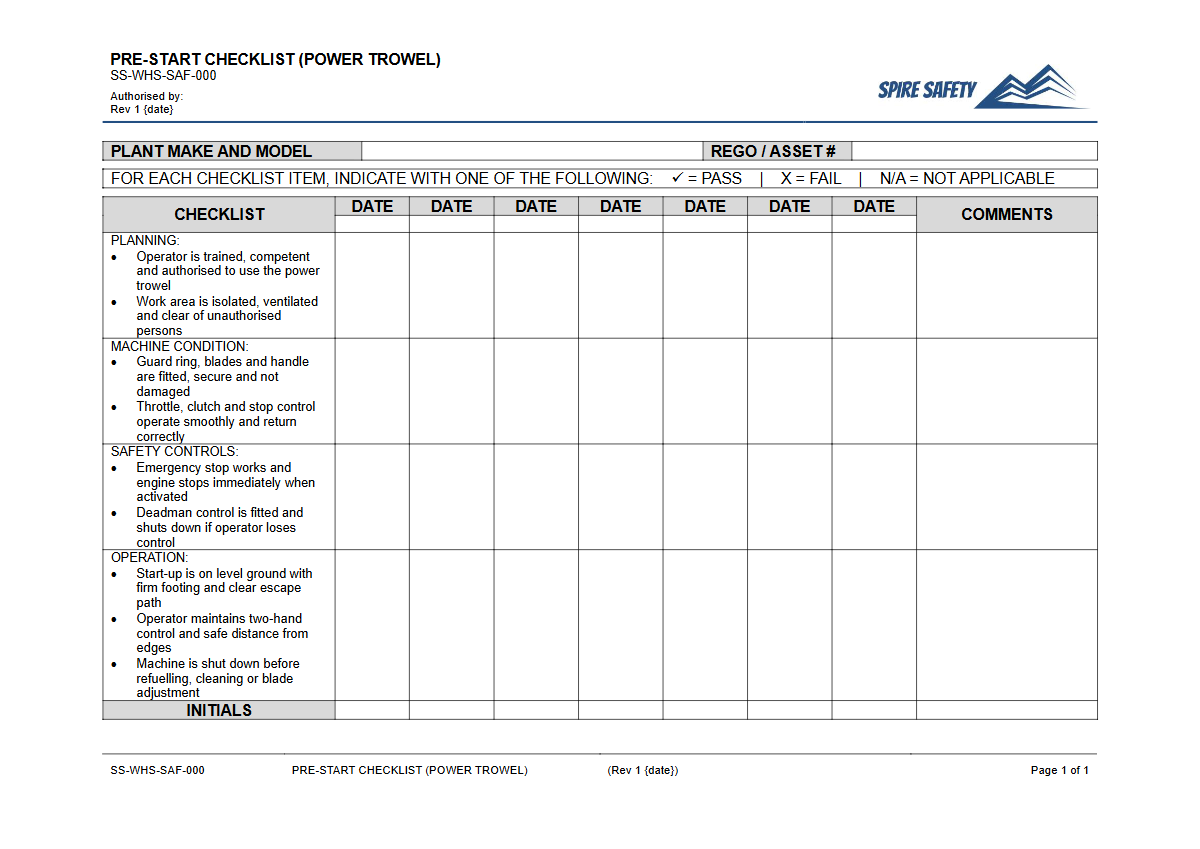
Download our free Pre-Start Checklist for Power Trowels. This template helps formalise equipment safety checks and identify hazards.
Free Pre-Start Checklist (Power Trowel) Template
DOCX • 125 KB + PDF
Updated Oct 2026
No signup required
Purpose of the Free Pre-Start Checklist (Power Trowel) Template
Operating a power trowel, also known as a concrete helicopter or power float, involves significant risks if the equipment is not properly maintained. Our free Pre-Start Checklist (Power Trowel) Template provides a structured framework for operators to conduct thorough safety inspections before each use.
Systematically performing these checks helps identify potential mechanical faults, damage, or missing safety features, reducing the risk of incidents, injuries, and equipment failure. This document serves as a critical tool for reinforcing a proactive safety culture and ensuring that machinery is fit for purpose.
Formalising this process creates a consistent record of equipment condition, which is a key component of effective plant management. Regular inspections help organisations meet their duty of care obligations under Australian WHS legislation by taking reasonably practicable steps to ensure worker safety. It also supports operator training and reinforces key safety messages, which can be further strengthened with a specific power tool safety toolbox talk.
Video walkthrough
How to use the Free Pre-Start Checklist (Power Trowel) Template
This template is designed as a starting point, providing a comprehensive list of common inspection points for power trowels. To use it effectively, download the DOCX file and adapt it to your specific operational needs.
This customisation is essential for ensuring all relevant hazards are controlled.
Key steps for implementation include:
- Customise the Checklist: Add or remove items to match the specific make and model of your power trowel. Consider your site-specific conditions, such as indoor vs. outdoor use, and any unique environmental hazards. We strongly recommend that you customise this template to suit your organisation's specific needs.
- Train Your Workers: Ensure all operators are trained on how to properly complete the checklist, what each item means, and the procedure to follow if a fault is identified.
- Integrate and Monitor: Make the pre-start check a mandatory, non-negotiable step before any power trowel operation. Supervisors should periodically review completed checklists to ensure they are being filled out correctly and that maintenance actions are being closed out. For comprehensive safety oversight, consider how these daily checks can be integrated into a broader WHS management system.
If you require assistance tailoring this document or developing wider safety procedures, our WHS consulting services can offer expert guidance.
What a Power Trowel Pre-Start Checklist Should Cover
While your customised list may vary, a thorough pre-start inspection should include checks for:
- Guarding: Ensure the rotating blade guard ring is secure, undamaged, and free from concrete buildup.
- Emergency Stop: Verify the 'dead man's switch' or centrifugal stop switch functions correctly, immediately stopping blade rotation when the handle is released.
- Controls: Check that the throttle, pitch control, and other operating levers move freely and are responsive.
- Blades: Inspect trowel blades for excessive wear, cracks, or damage. Ensure they are securely fastened.
- Engine/Motor: Check fuel and oil levels (for petrol models) or inspect power cords and connections for damage (for electric models).
- General Condition: Look for any loose bolts, fluid leaks, or signs of structural damage to the handle and frame.
When to use it
A pre-start checklist for a power trowel should be completed at the beginning of every shift or before the equipment is used for the first time each day. It is a preventative tool designed to catch issues before they escalate into safety incidents or costly breakdowns. This routine is a foundational element of equipment safety and can be effectively communicated through regular safety meetings, such as those covered in our Pre-Start Checks and Plant Maintenance Toolbox Talk template.
Who should use it
The primary user of this pre-start checklist is the trained and authorised operator of the power trowel. They have the most direct interaction with the equipment and are best placed to identify subtle changes in its condition or performance.
Supervisors and maintenance personnel also have a role in reviewing the completed checklists to schedule repairs, track recurring issues, and supports your compliance efforts with company procedures. The principles of pre-start checks are transferable across many tasks in the construction and concrete industry, similar to the pre-operational planning required for a Safe Work Method Statement for Concrete Truck Operation.
Documenting these checks is not just about compliance; it's about creating a clear line of communication between operators and maintenance teams. Similar inspection processes are vital for other machinery used in concreting, as highlighted in our Free Pre-Start Checklist for Agitators. To discover more templates to support your safety processes, you can browse our complete free WHS resources library.
Common mistakes
Common mistakes to avoid
- Failing to customise the generic template for the specific power trowel model in use.
- "Pencil-whipping" the checklist without physically inspecting each item.
- Neglecting to remove faulty equipment from service after identifying a defect.
- Poor record-keeping or failing to follow up on reported maintenance issues.
Legal references
Legal considerations
The following legal requirements may be relevant to this type of work.
- Work Health and Safety Act (Harmonised) — Provides the primary duties for protecting workers and other people from work health and safety risks.
- Work Health and Safety Regulations (Harmonised) — Sets out requirements supporting the management of workplace hazards and risks.
The following codes may be relevant to this type of work.
- Managing WHS Risks Code of Practice — Provides practical guidance on identifying hazards, assessing risks and applying effective controls.
- Work Health and Safety Consultation, Cooperation and Coordination Code of Practice — Provides practical guidance on consulting workers and coordinating with other duty holders.
- Managing the Work Environment and Facilities Code of Practice — Provides practical guidance on safe work environments, workplace facilities and related controls.
Did you know
Vibration Risk
Prolonged use of power trowels can expose operators to high levels of hand-arm vibration, potentially leading to Hand-Arm Vibration Syndrome (HAVS). Regular maintenance, identified through pre-start checks, can help ensure anti-vibration components are functioning correctly.
Guard Your Safety
The rotating guard ring on a power trowel is its most critical safety feature. The majority of serious injuries involving power trowels occur when this guard is missing, damaged, or has been deliberately removed.
FAQ
Frequently asked questions
01Is a power trowel pre-start check legally required in Australia?
02What happens if a fault is found during a power trowel pre-start check?
03How often should a power trowel pre-start check be completed?
04Can this template be used for any brand of power trowel?
Share this resource
Free Pre-Start Checklist (Power Trowel) Template
Browse Categories
How To Use It
- 1Download and open in Word or PDF.
- 2Replace the placeholders with your business details.
- 3Get it reviewed by a WHS specialist before rollout.
Need it customised?
Our WHS consultants can adapt this template to your site, run a gap analysis, or audit what you already have in place.
Book a Free Consultation WHS consulting servicesor call 1300 156 382