
Free Pre-Start Checklist (Pressure Pump) Template
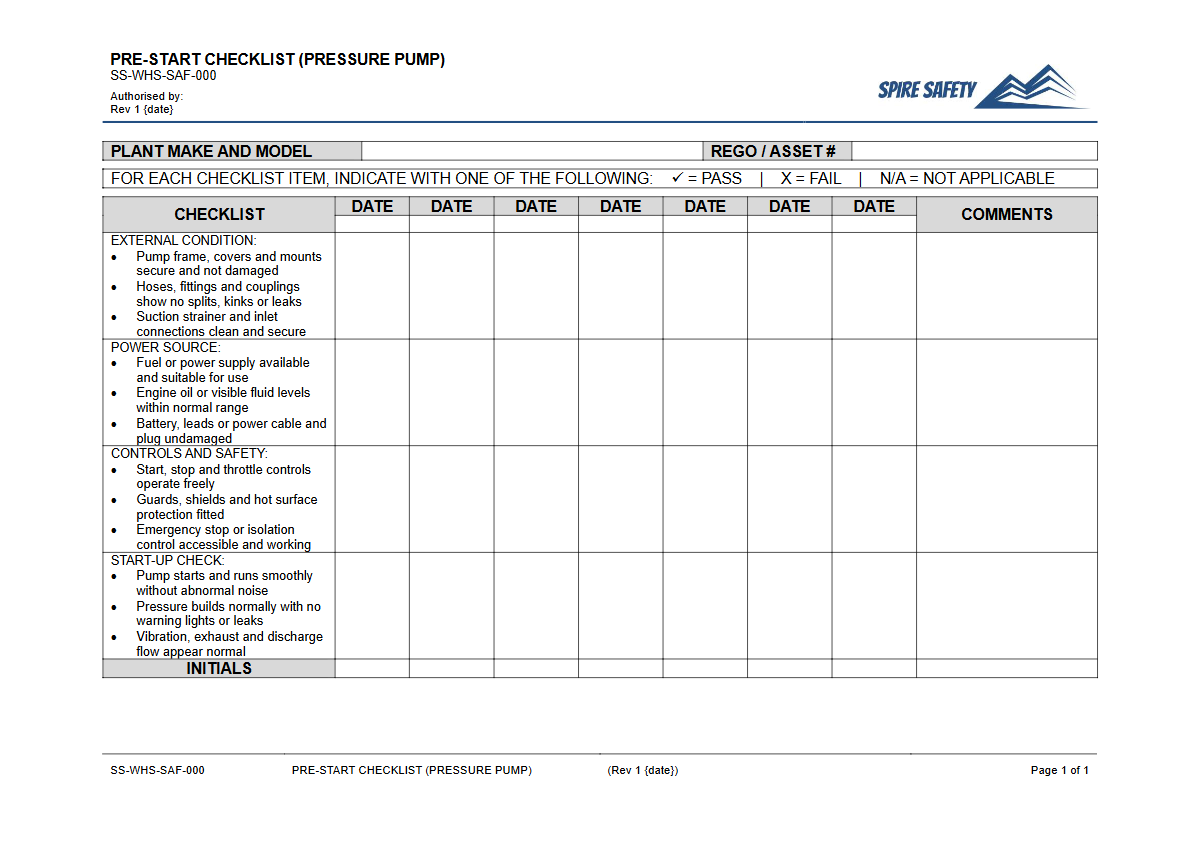
Formalise equipment safety checks with our Free Pre-Start Checklist (Pressure Pump) Template. A structured DOCX & PDF to manage WHS risks. Download yours now.
Free Pre-Start Checklist (Pressure Pump) Template
DOCX • 125 KB + PDF
Updated Oct 2026
No signup required
Purpose of the Free Pre-Start Checklist (Pressure Pump) Template
The primary purpose of this Free Pre-Start Checklist (Pressure Pump) Template is to systematise the process of verifying equipment safety before operation. Pressure pumps, by their nature, operate under significant force and can present serious hazards if not properly maintained.
These hazards include high-pressure fluid injection, mechanical failure, electrical shock, and unexpected start-up. A consistent pre-start inspection helps operators confirm that all safety features are functional, fluid levels are correct, pressure gauges are accurate, and the work area is clear of obstructions.
By identifying potential faults, leaks, or electrical issues early, you can prevent incidents, reduce downtime, and foster a stronger safety culture. Integrating this checklist into your daily operations demonstrates a commitment to proactive risk management and forms a key component of robust WHS management systems.
Video walkthrough
How to use the Free Pre-Start Checklist (Pressure Pump) Template
To get the most value from our free template, we recommend following these steps:
- Download: Get the template in your preferred format, DOCX for easy editing or PDF for straightforward printing.
- Customise: This is the most critical step. You must adapt the checklist to the specific models of pressure pumps used at your site, the tasks they perform, and the unique environmental conditions of your workplace. We've provided a solid, structured starting point based on common safety principles, but you must tailor it to ensure all relevant hazards are covered.
- Train: Ensure all operators and supervisors are trained on how to use the customised checklist correctly. This training should cover what each checkpoint means and what actions to take if a fault is found.
- Implement: Integrate the pre-start check into the standard operating procedure for using the pressure pump. Make it a non-negotiable step before every shift.
- Review: Periodically review the checklist's effectiveness and update it as necessary, especially if new pump models are introduced or incidents occur.
Completed checklists serve as valuable records for due diligence. They help track recurring faults and inform maintenance schedules. For organisations using a variety of pumps, it can be useful to see how checks are structured for similar equipment, as shown in our Free Pre-Start Checklist (Cooling Pump) Template.
When to use this Pre-Start Checklist
The pre-start checklist should be completed before the first use of the pressure pump on any given shift. It should also be used if the equipment is being returned to service after maintenance, repair, or a long period of inactivity.
This routine ensures that the pump's condition hasn't changed unexpectedly while idle. Consistent documentation of these checks is vital, especially when preparing for or undergoing a WHS compliance audit, as it demonstrates a systematic approach to equipment safety and risk management.
Who should use this Pre-Start Checklist
This checklist is designed for trained and competent operators who are authorised to use the pressure pump. Supervisors should also be familiar with the checklist to oversee its correct completion and ensure any identified issues are addressed promptly through established fault-reporting procedures.
Maintenance personnel may use it as part of their diagnostic or post-repair verification process. The principles of user-specific checks and operator competency apply to all specialised machinery, from industrial pumps to the equipment detailed in our Free Pre-Start Checklist (Fire Pump) Template.
If your organisation needs help developing customised checklists or implementing broader safety procedures that align with Australian WHS standards, our WHS consulting team can provide expert guidance tailored to your industry and operational needs.
By formalising your inspection process, you create a safer, more productive environment for everyone. Explore our extensive free WHS resources library for more templates and guides to support your organisation's safety objectives.
Common mistakes
Common mistakes to avoid
- Using a generic, non-customised checklist that doesn't cover model-specific hazards.
- Skipping or rushing checks to save time, especially during busy periods.
- Failing to take immediate corrective action or report faults identified during the check.
- Poor record-keeping, making it impossible to track recurring issues or prove due diligence.
Legal references
Legal considerations
The following legal requirements may be relevant to this type of work.
- Work Health and Safety Act (Harmonised) — Provides the primary duties for protecting workers and other people from work health and safety risks.
- Work Health and Safety Regulations (Harmonised) — Sets out requirements supporting the management of workplace hazards and risks.
The following codes may be relevant to this type of work.
- Managing WHS Risks Code of Practice — Provides practical guidance on identifying hazards, assessing risks and applying effective controls.
- Work Health and Safety Consultation, Cooperation and Coordination Code of Practice — Provides practical guidance on consulting workers and coordinating with other duty holders.
- Managing the Work Environment and Facilities Code of Practice — Provides practical guidance on safe work environments, workplace facilities and related controls.
Did you know
Fluid Injection Hazard
A high-pressure fluid injection injury from a pinhole leak in a hose can occur from a distance and may look like a minor cut, but it is a medical emergency that can lead to severe tissue damage or amputation.
Pump Energy Usage
Pumping systems account for nearly 20% of the world's electrical energy demand. Ensuring pumps are well-maintained and operating efficiently not only improves safety but can also lead to significant energy savings.
FAQ
Frequently asked questions
01What are the most critical checks for a pressure pump pre-start?
02How often should a pressure pump pre-start check be completed?
03Who is responsible for ensuring pressure pump pre-starts are done correctly?
04Can a digital pre-start checklist be used instead of a paper one?
Share this resource
Free Pre-Start Checklist (Pressure Pump) Template
Browse Categories
How To Use It
- 1Download and open in Word or PDF.
- 2Replace the placeholders with your business details.
- 3Get it reviewed by a WHS specialist before rollout.
Need it customised?
Our WHS consultants can adapt this template to your site, run a gap analysis, or audit what you already have in place.
Book a Free Consultation WHS consulting servicesor call 1300 156 382