
Free Pre-Start Checklist (Pressure Washer) Template
Download our free Pre-Start Checklist (Pressure Washer) Template to formalise equipment inspections and manage WHS risks. Get your DOCX and PDF template now.
Free Pre-Start Checklist (Pressure Washer) Template
DOCX • 125 KB + PDF
Updated Oct 2026
No signup required
Purpose of the Free Pre-Start Checklist (Pressure Washer) Template
Using a high-pressure washer introduces significant workplace hazards, from high-pressure water injection injuries to electrical shocks and slips, trips, and falls. Implementing a routine inspection process is a critical control measure to ensure the equipment is safe to operate.
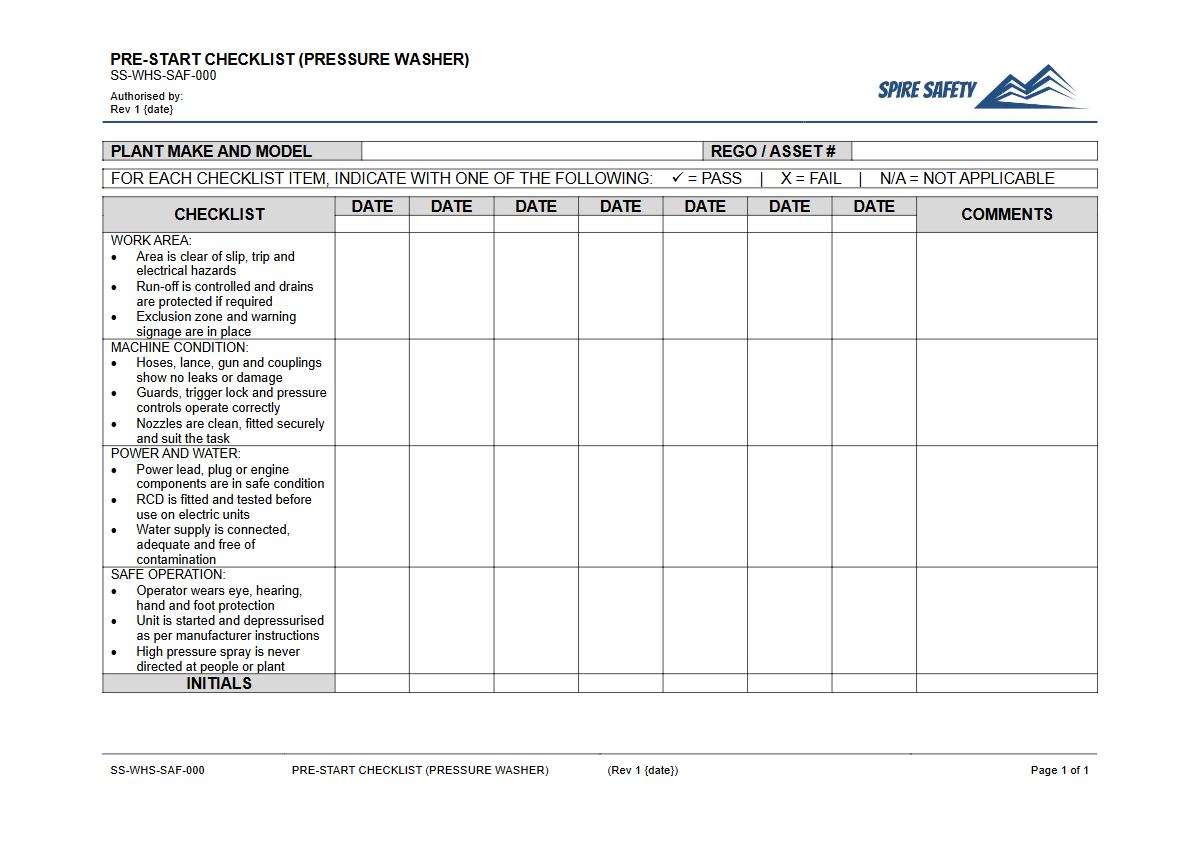
This free Pre-Start Checklist (Pressure Washer) Template provides a structured format for operators to verify the condition of the equipment before commencing work. It helps your organisation systematically identify and address potential faults, preventing equipment failure, property damage, and serious injuries.
A documented pre-start check serves as a record of due diligence, demonstrating a commitment to proactive risk management. It formalises a key step in a safe system of work, complementing documents like a Pressure Washer Safe Operating Procedure (SOP) to ensure all safety aspects are considered.
Regular use helps maintain the equipment in good working order, extending its operational life and reducing costly downtime.
Video walkthrough
How to use the Free Pre-Start Checklist (Pressure Washer) Template
This template provides a comprehensive starting point for developing your site-specific checklist. The process is straightforward:
- Download: Select the DOCX or PDF version of the resource. The DOCX file is fully editable.
- Customise: Modify the checklist to reflect the specific make and model of the pressure washer(s) used at your workplace. Add or remove checks related to fuel/engine type (electric, petrol, diesel), nozzle types, hose reel mechanisms, and any unique accessories.
- Train: Ensure all operators are trained not only on how to use the pressure washer safely but also on the importance and correct procedure for completing the pre-start checklist. Competency can be confirmed using a resource like our Pressure Cleaner VOC (Verification of Competency) template.
- Implement: Integrate the checklist into your daily operational routine. Establish a clear process for reporting and rectifying any identified faults before the equipment is used.
Important: This document is a template and is not a substitute for a comprehensive risk assessment. It must be customised by a competent person to suit the specific equipment, tasks, and operating environment of your workplace.
We provide this as a structured starting point to help you develop your safety documentation.
When to use it
The Pre-Start Checklist for a pressure washer should be completed before every use or, at a minimum, at the beginning of each shift where the equipment is expected to be used. It should also be completed after the equipment has undergone maintenance or repairs to verify it has been returned to a safe operational state.
While the check itself is brief, its consistent application is key to preventing incidents arising from equipment faults.
Discussing the importance of these checks is a valuable topic for safety meetings. You can facilitate this conversation using a Pre-Start Checks and Plant Maintenance Toolbox Talk to reinforce safe work habits across your team.
Who should use it
This checklist is designed to be completed by the person operating the equipment. Workers must be trained and deemed competent to both operate the pressure washer and conduct the pre-start inspection effectively.
Supervisors or managers should periodically review completed checklists to ensure they are being filled out correctly and that maintenance actions are being closed out in a timely manner. These records are a vital component of effective WHS management systems, providing valuable data on equipment condition and safety compliance.
Integrating Checks into Your Safety System
Pre-start checklists are more than just a daily task; they are an integral part of a holistic safety framework. Completed checklists provide a historical record of an asset's condition, which can be invaluable during incident investigations or WHS compliance audits. They demonstrate that the organisation is actively monitoring the condition of its plant and equipment as required by WHS regulations.
By analysing trends in checklist findings, organisations can identify recurring issues, schedule preventative maintenance more effectively, and make informed decisions about equipment replacement. Integrating this process into your standard procedures reinforces a culture of safety where every worker is responsible for their own safety and the safety of others. For more tools to support your safety system, explore our library of free WHS resources.
Common mistakes
Common mistakes to avoid
- Skipping checks on nozzles and spray wands, assuming they don't wear out.
- Ignoring minor leaks from hoses or couplings, which can indicate imminent failure under pressure.
- Using a generic checklist that doesn't cover the specific features of the pressure washer model (e.g., fuel type, unloader valve).
- Failing to document a 'pass' result, leaving no record that the check was actually performed.
Legal references
Legal considerations
The following legal requirements may be relevant to this type of work.
- Work Health and Safety Act (Harmonised) — Provides the primary duties for protecting workers and other people from work health and safety risks.
- Work Health and Safety Regulations (Harmonised) — Sets out requirements supporting the management of workplace hazards and risks.
The following codes may be relevant to this type of work.
- Managing WHS Risks Code of Practice — Provides practical guidance on identifying hazards, assessing risks and applying effective controls.
- Work Health and Safety Consultation, Cooperation and Coordination Code of Practice — Provides practical guidance on consulting workers and coordinating with other duty holders.
- Managing the Work Environment and Facilities Code of Practice — Provides practical guidance on safe work environments, workplace facilities and related controls.
Did you know
Injection Injury Risk
A pressure washer with a rating as low as 100 bar (1450 PSI) can puncture human skin. The resulting injection injury can cause severe tissue damage and infection, often requiring specialist medical treatment.
Electrical Danger
Water and electricity are a lethal combination. A significant number of incidents involving electric pressure washers are due to damaged power cords, improper use of extension leads, or faulty residual-current devices (RCDs).
FAQ
Frequently asked questions
01What are the main hazards of using a pressure washer?
02How often should a pressure washer be formally inspected?
03Is specific training required to operate a high-pressure washer?
04What should I do if a fault is found during a pre-start check?
Share this resource
Free Pre-Start Checklist (Pressure Washer) Template
Browse Categories
How To Use It
- 1Download and open in Word or PDF.
- 2Replace the placeholders with your business details.
- 3Get it reviewed by a WHS specialist before rollout.
Need it customised?
Our WHS consultants can adapt this template to your site, run a gap analysis, or audit what you already have in place.
Book a Free Consultation WHS consulting servicesor call 1300 156 382