
Free Pre-Start Checklist (Pug Mill) Template
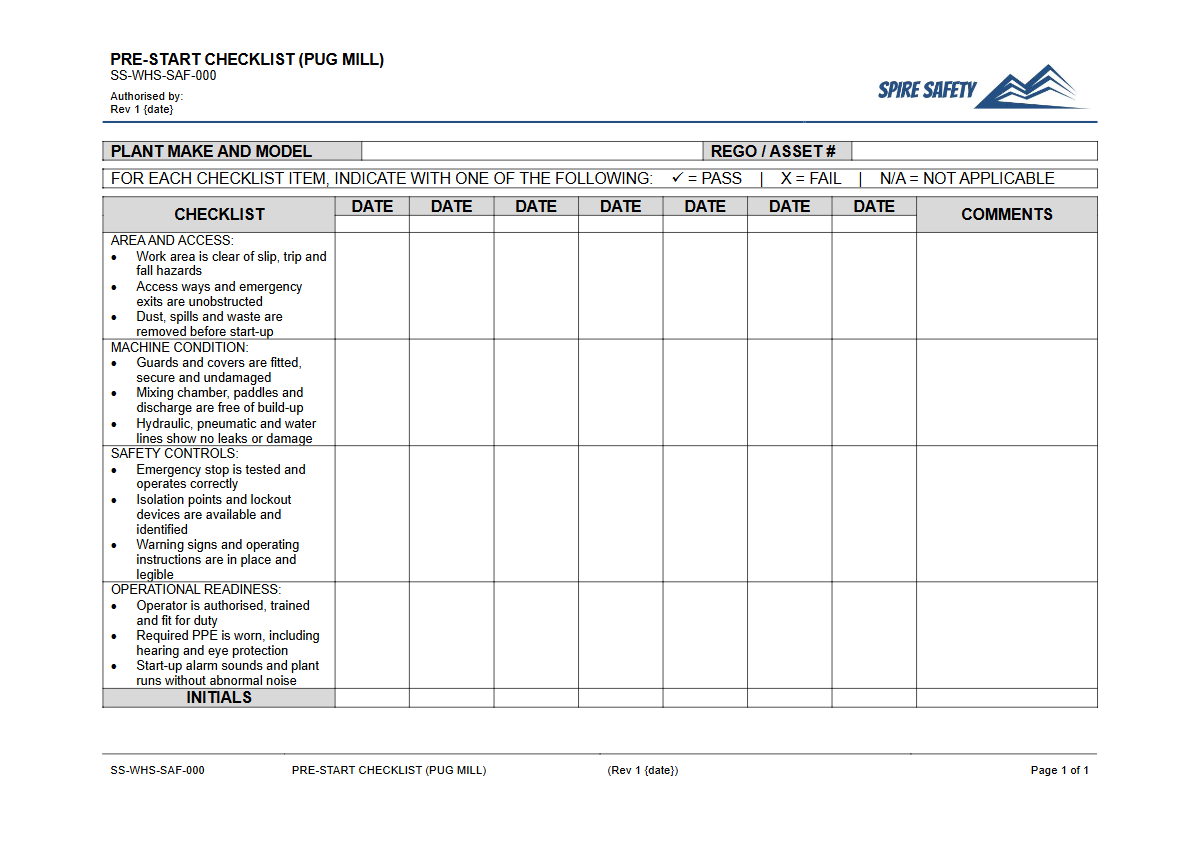
Download our free Pre-Start Checklist (Pug Mill) Template to formalise equipment inspections. This structured DOCX & PDF resource helps identify hazards.
Free Pre-Start Checklist (Pug Mill) Template
DOCX • 125 KB + PDF
Updated Oct 2026
No signup required
Purpose of the Free Pre-Start Checklist (Pug Mill) Template
Operating heavy plant like a pug mill introduces significant workplace hazards. A pre-start checklist is a fundamental safety tool used to verify that equipment is safe to operate before each use.
This free Pre-Start Checklist (Pug Mill) Template provides a structured format for operators to conduct systematic inspections, identify potential faults, and prevent incidents before they occur. Regular checks are a key part of proactive plant maintenance and demonstrate a commitment to health and safety. Integrating these checks helps an organisation fulfil its duty of care and can be a focal point of safety discussions, such as in a Pre-Start Checks and Plant Maintenance Toolbox Talk.
Using a documented system ensures that inspections are consistent and that any identified issues are formally recorded. This creates a clear paper trail for maintenance scheduling, incident investigations, and regulatory compliance activities.
A well-maintained pug mill is a safer, more reliable, and more productive asset.
Video walkthrough
How to use the Free Pre-Start Checklist (Pug Mill) Template
This Pre-Start Checklist is provided as a DOCX file for easy editing and a PDF for immediate use. While it is based on Australian WHS principles and common pug mill configurations, it serves as a starting point.
It is crucial to adapt the document to the specific make, model, and operational context of the pug mill in your workplace.
Note: We have created this template as a guide. You must customise it to reflect the specific hazards and control measures relevant to your site, equipment, and procedures.
This might include adding checks for custom guarding, specific lockout/tagout points, or environmental controls.
To use the template effectively:
- Customise: Add your company branding and review each checklist item. Add or remove items to align with the manufacturer's recommendations and your own risk assessments. Since pug mills are a type of mixer, you might find inspiration in our Pre-Start Checklist for an Agitator when considering specific component checks.
- Train: Ensure all operators are trained on how to properly conduct the pre-start inspection and what to do if a fault is found.
- Implement: Make the checklist readily available near the equipment. Enforce the procedure that a pug mill cannot be operated until the check is completed and signed off.
- Action: If a defect is identified, the pug mill must be taken out of service, isolated, and tagged. The fault must be reported immediately to a supervisor for corrective action.
- Review: Periodically review completed checklists to identify recurring issues, which may indicate a need for revised maintenance schedules or operator retraining.
When to use it
A pug mill pre-start inspection should be completed at the beginning of every shift before the machine is operated for the first time that day. A new check should also be performed whenever there is a change of operator.
This ensures that the incoming operator is personally satisfied with the condition of the equipment. It's good practice to integrate this activity with other daily briefings, such as daily pre-start meetings, to reinforce its importance.
Who should use it
The pre-start checklist should be completed by a person who is competent to operate the pug mill. This means they have the necessary training, experience, and knowledge to both operate the machine safely and identify potential hazards or defects.
Supervisors or maintenance personnel may also use the checklist to conduct periodic spot-checks or formal audits. The information gathered from these checklists is a valuable input for creating and maintaining effective WHS management systems, as it provides real-world data on plant condition and safety behaviour.
By consistently using this document, your organisation can build a stronger safety culture and reduce the risk of plant-related incidents. For more tools to support your safety processes, explore our extensive library of free WHS resources.
Common mistakes
Common mistakes to avoid
- "Pencil-whipping" the checklist without physically inspecting the equipment.
- Using a generic checklist that doesn't address the specific hazards of the pug mill model in use.
- Failing to immediately tag out and report faulty equipment found during the inspection.
- Not reviewing completed checklists to identify recurring faults or maintenance trends.
Legal references
Legal considerations
The following legal requirements may be relevant to this type of work.
- Work Health and Safety Act (Harmonised) — Provides the primary duties for protecting workers and other people from work health and safety risks.
- Work Health and Safety Regulations (Harmonised) — Sets out requirements supporting the management of workplace hazards and risks.
The following codes may be relevant to this type of work.
- Managing WHS Risks Code of Practice — Provides practical guidance on identifying hazards, assessing risks and applying effective controls.
- Work Health and Safety Consultation, Cooperation and Coordination Code of Practice — Provides practical guidance on consulting workers and coordinating with other duty holders.
- Managing the Work Environment and Facilities Code of Practice — Provides practical guidance on safe work environments, workplace facilities and related controls.
Did you know
Material Mixing
Pug mills are essential in industries like brick manufacturing, ceramics, and road construction for their ability to homogenously blend materials like clay, soil, and asphalt.
Operator Competency
Under model WHS laws, a PCBU must ensure operators are competent to use plant like a pug mill. This includes providing the necessary information, training, instruction, and supervision.
FAQ
Frequently asked questions
01What should be included in a pug mill pre-start checklist?
02How often should a pug mill pre-start check be performed?
03Is this Pug Mill Pre-Start Checklist template compliant with WHS laws?
04What happens if a fault is found during a pre-start check?
Share this resource
Free Pre-Start Checklist (Pug Mill) Template
Browse Categories
How To Use It
- 1Download and open in Word or PDF.
- 2Replace the placeholders with your business details.
- 3Get it reviewed by a WHS specialist before rollout.
Need it customised?
Our WHS consultants can adapt this template to your site, run a gap analysis, or audit what you already have in place.
Book a Free Consultation WHS consulting servicesor call 1300 156 382