
Free Pre-Start Checklist (Quad Bike) Template
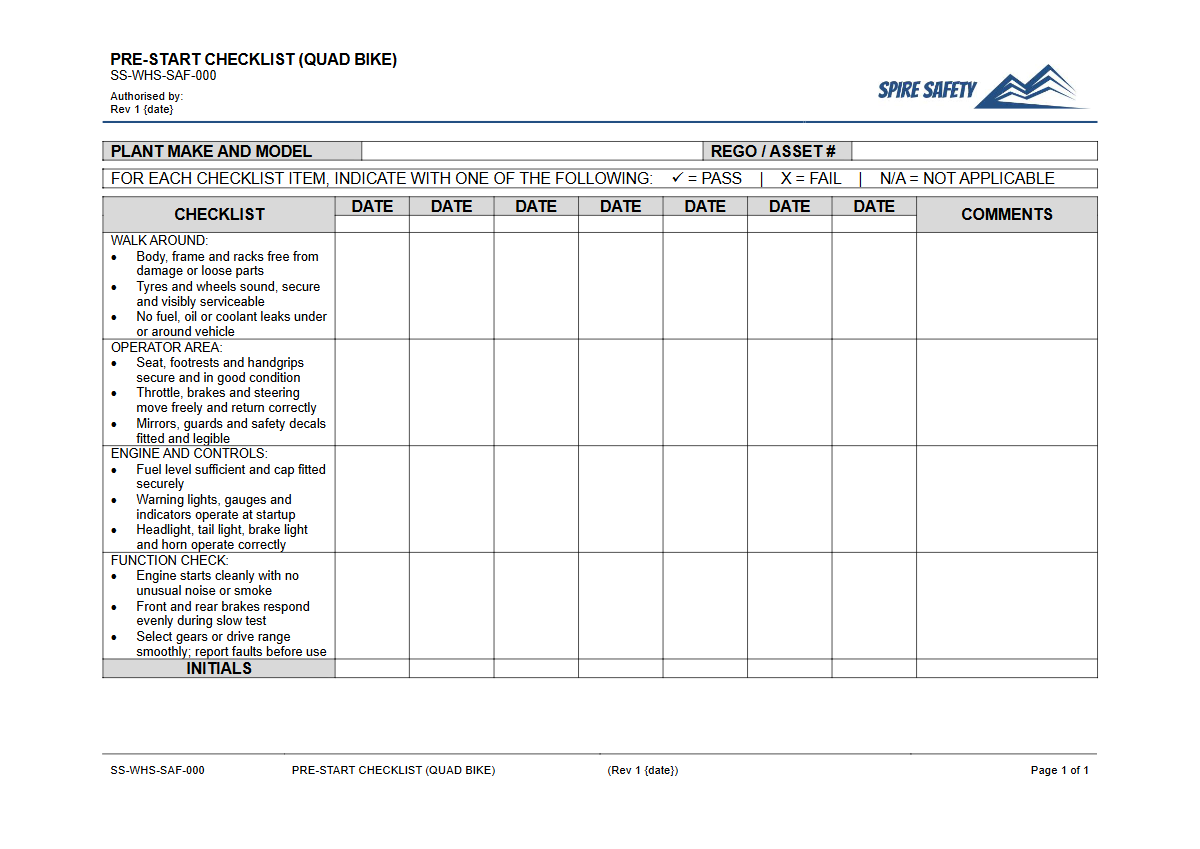
Download our free Pre-Start Checklist (Quad Bike) Template. This structured DOCX & PDF helps formalise daily safety inspections for quad bikes.
Free Pre-Start Checklist (Quad Bike) Template
DOCX • 125 KB + PDF
Updated Oct 2026
No signup required
Purpose of the Free Pre-Start Checklist (Quad Bike) Template
This free Pre-Start Checklist (Quad Bike) Template provides a structured framework for conducting and documenting daily safety inspections of quad bikes, also known as All-Terrain Vehicles (ATVs). Quad bikes present significant risks, including rollovers, collisions, and loss of control, making pre-operational checks a critical safety measure.
Using a standardised checklist ensures that key components like brakes, tyres, steering, controls, and safety features are inspected consistently before every use.
Regularly completing these checks helps identify mechanical faults or damage that could lead to an incident, allowing for corrective action before the vehicle is operated. It creates a documented history of the equipment's condition, which is a fundamental part of a proactive safety culture and a key component of any robust WHS management system. By formalising this process, your organisation can demonstrate its commitment to managing risks associated with plant and equipment.
Video walkthrough
How to use the Free Pre-Start Checklist (Quad Bike) Template
This template, available as a DOCX and PDF file, is designed for immediate use after customisation. The DOCX version allows you to easily add your company branding and modify the checklist items to align with your specific equipment and operational context.
Effective implementation involves several key steps.
- Customise the Template: IMPORTANT: We've provided a strong starting point based on Australian WHS principles, but you must customise this template to suit the specific makes and models of quad bikes in your workplace, your operating conditions (e.g., terrain, tasks), and your organisation's safety procedures.
- Train Your Operators: Ensure all workers who use quad bikes are thoroughly trained on how to conduct the inspection, what each checkpoint means, and the procedure for reporting defects.
- Integrate into Daily Workflow: Make the pre-start check a non-negotiable first step before any quad bike is used for the day. Store blank checklists in a convenient location near the equipment.
- Establish a Reporting Procedure: Create a clear process for operators to follow if they find a fault. This must include immediately tagging the equipment as 'Out of Service' and notifying a supervisor or maintenance manager.
- Review and Retain Records: Completed checklists should be collected and reviewed by supervisors to identify recurring issues or training gaps. These records are invaluable for incident investigations and regular WHS compliance auditing.
When to use it
A pre-start checklist should be completed before every single use or at the beginning of each shift where a quad bike will be operated. It is not a weekly or monthly check; it is a pre-operational safety verification.
If an operator swaps to a different quad bike during their shift, a new pre-start check should be performed on that new vehicle.
Additionally, a full inspection using this checklist is recommended after any significant event, such as a minor collision, a near-miss incident, or after the bike has undergone maintenance or repairs, to ensure it is safe to return to service. This vigilance ensures the equipment's condition is constantly monitored, not just at scheduled intervals.
Who should use it
The person who will be operating the quad bike is the primary individual responsible for completing the pre-start checklist. They have the most immediate interest in ensuring the equipment is safe to use and are in the best position to physically verify each item.
They must be deemed competent not only to operate the vehicle but also to understand the importance of each check.
Supervisors and managers have a secondary responsibility. They must ensure that operators are completing the checks correctly and consistently.
They are also responsible for taking action on any reported defects, arranging for repairs, and ensuring no one uses a vehicle that has been tagged as unsafe. If your organisation needs assistance in developing comprehensive safe operating procedures and training frameworks for rural or agricultural equipment, our WHS consulting team can provide expert guidance.
For other farm or groundskeeping equipment, you may find resources like our free Pre-Start Checklist for Lawn Tractors useful.
In sectors like forestry, agriculture, and property maintenance, managing a diverse fleet of machinery is common. A systematic approach to pre-start checks across all equipment, from quad bikes to more specialised vehicles covered by our Pre-Start Checklist for Forwarders, is essential for maintaining a safe workplace. You can find more templates and tools in our complete free WHS resources library.
Common mistakes
Common mistakes to avoid
- "Pencil-whipping" the checklist without physically inspecting each item.
- Failing to tag out and report unsafe equipment found during the check.
- Using a generic checklist that doesn't cover the specific features or risks of the quad bike model in use.
- Neglecting to train operators on how to properly conduct the inspection and what each item means.
Legal references
Legal considerations
The following legal requirements may be relevant to this type of work.
- Work Health and Safety Act (Harmonised) — Provides the primary duties for protecting workers and other people from work health and safety risks.
- Work Health and Safety Regulations (Harmonised) — Sets out requirements supporting the management of workplace hazards and risks.
The following codes may be relevant to this type of work.
- Managing WHS Risks Code of Practice — Provides practical guidance on identifying hazards, assessing risks and applying effective controls.
- Work Health and Safety Consultation, Cooperation and Coordination Code of Practice — Provides practical guidance on consulting workers and coordinating with other duty holders.
- Managing the Work Environment and Facilities Code of Practice — Provides practical guidance on safe work environments, workplace facilities and related controls.
Did you know
Rollover Risk
According to Safe Work Australia, quad bike incidents are a leading cause of death and serious injury on Australian farms, with rollovers being the most common cause of fatalities.
Operator Protective Devices (OPDs)
Many quad bikes can be retrofitted with Operator Protective Devices (OPDs), also known as crush protection devices, which are designed to create a survivable space for the rider in the event of a rollover.
FAQ
Frequently asked questions
01Are quad bike pre-start checks legally required in Australia?
02What should happen if a defect is found during a pre-start check?
03How often should a quad bike be inspected?
04Can this template be used for all types of quad bikes and ATVs?
Share this resource
Free Pre-Start Checklist (Quad Bike) Template
Browse Categories
How To Use It
- 1Download and open in Word or PDF.
- 2Replace the placeholders with your business details.
- 3Get it reviewed by a WHS specialist before rollout.
Need it customised?
Our WHS consultants can adapt this template to your site, run a gap analysis, or audit what you already have in place.
Book a Free Consultation WHS consulting servicesor call 1300 156 382