
Free Pre-Start Checklist (Lawn Tractor) Template
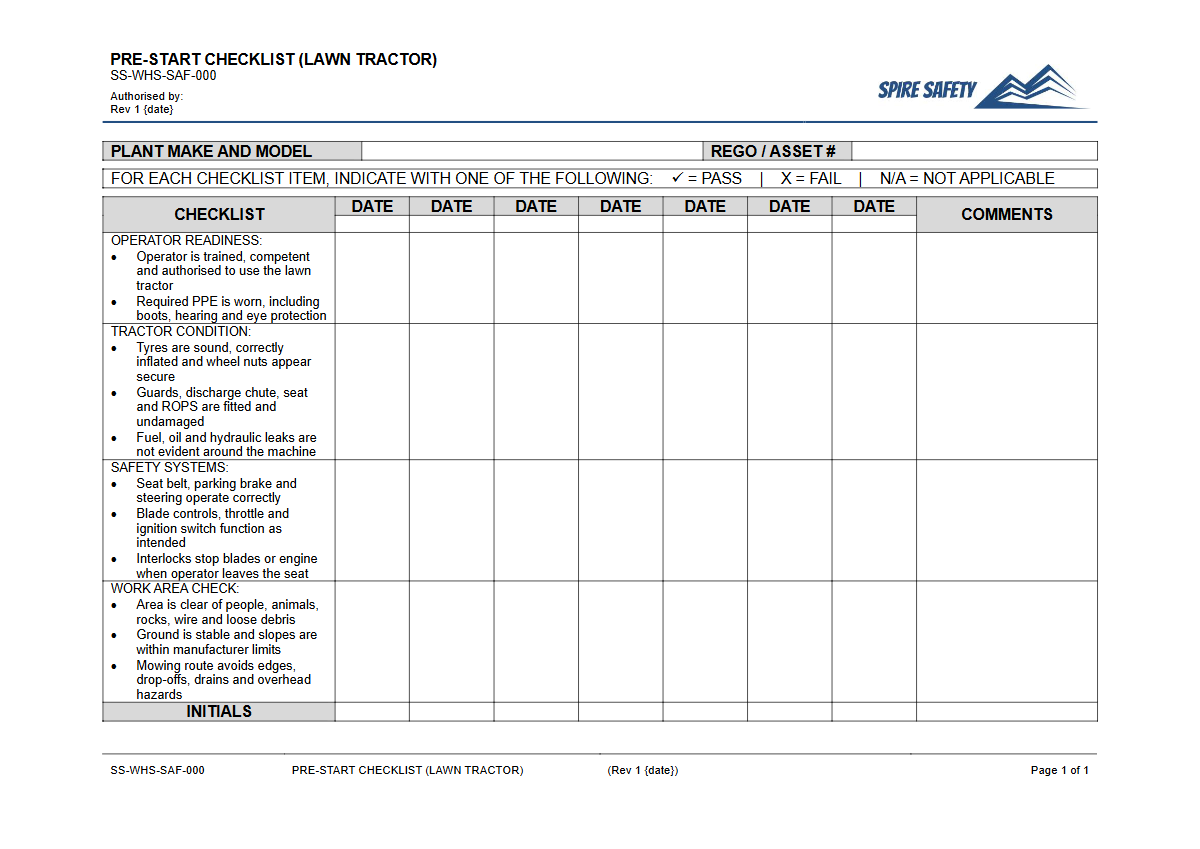
Download our Free Pre-Start Checklist (Lawn Tractor) Template (DOCX & PDF).
Free Pre-Start Checklist (Lawn Tractor) Template
DOCX • 125 KB + PDF
Updated Oct 2026
No signup required
Purpose of the Free Pre-Start Checklist (Lawn Tractor) Template
Our free Pre-Start Checklist (Lawn Tractor) Template provides a structured starting point for organisations to formalise their daily equipment inspections. Systematically checking a lawn tractor or ride-on mower before use is a critical control measure to identify mechanical faults, damage, or fluid leaks that could lead to an incident.
By documenting these checks, you create a clear record of due diligence and help prevent accidents related to equipment failure, such as brake malfunction, loss of control, or blade-related injuries.
Conducting these checks helps manage common hazards associated with lawn tractors, including rollovers on uneven terrain, contact with the moving blades, and projectiles being ejected from the cutting deck. This process is a fundamental part of a safe system of work for any groundskeeping or maintenance operation.
Using a formal document like our Tractor Risk Assessment Template can help you identify these and other site-specific hazards that your pre-start checks should address.
Video walkthrough
How to use the Free Pre-Start Checklist (Lawn Tractor) Template
This Pre-Start Checklist (Lawn Tractor) Template is designed to be a practical tool for your workplace. After downloading the DOCX or PDF file, the first step is to review and adapt the checklist items to match the specific make and model of the lawn tractors used at your site.
Different machines will have unique features, controls, and safety devices that must be included in the inspection.
Once customised, operators should be trained on how to properly complete the checklist and what actions to take if a fault is discovered. The process should be simple: the operator performs each check, ticks off the item, and signs the form.
If any item fails the inspection, the lawn tractor must be immediately taken out of service, tagged as faulty, and the issue reported to a supervisor for repair. This pre-start check can be integrated into a more comprehensive Tractor SOP (Safe Operating Procedure) template to ensure a consistent approach to safety.
Important: This document is a template designed as a starting point. We have provided a solid foundation based on common safety principles, but you must customise it to reflect the specific equipment, operational risks, and procedures of your organisation to ensure it is fit for purpose.
When to use it
A pre-start checklist for a lawn tractor should be completed before the equipment is used for the first time on any given day or at the beginning of each operator's shift. Making this check a non-negotiable part of the daily work routine ensures that the machine's condition is verified before it begins operation, minimising the risk of in-service failure.
Regular reinforcement of this requirement is crucial for building a strong safety culture.
These checks are an excellent topic for routine safety communications. You can use our Pre-Start Checks and Plant Maintenance Toolbox Talk to remind workers of their importance.
Integrating this checklist into daily briefings, perhaps using a broader Pre-Start Meeting Template, can further embed the practice within your team's standard procedures.
Who should use it
The primary user of this checklist is the competent person assigned to operate the lawn tractor. They are responsible for physically inspecting the equipment and verifying its safe condition.
Supervisors and managers also have a role in ensuring the checks are being completed correctly and consistently. They are responsible for reviewing the completed checklists, addressing any reported faults promptly, and maintaining the records as part of the organisation's safety documentation.
Ultimately, the Person Conducting a Business or Undertaking (PCBU) holds the primary duty of care to provide and maintain safe plant and equipment. Implementing mandatory pre-start inspections is a key way a PCBU can demonstrate it is taking reasonably practicable steps to meet this obligation. These documented procedures form an essential part of effective WHS management systems.
The records generated by these checklists also provide valuable data for maintenance planning and can be a key point of evidence during internal or external safety reviews. Verifying that these checks are being completed and acted upon is a common focus of WHS compliance audits, demonstrating a proactive approach to plant safety.
Common mistakes
Common mistakes to avoid
- Using a generic checklist without customising it for the specific lawn tractor model.
- "Pencil-whipping" the form without physically performing each inspection.
- Failing to immediately tag out and report faulty equipment identified during the check.
- Not retaining completed checklists as a record of safety diligence and maintenance needs.
Legal references
Legal considerations
The following legal requirements may be relevant to this type of work.
- Work Health and Safety Act (Harmonised) — Provides the primary duties for protecting workers and other people from work health and safety risks.
- Work Health and Safety Regulations (Harmonised) — Sets out requirements supporting the management of workplace hazards and risks.
The following codes may be relevant to this type of work.
- Managing WHS Risks Code of Practice — Provides practical guidance on identifying hazards, assessing risks and applying effective controls.
- Work Health and Safety Consultation, Cooperation and Coordination Code of Practice — Provides practical guidance on consulting workers and coordinating with other duty holders.
- Managing the Work Environment and Facilities Code of Practice — Provides practical guidance on safe work environments, workplace facilities and related controls.
Did you know
Rollover Risk
The most serious incidents involving ride-on mowers and lawn tractors are rollovers, particularly on slopes, embankments, or uneven ground. Many modern tractors are fitted with Rollover Protective Structures (ROPS) to protect the operator.
Blade Speed
The tips of a lawn tractor's cutting blades can travel at speeds of up to 300 km/h, highlighting the critical importance of ensuring all safety guards are in place and undamaged before operation.
FAQ
Frequently asked questions
01What should be included in a lawn tractor pre-start check?
02Is a pre-start checklist a legal requirement in Australia?
03What happens if a fault is found during a lawn tractor pre-start check?
04How often do lawn tractors need to be serviced?
Share this resource
Free Pre-Start Checklist (Lawn Tractor) Template
Browse Categories
How To Use It
- 1Download and open in Word or PDF.
- 2Replace the placeholders with your business details.
- 3Get it reviewed by a WHS specialist before rollout.
Need it customised?
Our WHS consultants can adapt this template to your site, run a gap analysis, or audit what you already have in place.
Book a Free Consultation WHS consulting servicesor call 1300 156 382