
Free Pre-Start Checklist (Leg Press) Template
Download our Free Pre-Start Checklist (Leg Press) Template in DOCX and PDF. A structured starting point for equipment safety inspections in gyms or workplaces.
Free Pre-Start Checklist (Leg Press) Template
DOCX • 125 KB + PDF
Updated Oct 2026
No signup required
Purpose of the Free Pre-Start Checklist (Leg Press) Template
Regularly inspecting gym and workplace equipment is a fundamental aspect of managing health and safety risks. This Free Pre-Start Checklist (Leg Press) Template provides a structured framework to formalise daily safety checks on leg press machines.
Using this checklist helps identify potential hazards such as worn cables, damaged frames, or malfunctioning safety stops before the equipment is used, significantly reducing the risk of injury to users. It serves as a practical tool for proactive risk management, helping your organisation demonstrate due diligence in maintaining safe plant and equipment.
Implementing consistent pre-start checks is a critical component of a proactive safety culture. By documenting these inspections, you create a clear record of equipment condition and maintenance activities.
This process not only helps prevent incidents but also forms an essential part of your overall WHS management systems, ensuring that safety procedures are consistently applied and monitored.
Video walkthrough
How to use the Free Pre-Start Checklist (Leg Press) Template
This template is provided in both DOCX and PDF formats for your convenience. The DOCX file is fully editable, allowing you to tailor the checklist to your specific needs.
The process is straightforward: download the document, add your company branding, and modify the checklist items to match the exact make and model of your leg press equipment. It is vital to ensure the checklist accurately reflects the specific features and potential failure points of your machine.
Important: This document is a template and must be customised. We provide this as a starting point.
You must review and amend it to suit your specific equipment, operational procedures, and the unique risks identified in your workplace. A generic checklist may not cover all hazards associated with your particular model.
For complex machinery, checklists are often used alongside detailed procedural documents like a Hydraulic Press SOP to ensure all safety aspects are covered.
When to use it
A pre-start checklist for a leg press machine should be completed before its first use each day or at the beginning of each shift in a high-traffic environment like a commercial gym or fitness centre. The goal is to catch any issues that may have developed overnight or during previous use before they can cause harm.
This routine check ensures the equipment is in safe working order for all subsequent users during that period.
These daily checks can also be reinforced through regular workplace discussions. Integrating the findings and importance of these inspections into routine safety meetings is an effective strategy.
A Pre-Start Checks and Plant Maintenance Toolbox Talk can help remind staff of their obligations and the correct inspection procedures.
Who should use it
The responsibility for completing the pre-start checklist typically falls to a designated competent person. This could be a gym manager, a floor supervisor, a personal trainer, or a maintenance team member.
The individual must be familiar with the leg press machine's normal operation and be trained to recognise the signs of wear, damage, or malfunction listed on the checklist. Competency is key; the person performing the check must understand what they are looking for and know the procedure to follow if a defect is found, such as isolating the equipment and reporting the fault.
Formalising competency for machine operation and inspection is a cornerstone of workplace safety. While this checklist is for a simple inspection, more complex machinery requires formal assessment, for which a document like our Drill Press VOC template can provide a useful structural example.
Key Elements of a Leg Press Pre-Start Check
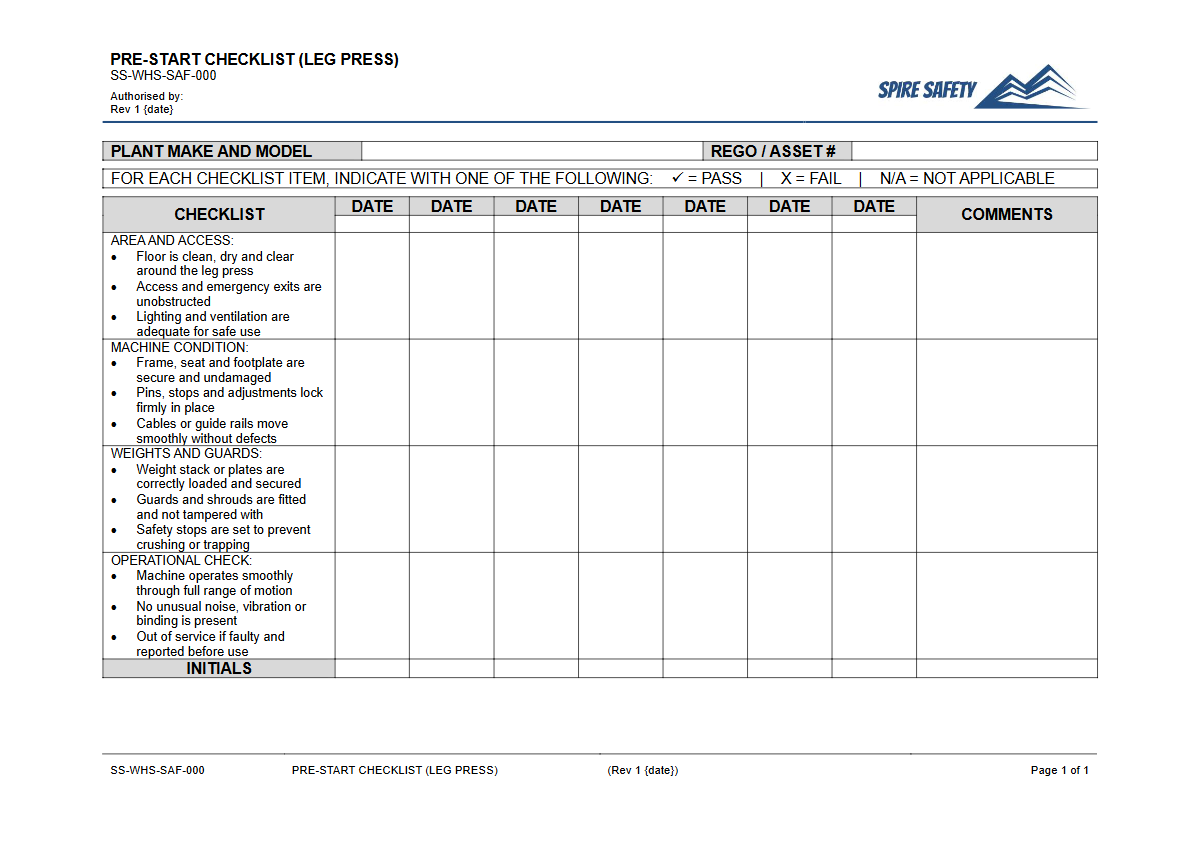
A thorough pre-start check for a leg press covers several critical areas to ensure user safety. Our template prompts the user to inspect the following, which you should adapt for your specific machine:
- Structural Integrity: Checking the frame, base, and all welded joints for signs of stress, cracks, or corrosion. Ensure all nuts, bolts, and fasteners are secure and that the machine sits level and stable on the floor.
- Mechanical Components: Inspecting cables or belts for fraying, wear, or damage. For plate-loaded machines, check the condition of weight horns. For stack machines, examine the weight stack, guide rods, and selector pin. Ensure all pulleys and moving parts operate smoothly without unusual noises.
- User Interface and Adjustments: Verifying that all adjustable parts, such as the seat back and footplate angle, move freely and lock securely into place. Most importantly, test any safety stops or range-of-motion limiters to confirm they are functional.
- General Area and Hygiene: Ensuring the area around the machine is clear of trip hazards. Upholstery should be checked for rips or tears that could pose a hazard or harbour bacteria, and surfaces should be clean.
Regularly reviewing completed checklists helps identify recurring issues and informs your maintenance schedule. These records are invaluable during safety reviews and can be a key point of evidence during a WHS compliance auditing process to demonstrate proactive equipment management.
Common mistakes
Common mistakes to avoid
- Ignoring minor frays in cables, which can lead to sudden failure under load.
- Failing to check that all adjustment pins and safety stops lock securely in place.
- "Pencil-whipping" the form without physically inspecting each item.
- Not customising the checklist for the specific make and model of the leg press machine.
Legal references
Legal considerations
The following legal requirements may be relevant to this type of work.
- Work Health and Safety Act (Harmonised) — Provides the primary duties for protecting workers and other people from work health and safety risks.
- Work Health and Safety Regulations (Harmonised) — Sets out requirements supporting the management of workplace hazards and risks.
The following codes may be relevant to this type of work.
- Managing WHS Risks Code of Practice — Provides practical guidance on identifying hazards, assessing risks and applying effective controls.
- Work Health and Safety Consultation, Cooperation and Coordination Code of Practice — Provides practical guidance on consulting workers and coordinating with other duty holders.
- Managing the Work Environment and Facilities Code of Practice — Provides practical guidance on safe work environments, workplace facilities and related controls.
Did you know
Mechanical Advantage
On a typical 45-degree leg press, the user is only lifting about 70.7% of the total weight loaded onto the sled due to the angle. This is why people can often press more weight than they can squat.
Plant Regulations
Under Australian WHS Regulations, gym equipment like a leg press is defined as 'plant'. This means PCBUs (Persons Conducting a Business or Undertaking) have a legal duty to ensure it is inspected and maintained to be safe for use.
FAQ
Frequently asked questions
01What is the purpose of a leg press pre-start checklist?
02How often should a leg press machine be inspected?
03Who is responsible for completing a leg press pre-start check?
04Can this template be used for different types of leg press machines?
Share this resource
Free Pre-Start Checklist (Leg Press) Template
Browse Categories
How To Use It
- 1Download and open in Word or PDF.
- 2Replace the placeholders with your business details.
- 3Get it reviewed by a WHS specialist before rollout.
Need it customised?
Our WHS consultants can adapt this template to your site, run a gap analysis, or audit what you already have in place.
Book a Free Consultation WHS consulting servicesor call 1300 156 382