
Free Pre-Start Checklist (Lever Hoist) Template
Download our free Pre-Start Checklist (Lever Hoist) Template in DOCX & PDF. A structured starting point for formalising daily equipment safety inspections.
Free Pre-Start Checklist (Lever Hoist) Template
DOCX • 125 KB + PDF
Updated Oct 2026
No signup required
Purpose of the Free Pre-Start Checklist (Lever Hoist) Template
Lever hoists are powerful tools used for lifting, pulling, and tensioning heavy loads in a range of industries, from construction to manufacturing. However, their use presents significant risks if the equipment is faulty or used incorrectly.
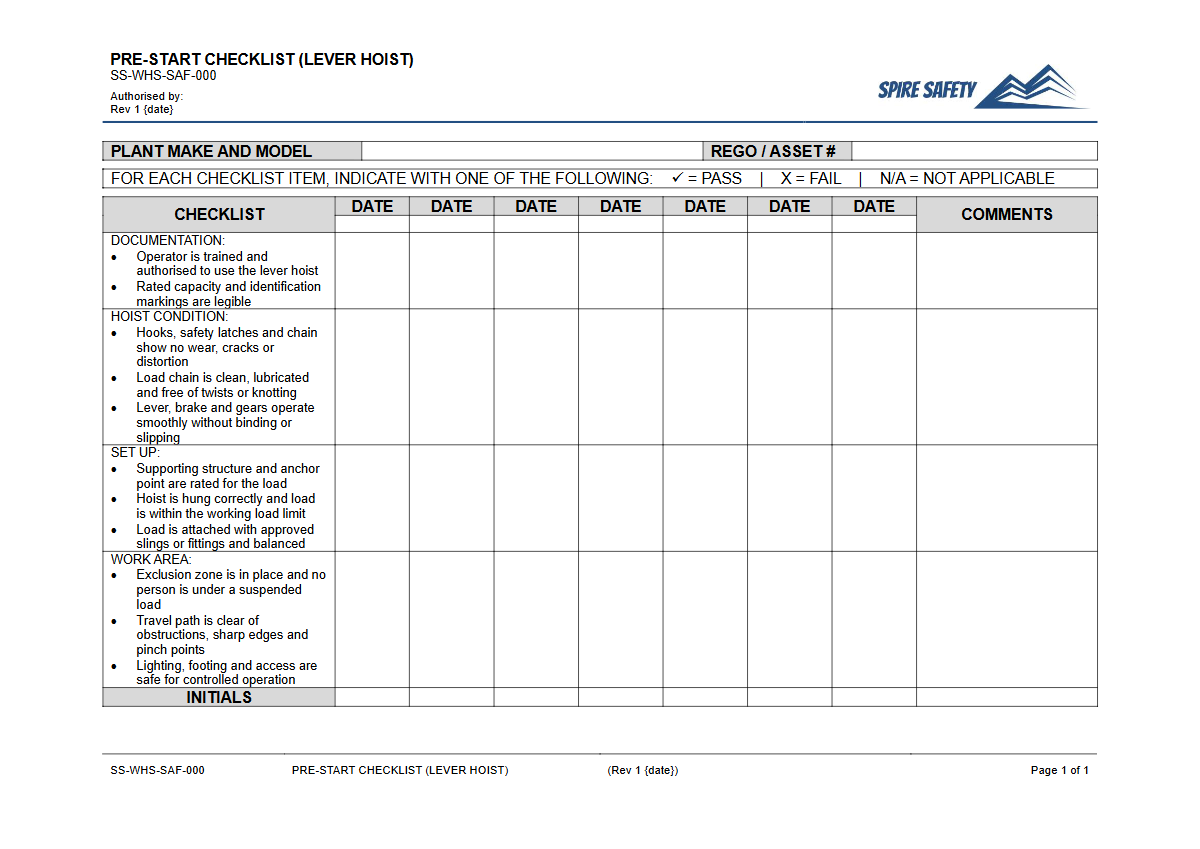
A systematic pre-start inspection is a fundamental safety control to prevent equipment failure, property damage, and serious injuries. This Free Pre-Start Checklist (Lever Hoist) Template provides a structured format to guide operators through these essential daily checks, helping your organisation meet its duty of care.
Using a standardised checklist ensures that inspections are consistent, thorough, and documented. It formalises the process of identifying potential hazards—such as worn chains, damaged hooks, or malfunctioning brake mechanisms—before the hoist is put into service.
Regular, documented checks are a key part of proactive plant and equipment safety management. While this checklist focuses on pre-start inspections, it's also crucial to confirm that operators have the necessary skills, which can be formally assessed using a document like our Verification of Competency (Electric Hoist or Chain Block) Template.
Video walkthrough
How to use the Free Pre-Start Checklist (Lever Hoist) Template
Integrating this checklist into your daily operations is straightforward. The template is provided as a customisable DOCX file and a ready-to-use PDF.
Operators should complete the checklist before their first use of the lever hoist on any given shift. Any identified defects or concerns must be reported immediately to a supervisor, and the hoist must be tagged out of service until it has been inspected by a competent person and deemed safe to use.
This document provides a strong foundation aligned with Australian WHS principles, but it must be adapted to your specific operational context. We recommend you review and customise the checklist to include details relevant to the makes and models of lever hoists used at your site, your specific work environment, and any unique tasks performed.
Effective safety documentation is a core component of robust WHS management systems, ensuring that procedures are practical and fit for purpose.
Key Checks for a Lever Hoist Pre-Start
While your customised checklist should be comprehensive, a thorough inspection will generally include verifying:
- Hooks: Check for any bending, twisting, cracks, or excessive wear. Ensure the safety latch is present, functions correctly, and is not damaged.
- Load Chain: Inspect the entire length of the chain for twists, kinks, gouges, and stretched or worn links. Ensure it is properly lubricated.
- Braking System: Test the brake to ensure it engages properly and holds the load without slipping.
- Housing and Levers: Look for cracks, distortion, or other damage to the hoist body and operating lever.
- Markings: Confirm that the Working Load Limit (WLL) is clearly marked and legible on the hoist.
When to use it
A pre-start checklist for a lever hoist should be completed by the operator before each shift or before the first use of the day. This frequency ensures that any damage or defects that may have occurred during previous use or while in storage are identified before the equipment is used again.
It's a high-frequency check that complements, but does not replace, the need for periodic and major inspections conducted by competent persons according to manufacturer specifications and Australian Standards.
These daily inspections form the frontline of your equipment safety strategy. To reinforce their importance, consider discussing findings and best practices during team meetings, which can be guided by our Pre-Start Checks and Plant Maintenance Toolbox Talk Template. This helps embed a proactive safety culture where equipment care is everyone's responsibility.
Who should use it
The primary user of this pre-start checklist is the operator—the person who will be physically using the lever hoist. They have the most immediate opportunity to identify and report issues.
Supervisors and managers also have a role in ensuring the checks are being completed correctly and that appropriate action is taken when defects are found. They are responsible for providing the necessary training and resources to facilitate this process.
Safety officers and WHS managers can use the completed records to monitor safety performance, identify trends in equipment failure, and verify that procedures are being followed. These records serve as valuable evidence of your organisation's commitment to safety during internal reviews or external evaluations like WHS compliance auditing. If any significant issues are found during a pre-start, it's good practice to document and discuss them in a team briefing, which can be structured using our free Pre-Start Meeting Template.
By implementing this checklist, your business takes a practical step towards managing the risks associated with lifting operations. To explore more tools for managing workplace safety, browse our complete free WHS resources library for a wide range of templates and guides.
Common mistakes
Common mistakes to avoid
- Using the hoist's chain over sharp edges without protective padding.
- Applying the load to the tip of the hook instead of seating it properly in the hook saddle.
- Failing to remove a defective hoist from service, leaving it for an unsuspecting colleague to use.
- Using extensions or 'cheater bars' on the lever to increase force, which can damage the mechanism and lead to overloading.
Legal references
Legal considerations
The following legal requirements may be relevant to this type of work.
- Work Health and Safety Act (Harmonised) — Provides the primary duties for protecting workers and other people from work health and safety risks.
- Work Health and Safety Regulations (Harmonised) — Sets out requirements supporting the management of workplace hazards and risks.
The following codes may be relevant to this type of work.
- Managing WHS Risks Code of Practice — Provides practical guidance on identifying hazards, assessing risks and applying effective controls.
- Work Health and Safety Consultation, Cooperation and Coordination Code of Practice — Provides practical guidance on consulting workers and coordinating with other duty holders.
- Managing the Work Environment and Facilities Code of Practice — Provides practical guidance on safe work environments, workplace facilities and related controls.
Did you know
Mechanical Advantage
A lever hoist uses a system of gears to create a significant mechanical advantage, allowing a person to lift or pull loads many times their own weight with relatively little effort.
Overloading is a Top Risk
One of the most common causes of hoist failure is overloading. Exceeding the Working Load Limit (WLL) can cause catastrophic failure of the chain, hooks, or internal braking mechanism.
FAQ
Frequently asked questions
01What should happen if a defect is found on a lever hoist during a pre-start check?
02How often do lever hoists need a major inspection?
03Is a pre-start check the same as a formal periodic inspection?
04Can this template be used for other types of hoists, like chain blocks or electric hoists?
Share this resource
Free Pre-Start Checklist (Lever Hoist) Template
Browse Categories
How To Use It
- 1Download and open in Word or PDF.
- 2Replace the placeholders with your business details.
- 3Get it reviewed by a WHS specialist before rollout.
Need it customised?
Our WHS consultants can adapt this template to your site, run a gap analysis, or audit what you already have in place.
Book a Free Consultation WHS consulting servicesor call 1300 156 382