
Free Pre-Start Checklist (Lighting Tower) Template
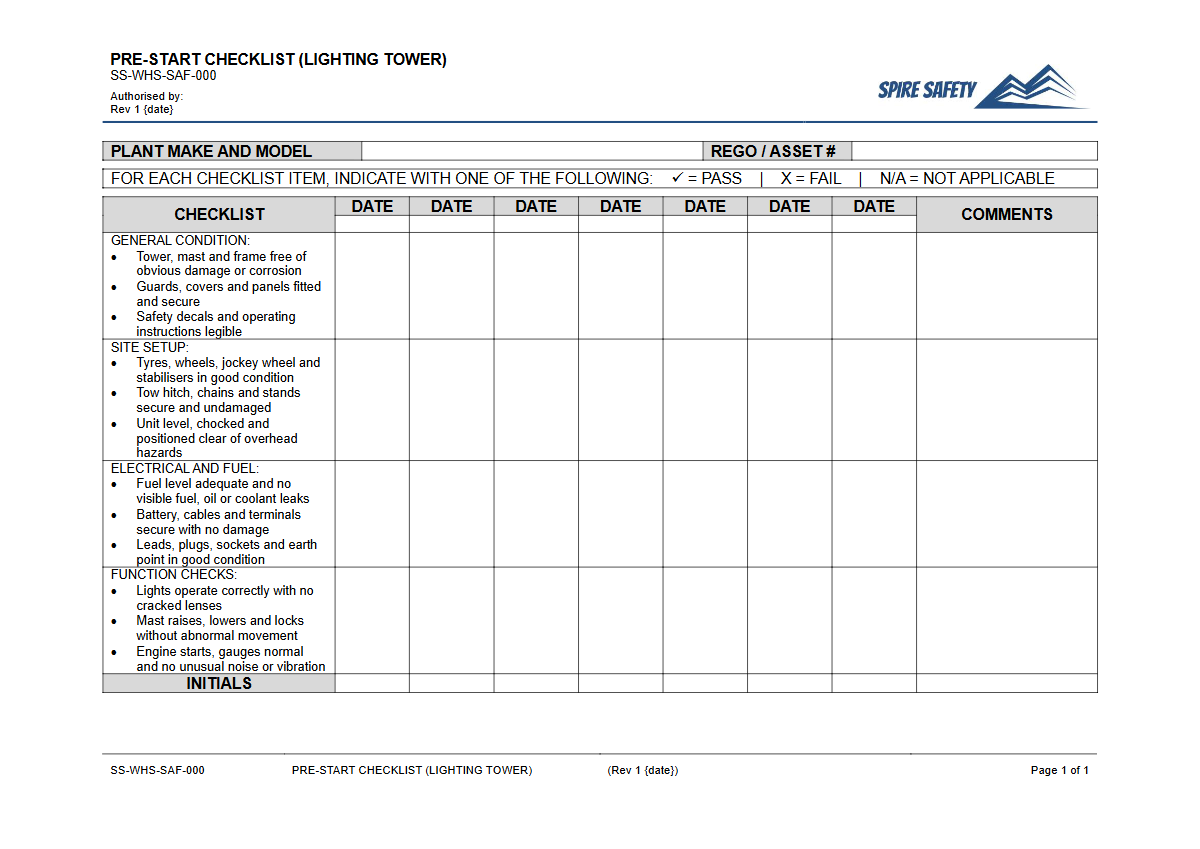
Formalise site safety with our free Pre-Start Checklist for Lighting Towers. This structured DOCX & PDF template helps manage WHS risks. Download yours now.
Free Pre-Start Checklist (Lighting Tower) Template
DOCX • 125 KB + PDF
Updated Oct 2026
No signup required
Purpose of the Free Pre-Start Checklist (Lighting Tower) Template
Using a structured checklist before operating a lighting tower is a critical safety measure. Our Free Pre-Start Checklist (Lighting Tower) Template provides a systematic way to inspect equipment, helping to identify potential defects like fuel leaks, electrical faults, structural damage, or instability before they lead to an incident.
Regular, documented checks are a cornerstone of effective plant safety management and demonstrate a commitment to workplace health and safety. These inspections help ensure the equipment is safe for use, reducing the risk of property damage, environmental incidents, and, most importantly, injury to personnel.
A formal checklist process creates a reliable record that inspections have been completed. This documentation is invaluable for maintenance scheduling, incident investigations, and demonstrating due diligence.
It forms a key part of a broader safety framework, much like how other specialised equipment, such as that covered by our pre-start checklist for floor saws, requires specific pre-use verifications to manage its unique risks. By standardising the inspection process, you ensure that no critical safety component is overlooked, regardless of who is operating the equipment.
Video walkthrough
How to use the Free Pre-Start Checklist (Lighting Tower) Template
This template provides a comprehensive starting point aligned with Australian WHS principles for managing risks associated with portable lighting equipment. To implement it effectively in your workplace, follow these steps:
- Download: Get the template in your preferred format, either DOCX for easy editing or PDF for straightforward printing.
- Customise: This is the most important step. You must review and modify the template to suit the specific models of lighting towers you use, the unique conditions of your work environment (e.g., uneven terrain, public areas), and your organisation's existing safety procedures. We cannot know your exact circumstances; this document is a starting point, not a complete, out-of-the-box solution.
- Train: Ensure all operators and supervisors are trained on how to correctly use the checklist. This includes understanding what each check involves and the procedure for reporting and rectifying faults (the tag-out process).
- Implement: Integrate the checklist into your daily operational workflow. Make it a non-negotiable step before any lighting tower is put into service.
The checklist guides the user to inspect key components, including the engine or generator, fuel and fluid levels, electrical systems (cables, plugs, RCDs), mast and boom integrity, light fittings, and stabilisers. The principles of pre-use inspection are universal across many types of equipment, from site machinery to workshop tools covered by a bench grinder pre-start checklist.
When to use it
A pre-start checklist for a lighting tower should be completed before its first use on every shift. This ensures that the equipment's condition has not changed overnight or between shifts.
It is also crucial to perform a full inspection after the tower has been moved to a new location on site, even if it's a short distance, as transit can affect stability and connections. An inspection should also be conducted after any maintenance or repair work has been performed to verify its readiness for service.
Consistent use of the checklist helps build a picture of the equipment's condition over time, assisting with preventative maintenance planning. This proactive approach is far more effective at preventing failures than relying on reactive repairs. In sectors like forestry or remote civil works, where equipment is subjected to harsh conditions, diligent checks are even more vital, similar to those needed for machinery covered in our pre-start checklist for forwarders.
Who should use it
The pre-start check should be conducted by a person who is competent to operate the lighting tower. A competent person is someone who has received the necessary information, training, and instruction to perform the task safely.
They must be able to identify defects and understand the risks associated with them. Supervisors or team leaders also have a role in ensuring these checks are being completed correctly and that any reported issues are addressed promptly.
Ultimately, the Person Conducting a Business or Undertaking (PCBU) holds the primary duty of care to ensure the provision and maintenance of safe plant. Implementing mandatory pre-start checks is a practical way to fulfil this duty.
Reviewing completed checklists can also be a valuable input for higher-level verification activities, such as periodic WHS compliance auditing, which confirms that your safety procedures are working as intended on the ground.
This document is just one of many templates designed to assist your organisation in building a robust safety system. For more tools and templates, browse our complete free WHS resources library.
Common mistakes
Common mistakes to avoid
- Failing to check that stabilisers or outriggers are correctly deployed and locked on firm, level ground.
- Ignoring checks for frayed electrical cables, damaged plugs, or non-functional RCDs.
- 'Pencil-whipping' the checklist by ticking boxes without physically inspecting the corresponding items.
- Neglecting to check fuel and oil levels, leading to unexpected shutdowns or engine damage.
Legal references
Legal considerations
The following legal requirements may be relevant to this type of work.
- Work Health and Safety Act (Harmonised) — Provides the primary duties for protecting workers and other people from work health and safety risks.
- Work Health and Safety Regulations (Harmonised) — Sets out requirements supporting the management of workplace hazards and risks.
The following codes may be relevant to this type of work.
- Managing WHS Risks Code of Practice — Provides practical guidance on identifying hazards, assessing risks and applying effective controls.
- Work Health and Safety Consultation, Cooperation and Coordination Code of Practice — Provides practical guidance on consulting workers and coordinating with other duty holders.
- Managing the Work Environment and Facilities Code of Practice — Provides practical guidance on safe work environments, workplace facilities and related controls.
Did you know
Glare and Light Spill
Improperly positioned lighting towers can create significant hazards, such as dangerous glare for vehicle operators or light spill into neighbouring properties, which can be both a nuisance and a safety risk.
Carbon Monoxide Risk
Diesel-powered lighting towers emit carbon monoxide. Their placement must consider ventilation and proximity to work areas to prevent asphyxiation and poisoning risks to workers.
FAQ
Frequently asked questions
01What should be included in a lighting tower pre-start check?
02Are digital pre-start checklists better than paper?
03How often do lighting towers need a pre-start inspection?
04Who is responsible for ensuring lighting tower pre-start checks are done?
Share this resource
Free Pre-Start Checklist (Lighting Tower) Template
Browse Categories
How To Use It
- 1Download and open in Word or PDF.
- 2Replace the placeholders with your business details.
- 3Get it reviewed by a WHS specialist before rollout.
Need it customised?
Our WHS consultants can adapt this template to your site, run a gap analysis, or audit what you already have in place.
Book a Free Consultation WHS consulting servicesor call 1300 156 382