
Free Pre-Start Checklist (Litter Vacuum) Template
Download our free Pre-Start Checklist for Litter Vacuums. This customisable DOCX and PDF template helps formalise equipment safety checks. Start today.
Free Pre-Start Checklist (Litter Vacuum) Template
DOCX • 125 KB + PDF
Updated Oct 2026
No signup required
Purpose of the Free Pre-Start Checklist (Litter Vacuum) Template
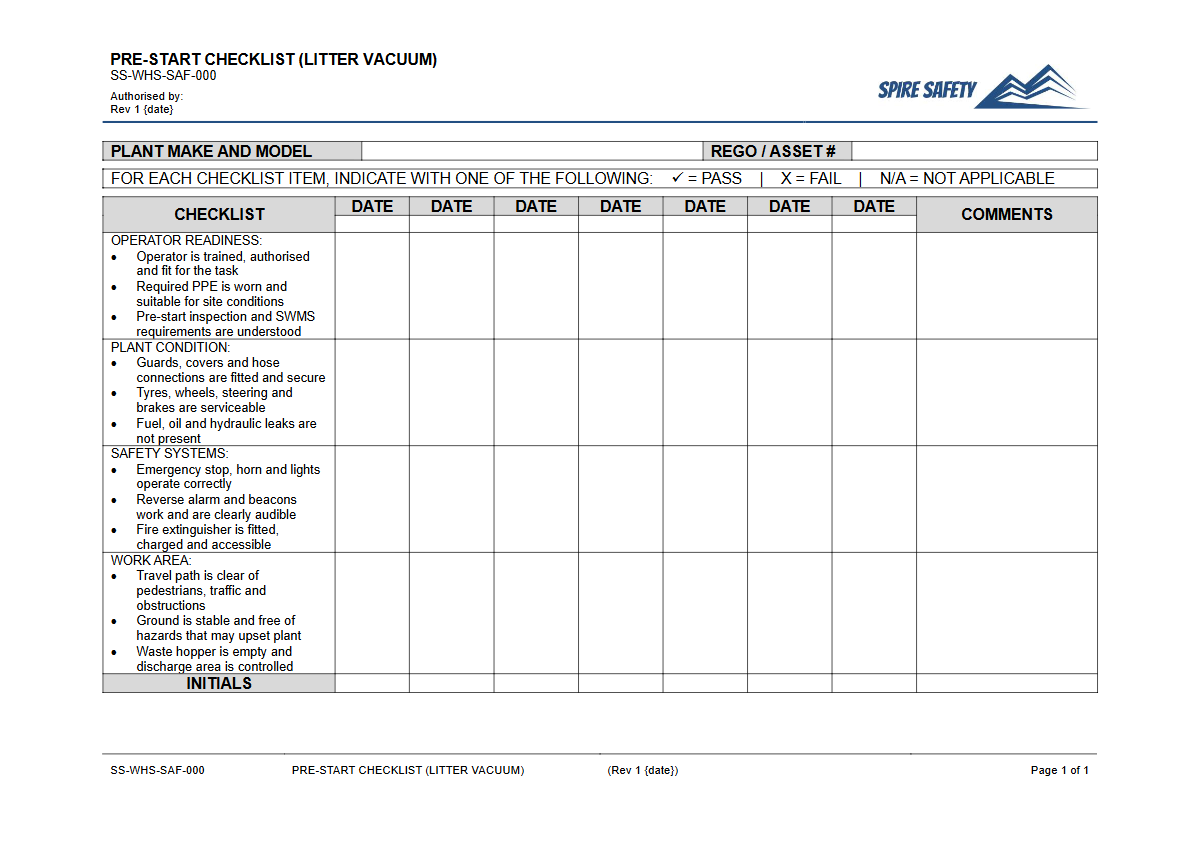
Using a structured checklist before operating machinery like a litter vacuum is a fundamental part of maintaining a safe work environment. This Free Pre-Start Checklist (Litter Vacuum) Template provides a formal method for operators to conduct essential safety and operational inspections before each use.
The primary purpose is to systematically identify any faults, damage, or wear and tear that could compromise the machine's safety or performance. Early detection of issues such as damaged suction hoses, worn wheels, or malfunctioning safety cut-outs helps prevent accidents, protect the operator, and avoid unexpected equipment breakdowns and costly repairs.
Implementing regular pre-start checks demonstrates a commitment to proactive safety management and helps meet your PCBU (Person Conducting a Business or Undertaking) duties under Australian WHS law. Consistent use of this checklist forms a critical part of your overall WHS management systems by creating a verifiable record of equipment maintenance and due diligence.
It ensures that only equipment in safe, working order is used, reducing the risk of incidents related to mechanical failure.
Video walkthrough
How to use the Free Pre-Start Checklist (Litter Vacuum) Template
This template is designed as a structured starting point for your organisation's safety procedures. To implement it effectively, begin by downloading the template in your preferred format (DOCX or PDF).
The next crucial step is customisation. It is essential that you review and adapt the checklist to suit the specific make and model of the litter vacuum(s) used in your workplace, as well as the unique environmental conditions and operational risks present.
Important: This is a template only. We are not familiar with your unique operational context.
You MUST customise this document to align with your specific machinery, tasks, and workplace risks. Consult the manufacturer's operating manual for a comprehensive list of required checks and integrate them into your final document.
Once customised, provide training to all operators on how to properly complete the checklist, what to look for during each inspection point, and the procedure for reporting defects. For guidance on communicating these procedures, consider using our Pre-Start Checks and Plant Maintenance Toolbox Talk Template to facilitate team discussions.
Key Components to Include
While customisation is key, a comprehensive litter vacuum pre-start checklist should generally cover several critical areas. These include:
- General Condition: Check for any obvious structural damage, loose parts, or fluid leaks.
- Engine/Motor: Inspect fuel or oil levels (for petrol models), battery charge (for electric models), and the condition of electrical cords and plugs.
- Suction System: Examine the suction hose, nozzle, and debris bag or container for blockages, rips, or secure fittings.
- Wheels and Mobility: Check tyre pressure (if applicable), wheel condition, and ensure smooth movement and steering.
- Safety Features: Verify that all guards are in place, emergency stops are functional, and operator-presence controls work correctly.
- Controls and Handles: Ensure all controls are clearly labelled, responsive, and that handles provide a secure grip.
Integrating these checks helps create a robust inspection process. Keeping completed checklists on file is also an important step in record-keeping, which can be reviewed during a WHS compliance audit to demonstrate procedural consistency.
When to use it
A pre-start checklist for a litter vacuum should be completed before the start of every shift or before the first use of the day. This frequency ensures that any issues that may have developed overnight or between shifts are identified before the machine is put into operation.
Additionally, a check should be performed if a new operator takes over the equipment mid-shift. This ensures continuity of safety and holds each operator accountable for the machine's condition during their use.
Documenting the procedure for using equipment like this is a core part of a strong safety framework. High-risk tasks often require a Safe Work Method Statement for vacuum truck operation, and while a litter vacuum may seem less complex, the principle of documenting safe procedures remains the same.
Who should use it
The primary user of the pre-start checklist is the equipment operator. They are the ones with hands-on responsibility for conducting the physical inspection and are in the best position to notice subtle changes in the machine's performance or condition.
Supervisors and managers also have a key role; they are responsible for ensuring operators are trained and competent to perform the checks, that the procedure is consistently followed, and that a clear process exists for reporting and addressing any identified faults. A faulty machine should be immediately tagged out of service until it can be repaired by a qualified maintenance person.
Ensuring operators are competent is a critical step that goes beyond just the pre-start check. For more complex vacuum equipment, organisations often use a formal assessment like our Verification of Competency for a hydrovac or vacuum excavator to formally verify skills.
For more general WHS document needs, explore our comprehensive free WHS resources library for a wide range of templates.
Common mistakes
Common mistakes to avoid
- Completing the checklist from memory without physically inspecting the machine ('pencil-whipping').
- Failing to report minor defects, which can escalate into major failures or safety hazards.
- Using a generic, non-customised checklist that doesn't cover the specific features of the equipment model.
- Continuing to use a machine after a fault has been identified, instead of tagging it out of service for repair.
Legal references
Legal considerations
The following legal requirements may be relevant to this type of work.
- Work Health and Safety Act (Harmonised) — Provides the primary duties for protecting workers and other people from work health and safety risks.
- Work Health and Safety Regulations (Harmonised) — Sets out requirements supporting the management of workplace hazards and risks.
The following codes may be relevant to this type of work.
- Managing WHS Risks Code of Practice — Provides practical guidance on identifying hazards, assessing risks and applying effective controls.
- Work Health and Safety Consultation, Cooperation and Coordination Code of Practice — Provides practical guidance on consulting workers and coordinating with other duty holders.
- Managing the Work Environment and Facilities Code of Practice — Provides practical guidance on safe work environments, workplace facilities and related controls.
Did you know
Invisible Hazards
Industrial vacuums are critical for managing dust, but some dusts, like crystalline silica, are invisible to the naked eye and can cause serious lung disease. Effective filtration and maintenance are as important as suction power.
The Pareto Principle in Maintenance
Studies in industrial maintenance often show that around 80% of equipment failures are preceded by detectable warning signs. Routine pre-start checks are designed to catch these signs before they lead to a breakdown or incident.
FAQ
Frequently asked questions
01What is the main purpose of a litter vacuum pre-start check?
02How often should a litter vacuum pre-start inspection be completed?
03Who is responsible for ensuring pre-start checks are done correctly?
04Can I use this template for any brand of litter vacuum?
Share this resource
Free Pre-Start Checklist (Litter Vacuum) Template
Browse Categories
How To Use It
- 1Download and open in Word or PDF.
- 2Replace the placeholders with your business details.
- 3Get it reviewed by a WHS specialist before rollout.
Need it customised?
Our WHS consultants can adapt this template to your site, run a gap analysis, or audit what you already have in place.
Book a Free Consultation WHS consulting servicesor call 1300 156 382