
Free Pre-Start Checklist (Long Reach Ex) Template
Download our free Pre-Start Checklist for Long Reach Excavators. This DOCX & PDF template helps formalise daily equipment safety inspections. Download now.
Free Pre-Start Checklist (Long Reach Ex) Template
DOCX • 125 KB + PDF
Updated Oct 2026
No signup required
Purpose of the Free Pre-Start Checklist (Long Reach Ex) Template
Operating heavy machinery like a long reach excavator requires strict safety protocols. A critical first step before any shift is a thorough pre-start inspection.
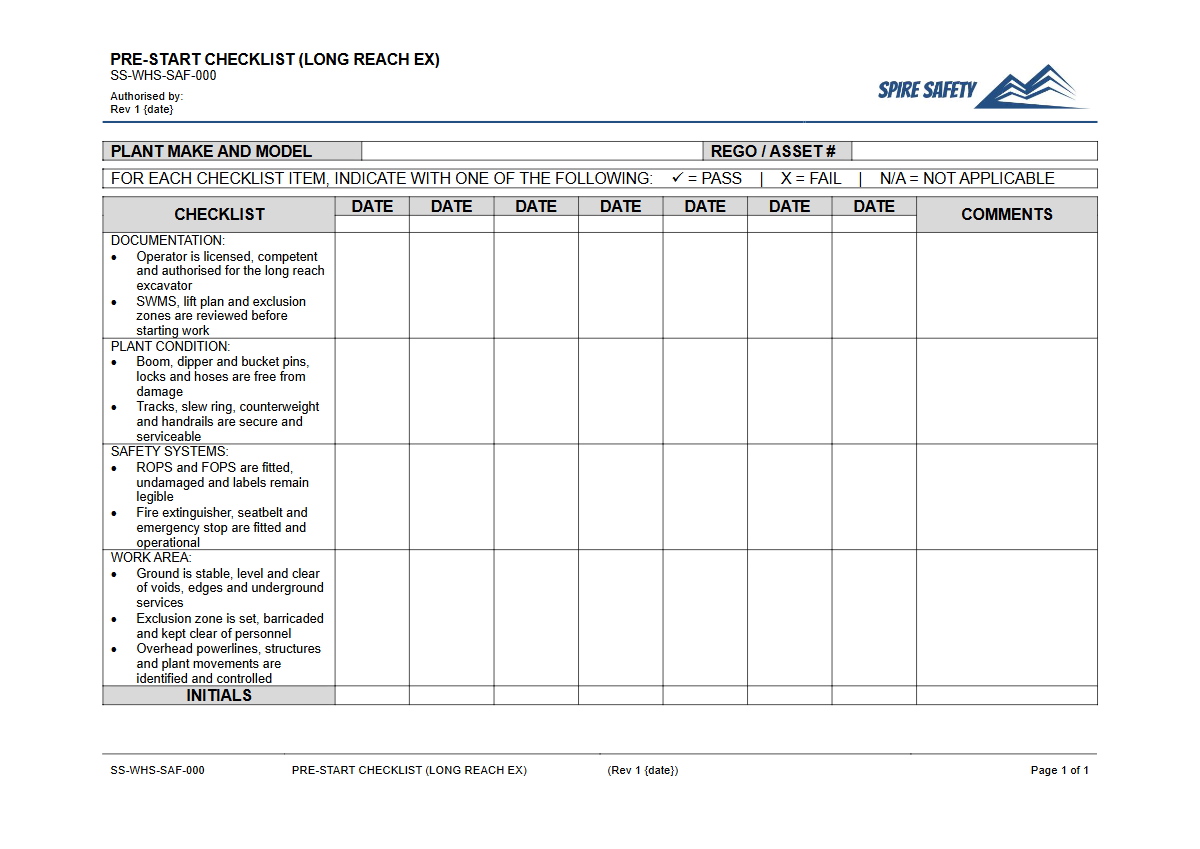
Our Free Pre-Start Checklist (Long Reach Ex) Template provides a structured framework to help operators systematically identify potential hazards and ensure the equipment is safe for use. This downloadable DOCX and PDF template is designed to be adapted to your specific machinery and operational context, helping you formalise your safety procedures.
The primary purpose of this Free Pre-Start Checklist (Long Reach Ex) Template is to prevent incidents by identifying mechanical faults, hydraulic leaks, structural damage, or other hazards before the excavator is put into service. Long reach excavators present unique risks, including instability due to the extended boom, increased stress on hydraulic systems, and a larger operational footprint.
A consistent checking process helps manage these risks, promotes operator accountability, and provides documented evidence of due diligence. Integrating such checks is a fundamental part of robust WHS management systems that protect workers and the organisation.
Video walkthrough
How to use the Free Pre-Start Checklist (Long Reach Ex) Template
Download the template in your preferred format (DOCX for easy editing or PDF). Before implementation, it is crucial to customise the checklist to reflect the specific make, model, and configuration of your long reach excavator, as well as the unique conditions of your worksite.
Important Note: This document is a template only. We have designed it as a structured starting point, but you must adapt it to the specific plant, tasks, and risks at your workplace.
We recommend consulting the manufacturer's manual and relevant safety standards during customisation.
Once customised, operators should be trained on how to complete the checklist correctly. This training can be effectively delivered through practical demonstrations and regular safety meetings, such as those facilitated by our Pre-Start Checks and Plant Maintenance Toolbox Talk Template.
When to use it
The pre-start checklist should be completed by the operator before the start of every shift or before using the excavator for the first time on any given day. If the operator changes during a shift, the incoming operator should also conduct their own pre-start check to verify the machine's condition. These daily checks are a crucial complement to scheduled periodic maintenance and should be treated as a non-negotiable part of the daily routine, often discussed in daily pre-start meetings.
Who should use it
The primary user of the checklist is the licensed and competent operator assigned to the long reach excavator. They have the hands-on responsibility to physically inspect each item listed.
Supervisors or managers also have a role in ensuring the checks are being completed consistently and correctly, and that any reported faults are actioned promptly. Verifying an operator's ability to safely use equipment is essential; this process can be formalised using tools like a Verification of Competency for a Reach Stacker, which confirms both theoretical knowledge and practical skill.
Completed checklists should be retained as part of your safety records. Regularly reviewing these records can help identify recurring issues with specific machines, indicating a need for more intensive maintenance or even replacement. This data becomes a valuable input for your continuous improvement processes and can be a key point of review during a WHS compliance audit.
By embedding a thorough pre-start inspection into your daily operations, you create a stronger safety culture and reduce the risk of incidents involving heavy plant. For more tools to support your safety program, explore our complete free WHS resources library.
Common mistakes
Common mistakes to avoid
- Skipping checks or rushing through the list to save time.
- Using a generic excavator checklist that doesn't cover long-reach specific components.
- Failing to formally document and report identified faults, leading to unsafe operation.
- Completing the checklist from memory without physically inspecting each item.
Legal references
Legal considerations
The following legal requirements may be relevant to this type of work.
- Work Health and Safety Act (Harmonised) — Provides the primary duties for protecting workers and other people from work health and safety risks.
- Work Health and Safety Regulations (Harmonised) — Sets out requirements supporting the management of workplace hazards and risks.
The following codes may be relevant to this type of work.
- Managing WHS Risks Code of Practice — Provides practical guidance on identifying hazards, assessing risks and applying effective controls.
- Work Health and Safety Consultation, Cooperation and Coordination Code of Practice — Provides practical guidance on consulting workers and coordinating with other duty holders.
- Managing the Work Environment and Facilities Code of Practice — Provides practical guidance on safe work environments, workplace facilities and related controls.
Did you know
Stability is Key
The extended boom on a long reach excavator significantly changes its centre of gravity, making stability calculations and ground condition assessments critical before every operation.
FAQ
Frequently asked questions
01What are the key checks for a long reach excavator pre-start?
02How often should a pre-start check be done on a long reach excavator?
03What should happen if a fault is found during a pre-start check?
04Is a digital pre-start checklist better than a paper one?
Share this resource
Free Pre-Start Checklist (Long Reach Ex) Template
Browse Categories
How To Use It
- 1Download and open in Word or PDF.
- 2Replace the placeholders with your business details.
- 3Get it reviewed by a WHS specialist before rollout.
Need it customised?
Our WHS consultants can adapt this template to your site, run a gap analysis, or audit what you already have in place.
Book a Free Consultation WHS consulting servicesor call 1300 156 382