
Free Pre-Start Checklist (Man Basket) Template
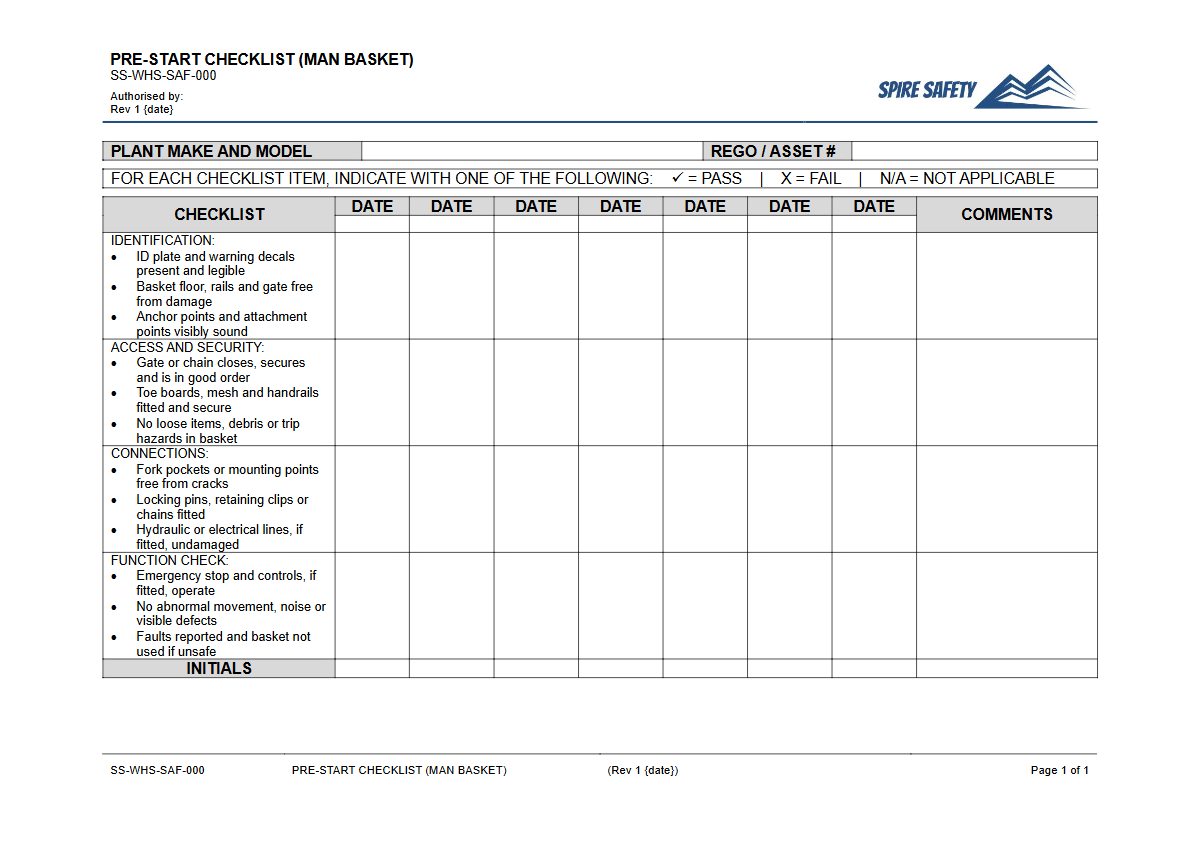
Download our Free Pre-Start Checklist (Man Basket) Template in DOCX & PDF. This resource helps formalise safety inspections and manage WHS risks. Get started.
Free Pre-Start Checklist (Man Basket) Template
DOCX • 125 KB + PDF
Updated Oct 2026
No signup required
Purpose of the Free Pre-Start Checklist (Man Basket) Template
Using a man basket (also known as a work box or personnel cage) for tasks at height introduces significant safety risks. This Free Pre-Start Checklist (Man Basket) Template provides a structured framework for operators and supervisors to conduct thorough pre-use inspections.
Formalising these checks helps systematically identify potential faults, damage, or wear and tear before the equipment is used, which is critical for preventing falls, structural failures, and other serious incidents. Integrating such documented procedures is a fundamental part of effective WHS management systems, creating a clear record of due diligence and promoting a proactive safety culture.
Video walkthrough
How to use the Free Pre-Start Checklist (Man Basket) Template
This Pre-Start Checklist is available as an editable DOCX file, allowing for easy customisation, and a ready-to-print PDF. It guides the user through a logical inspection sequence covering the most critical components of a man basket and its associated setup.
Key inspection areas include:
- Structural Integrity: Checking for cracks, corrosion, and deformities in welds, floors, and guardrails.
- Attachment Points: Ensuring lifting lugs and suspension points are secure and undamaged.
- Gate and Latch Mechanism: Verifying the entry gate self-closes and latches correctly.
- Fall Arrest Anchors: Inspecting the integrity and certification of engineered anchor points.
- Signage: Confirming that the load capacity, serial number, and compliance plates are legible and attached.
- Associated Gear: Checking slings, shackles, and other lifting accessories for damage or wear.
This template provides a strong foundation aligned with Australian WHS practice. However, we must stress that you need to customise it to your specific man basket model, the host machine (e.g., crane, telehandler), your site conditions, and your organisation's safe work procedures. The adequacy of these records may be reviewed during a WHS compliance audit.
When to use a Man Basket Pre-Start Checklist
A pre-start check must be completed before the first use of the man basket on every shift. If the equipment is used by different operators during a single shift, each new operator should review the checklist or conduct their own inspection before commencing work.
This routine is vital because the condition of equipment can change quickly due to transport, environmental factors, or the nature of the work being performed. This process is just as vital for high-risk lifting equipment as it is for other hazardous tools on site, such as those covered by our Free Pre-Start Checklist (Floor Saw) Template.
Who should use this Pre-Start Checklist
The person responsible for conducting the pre-start inspection is typically a competent person, which generally means the licensed and trained operator of the host machine (e.g., the crane or telehandler operator). They have the primary responsibility for ensuring both the host machine and the attached man basket are safe for use.
A supervisor or safety officer should also review the completed checklists to ensure procedures are being followed correctly and to address any identified defects promptly. The importance of competent operators is a common theme across all heavy equipment, including machinery detailed in our Free Pre-Start Checklist (Forwarder) Template.
By embedding this checklist into your daily routine, you create a verifiable safety record and empower your team to take ownership of workplace safety. The fundamental principles of inspecting lifting components apply to a wide range of plant, from complex crane attachments to simpler devices like those in our Free Pre-Start Checklist (Bin Lifter) Template. For more tools to support your safety framework, browse our complete free WHS resources library.
Common mistakes
Common mistakes to avoid
- Overlooking the condition of the host machine (e.g., crane) and focusing only on the basket.
- Failing to verify the load capacity of the basket against the combined weight of personnel, tools, and materials.
- Using a basket that has not been designed and manufactured in accordance with relevant Australian Standards (e.g., AS 1418.17).
- Neglecting to check the condition and certification of associated lifting gear like chains, slings, or shackles.
Legal references
Legal considerations
The following legal requirements may be relevant to this type of work.
- Work Health and Safety Act (Harmonised) — Provides the primary duties for protecting workers and other people from work health and safety risks.
- Work Health and Safety Regulations (Harmonised) — Sets out requirements supporting the management of workplace hazards and risks.
The following codes may be relevant to this type of work.
- Managing WHS Risks Code of Practice — Provides practical guidance on identifying hazards, assessing risks and applying effective controls.
- Work Health and Safety Consultation, Cooperation and Coordination Code of Practice — Provides practical guidance on consulting workers and coordinating with other duty holders.
- Managing the Work Environment and Facilities Code of Practice — Provides practical guidance on safe work environments, workplace facilities and related controls.
Did you know
A Method of Last Resort
Using a crane to lift personnel in a man basket is considered a high-risk activity. WHS regulations generally state it should only be done when it is not practicable to access the work area with other, inherently safer methods like an EWP or scaffolding.
Host Machine is Key
The safety of a man basket is equally dependent on the condition of the host machine lifting it. A pre-start inspection of the crane or telehandler is just as critical as the inspection of the basket itself.
FAQ
Frequently asked questions
01What is the purpose of a man basket pre-start checklist?
02Is it a legal requirement to use a pre-start checklist for a man basket in Australia?
03Who is responsible for completing the man basket pre-start inspection?
04How often should a man basket be inspected?
Share this resource
Free Pre-Start Checklist (Man Basket) Template
Browse Categories
How To Use It
- 1Download and open in Word or PDF.
- 2Replace the placeholders with your business details.
- 3Get it reviewed by a WHS specialist before rollout.
Need it customised?
Our WHS consultants can adapt this template to your site, run a gap analysis, or audit what you already have in place.
Book a Free Consultation WHS consulting servicesor call 1300 156 382