
Free Pre-Start Checklist (Bin Lifter) Template
Download our free Pre-Start Checklist (Bin Lifter) Template. This structured DOCX and PDF document helps formalise safety checks for Australian businesses.
Free Pre-Start Checklist (Bin Lifter) Template
DOCX • 125 KB + PDF
Updated Oct 2026
No signup required
Purpose of the Free Pre-Start Checklist (Bin Lifter) Template
Operating a bin lifter, whether wheelie bin tippers or larger industrial units, introduces significant workplace hazards if the equipment is not properly maintained. Using a structured Pre-Start Checklist for your bin lifter is a fundamental step in fulfilling your duty of care and managing risks.
This free template provides a systematic way for operators to verify that a bin lifter is safe to use before their shift begins, helping to identify mechanical faults, hydraulic leaks, or damage to safety-critical components like guards and emergency stops.
Regular, documented checks help prevent incidents related to equipment failure, such as uncontrolled movements, crushing injuries, or hydraulic system failures. Integrating these checks into your daily operations is a key part of a proactive safety culture and demonstrates a commitment to plant and equipment safety.
A well-implemented pre-start process reduces the risk of injury from both equipment malfunction and the hazardous manual tasks it is designed to replace; for more on this topic, our Aged Care Manual Handling Toolbox Talk Template provides valuable insights, even for industries outside of aged care.
What is included in this Bin Lifter Pre-Start Checklist?
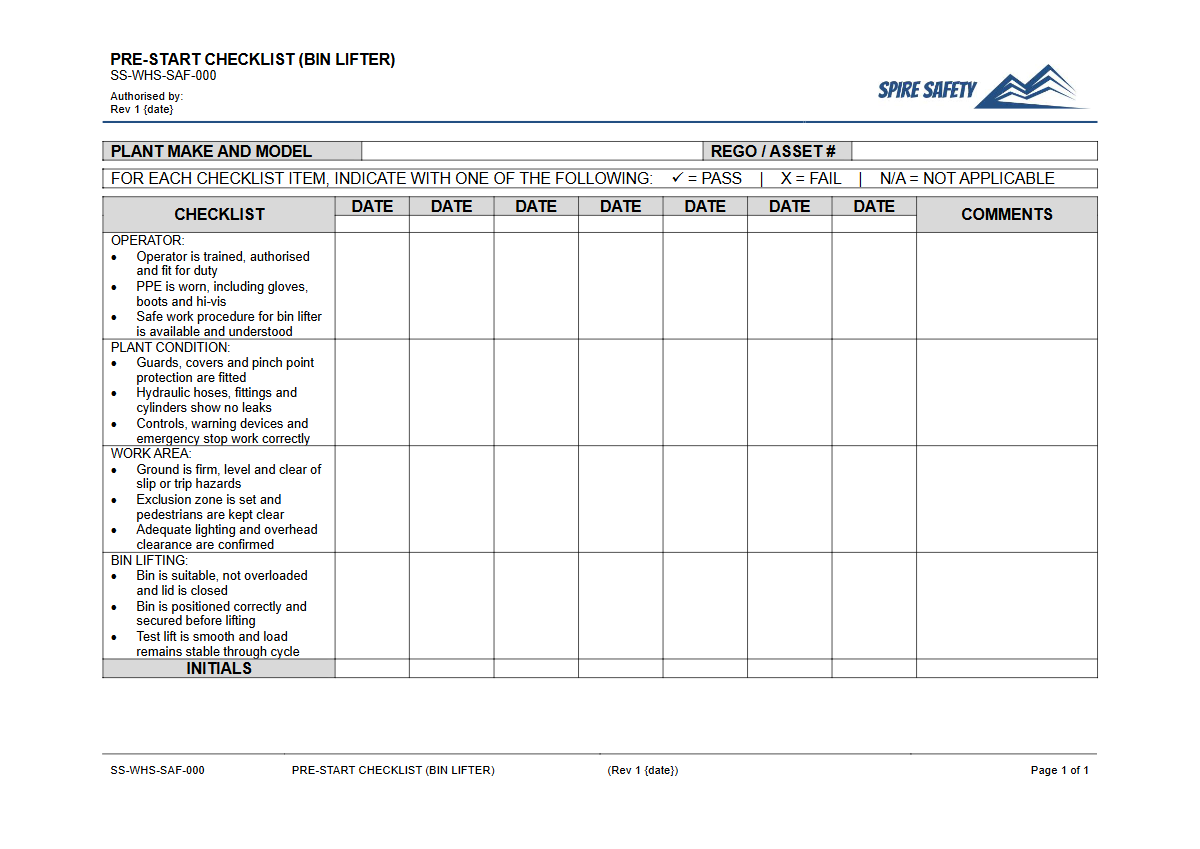
This template is designed as a comprehensive starting point, aligned with Australian WHS principles. It covers key inspection areas including:
- General machine condition (cleanliness, damage)
- Hydraulic systems (hoses, connections, fluid levels)
- Mechanical components (lifting arms, cradle, latches)
- Safety features (guards, emergency stop, warning devices)
- Controls and operation
These documented checks form an important part of your overall WHS management systems, providing records that can be reviewed during safety meetings, incident investigations, or internal audits.
Video walkthrough
How to use the Free Pre-Start Checklist (Bin Lifter) Template
To effectively implement this checklist, follow these steps:
- Download and Customise: Download the template in your preferred format (DOCX or PDF). It is crucial that you customise the document to suit the specific make and model of the bin lifter(s) used in your workplace. Review the manufacturer's operating manual and your own risk assessments to add or remove items. We have provided a solid starting point, but you must adapt it to your unique operational context and legal obligations.
- Train Operators: Ensure all operators are thoroughly trained on how to conduct the pre-start inspection correctly. They must understand what each checkpoint means and the procedure for reporting any identified faults or deficiencies.
- Implement the Process: Integrate the checklist into your daily start-up procedure. Operators must complete and sign the checklist before using the equipment for the first time each day or at the start of their shift.
- Establish a Reporting Procedure: Create a clear process for what an operator should do if a defect is found. This must include immediately taking the equipment out of service, applying a "Do Not Operate" tag, and reporting the fault to a supervisor or the maintenance department for repair. The effectiveness of these procedures can be verified through periodic WHS compliance auditing.
When to use a Bin Lifter Pre-Start Checklist
A bin lifter pre-start check should be conducted at the beginning of every shift or day of use, before the equipment is operated for the first time. This consistent routine ensures that any damage or faults that may have occurred since its last use—whether through operation, overnight storage, or environmental factors—are identified before the machine becomes a risk. Reinforcing this habit is essential, a topic covered in our Pre-Start Checks and Plant Maintenance Toolbox Talk.
Who should use this Pre-Start Checklist
This checklist should be completed by a person who is trained, authorised, and deemed competent to operate the specific bin lifter. A 'competent' person possesses the necessary knowledge and skill, gained through training and experience, to perform the task safely. This includes the ability to accurately identify faults and understand the risks associated with operating defective equipment. Supervisors should also be familiar with the checklist to ensure operators are completing it correctly and to follow up on any reported issues. The same principle of using competent operators for pre-start checks applies to all mobile plant; for instance, operators using our free Articulated Loader Pre-Start Checklist template must also be verified as competent on that specific machine. You can find more templates like this in our free WHS resources library.
Common mistakes
Common mistakes to avoid
- Failing to customise the generic template for the specific bin lifter model.
- Operators 'pencil-whipping' the form without physically performing the checks.
- Not immediately tagging out and reporting equipment with identified defects.
- Neglecting to review completed checklists to identify recurring maintenance issues.
Legal references
Legal considerations
The following legal requirements may be relevant to this type of work.
- Work Health and Safety Act (Harmonised) — Provides the primary duties for protecting workers and other people from work health and safety risks.
- Work Health and Safety Regulations (Harmonised) — Sets out requirements supporting the management of workplace hazards and risks.
The following codes may be relevant to this type of work.
- Managing WHS Risks Code of Practice — Provides practical guidance on identifying hazards, assessing risks and applying effective controls.
- Work Health and Safety Consultation, Cooperation and Coordination Code of Practice — Provides practical guidance on consulting workers and coordinating with other duty holders.
- Managing the Work Environment and Facilities Code of Practice — Provides practical guidance on safe work environments, workplace facilities and related controls.
Did you know
Hydraulic Pressure
A pinhole leak in a high-pressure hydraulic hose can release fluid at a velocity high enough to penetrate skin, causing severe and potentially fatal injection injuries.
Manual Handling Alternative
Bin lifters are a common engineering control used to mitigate risks associated with hazardous manual tasks, which account for a significant portion of all serious workers' compensation claims in Australia.
FAQ
Frequently asked questions
01What are the main hazards of operating a bin lifter?
02How often should a bin lifter pre-start check be done?
03Who is responsible for completing the bin lifter pre-start checklist?
04Can this template be used for any type of bin lifter?
Share this resource
Free Pre-Start Checklist (Bin Lifter) Template
Browse Categories
How To Use It
- 1Download and open in Word or PDF.
- 2Replace the placeholders with your business details.
- 3Get it reviewed by a WHS specialist before rollout.
Need it customised?
Our WHS consultants can adapt this template to your site, run a gap analysis, or audit what you already have in place.
Book a Free Consultation WHS consulting servicesor call 1300 156 382