
Free Pre-Start Checklist (Blast Drill) Template
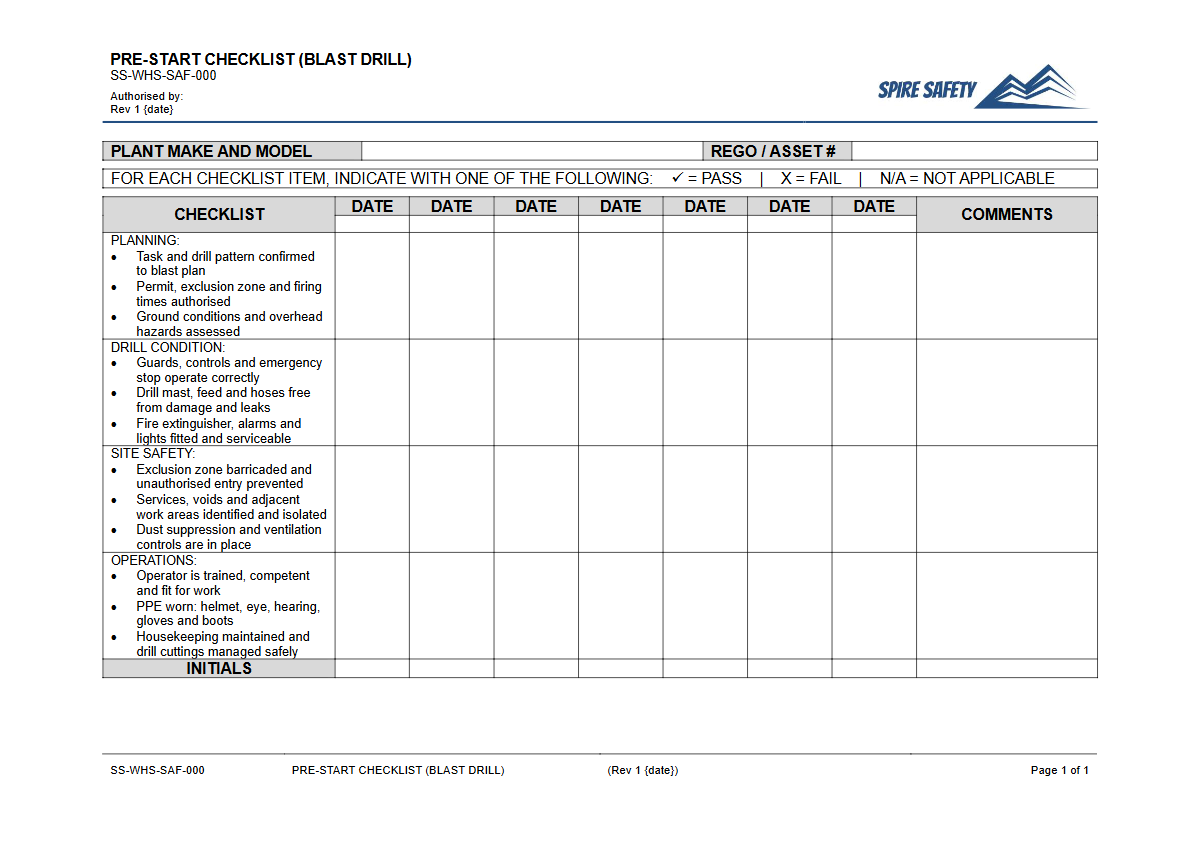
Download our free Pre-Start Checklist (Blast Drill) template, a user-friendly DOCX & PDF resource for Australian mining and construction sites.
Free Pre-Start Checklist (Blast Drill) Template
DOCX • 125 KB + PDF
Updated Oct 2026
No signup required
Purpose of the Free Pre-Start Checklist (Blast Drill) Template
Operating a blast drill is a high-risk activity common in mining, quarrying, and large-scale construction. Given the power and complexity of this machinery, a systematic pre-operation inspection is non-negotiable.
This Free Pre-Start Checklist (Blast Drill) Template provides a structured framework for operators to verify the safety and functionality of the equipment before commencing work. Its primary purpose is to identify any mechanical faults, hydraulic leaks, structural damage, or control system malfunctions that could lead to an incident, injury, or catastrophic failure during operation.
Using this checklist helps create a documented record of due diligence, demonstrating that all reasonably practicable steps were taken to ensure the drill was safe for use. It standardises the inspection process across all operators and shifts, ensuring no critical checks are missed.
Regular use fosters a proactive safety culture, shifting the focus from reaction to prevention. It also forms a key part of your overall plant maintenance strategy, which can be reinforced through regular training like a Pre-Start Checks and Plant Maintenance Toolbox Talk.
Video walkthrough
How to Use the Free Pre-Start Checklist (Blast Drill) Template
This template is provided in both DOCX and PDF formats for your convenience. The DOCX file is fully editable, allowing you to tailor it to your specific operational needs. Follow these steps for effective implementation:
- Download: Select the DOCX or PDF version and save it to your system.
- Customise: Open the DOCX file and add your company name, logo, and any site-specific details. Critically, you must review and modify the checklist items to match the exact make, model, and configuration of the blast drills used in your workplace.
- Review and Approve: Have the customised checklist reviewed by a competent person, such as a maintenance supervisor or safety manager, to ensure it is comprehensive and accurate.
- Train and Implement: Train all authorised blast drill operators on how to properly complete the checklist. Emphasise that this is not a 'tick-and-flick' exercise; each item requires a physical and visual inspection.
- Establish a Process: Define a clear procedure for what operators must do if they identify a 'No' or 'Fault' item. This must include immediately reporting the issue, tagging the equipment out of service, and not using the machine until it is certified as safe by a qualified mechanic.
Important Note: This document is a template only. We provide it as a starting point.
It is the responsibility of the Person Conducting a Business or Undertaking (PCBU) to ensure the final checklist is specific to their plant, processes, and risk profile. Proper customisation is essential for this document to be an effective risk management tool within your broader WHS management systems.
When to Use a Blast Drill Pre-Start Checklist
A pre-start checklist for a blast drill must be completed before the equipment is used for the first time on any given shift. It should also be completed whenever there is a change of operator during a shift.
This ensures that the incoming operator is fully aware of the machine's condition and is not relying on the checks of the previous operator.
Additional situations that warrant a full pre-start check include after the drill has undergone maintenance or repairs, before it is used after being idle for an extended period, or if it has been transported to a new location on-site. The checklist complements, but does not replace, other critical safety documents.
For example, while the pre-start focuses on the equipment's condition, a Hammer Drill SWMS would detail the high-risk steps of the drilling task itself.
Who Should Use This Pre-Start Checklist
The primary user of this checklist is the authorised and competent operator of the blast drill. They are the person with hands-on control of the machinery and are best placed to conduct the physical inspection before starting work. Verifying operator competency is a separate but related process, which can be documented using tools like a Free Drill Press VOC (Verification of Competency) Template.
Supervisors, foremen, and safety officers also have a role. They are responsible for ensuring that operators are completing the checks correctly and consistently.
They should periodically review completed checklists to identify recurring faults or trends that may indicate a need for improved maintenance schedules or operator retraining. These records are vital evidence of safety management during any formal WHS compliance auditing process.
The entire documentation lifecycle, from pre-starts to procedures like a Drill Safe Operating Procedure (SOP), builds a comprehensive picture of your safety practices.
Common mistakes
Common mistakes to avoid
- Pencil-whipping: Ticking off items without physically or visually inspecting them.
- Using a generic, non-specific checklist that doesn't match the drill's make and model.
- Ignoring minor reported faults (e.g., a small hydraulic leak) that can escalate into major failures.
- Failing to immediately remove and tag-out faulty equipment from service, creating risk for the next user.
Legal references
Legal considerations
The following legal requirements may be relevant to this type of work.
- Work Health and Safety Act (Harmonised) — Provides the primary duties for protecting workers and other people from work health and safety risks.
- Work Health and Safety Regulations (Harmonised) — Sets out requirements supporting the management of workplace hazards and risks.
The following codes may be relevant to this type of work.
- Managing WHS Risks Code of Practice — Provides practical guidance on identifying hazards, assessing risks and applying effective controls.
- Work Health and Safety Consultation, Cooperation and Coordination Code of Practice — Provides practical guidance on consulting workers and coordinating with other duty holders.
- Managing the Work Environment and Facilities Code of Practice — Provides practical guidance on safe work environments, workplace facilities and related controls.
Did you know
Flyrock Hazard
Flyrock, which are fragments propelled through the air by a blast, can travel over a kilometre from the blast site. This highlights the critical need for perfectly executed drilling patterns and equipment, starting with a thorough pre-start check.
FAQ
Frequently asked questions
01Why is a specific pre-start checklist for a blast drill so important?
02What is the difference between a pre-start checklist and a Safe Operating Procedure (SOP)?
03Can I use this template for other types of drills, like a rock drill or DTH drill?
04How often should our blast drill pre-start checklists be reviewed and updated?
Share this resource
Free Pre-Start Checklist (Blast Drill) Template
Browse Categories
How To Use It
- 1Download and open in Word or PDF.
- 2Replace the placeholders with your business details.
- 3Get it reviewed by a WHS specialist before rollout.
Need it customised?
Our WHS consultants can adapt this template to your site, run a gap analysis, or audit what you already have in place.
Book a Free Consultation WHS consulting servicesor call 1300 156 382