
Free Pre-Start Checklist (Blast Pot) Template
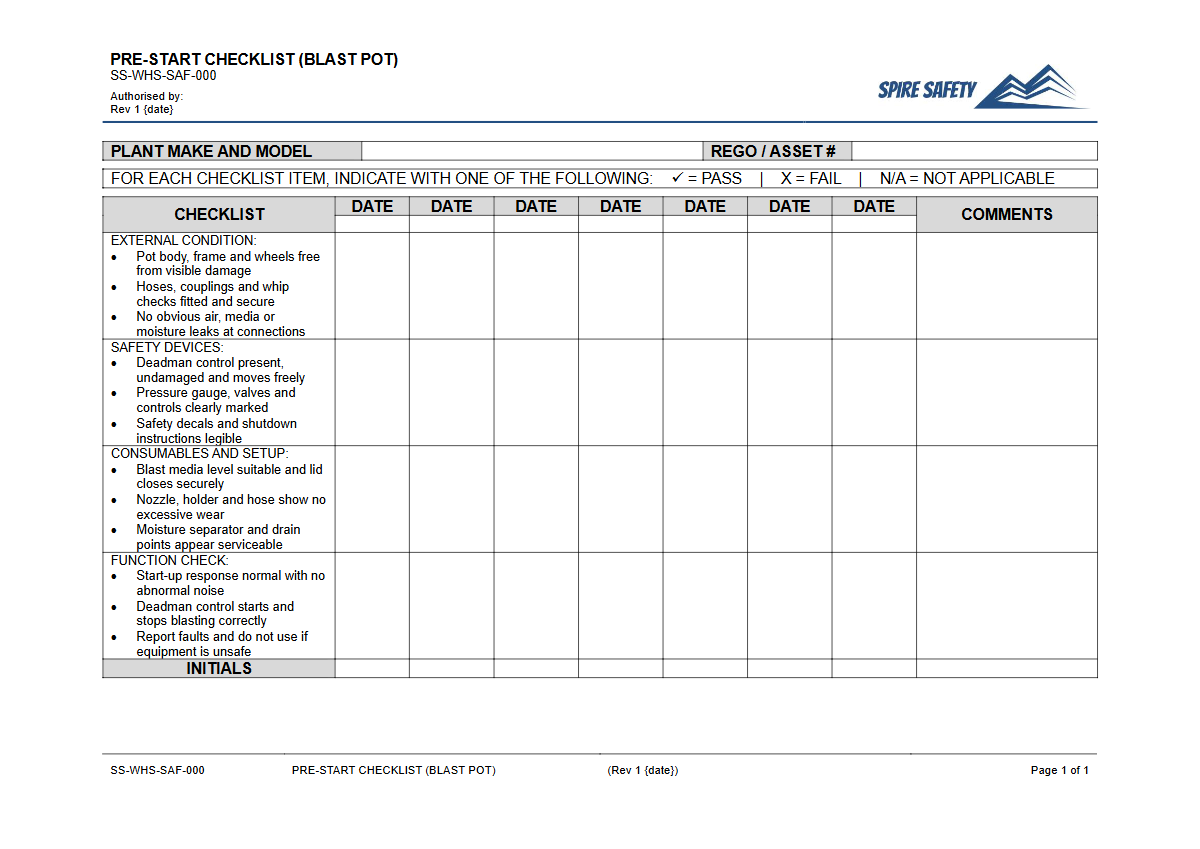
Formalise your abrasive blasting safety procedures with our Free Pre-Start Checklist (Blast Pot) Template. This structured DOCX & PDF helps manage risks.
Free Pre-Start Checklist (Blast Pot) Template
DOCX • 125 KB + PDF
Updated Oct 2026
No signup required
Purpose of the Free Pre-Start Checklist (Blast Pot) Template
Abrasive blasting involves significant risks, including high-pressure equipment failure, respiratory hazards from dust, and ergonomic injuries. This Free Pre-Start Checklist (Blast Pot) Template provides a structured framework for operators to conduct thorough, documented safety inspections before starting work.
By systematically checking critical components like hoses, nozzles, pressure vessels, and emergency controls, you can identify potential faults before they lead to an incident. A consistent pre-start process is a fundamental part of a proactive safety culture and helps demonstrate due diligence in managing plant and equipment risks.
Integrating such checks into daily operations is a cornerstone of effective WHS management systems. This template is designed as a practical tool aligned with Australian WHS principles to help your organisation formalise its equipment safety verification process. It guides users through key inspection points, ensuring that no critical safety feature is overlooked before the equipment is pressurised and put into service.
Video walkthrough
How to use the Free Pre-Start Checklist (Blast Pot) Template
Using this template effectively involves more than just printing it out. First, download the document in your preferred format (DOCX for easy customisation or PDF for immediate use).
The next crucial step is to adapt the checklist to your specific operational context. This involves reviewing each item and adding, removing, or modifying checks to suit the exact make and model of your blast pot, the type of abrasive media used, and the specific hazards of your work environment.
Once customised, ensure all operators are trained on how to use the checklist correctly. This training should cover what each checkpoint means, how to identify a fault, and the exact procedure to follow if a defect is found (e.g., tag-out, report to a supervisor).
For a comprehensive approach, consider how this document complements other equipment checks, such as our free checklist for bench grinders, to create a consistent safety inspection standard across your workshop.
Important Note on Customisation
This resource provides a solid foundation, but it is not a complete, out-of-the-box solution. We have drafted it to align with the model WHS framework, but you must customise it to reflect the specific blast pot model, abrasive media, work environment, and control measures unique to your organisation.
When to use it
The Pre-Start Checklist for a Blast Pot should be completed before every use or, at a minimum, at the beginning of each shift where the equipment will be operated. This frequency ensures that any damage or wear that may have occurred since the last use is identified promptly.
Conducting the check before the system is pressurised is a critical preventative step. It allows for safe inspection and rectification of issues without the risks associated with a live, high-pressure system.
These completed checklists should be retained as a record of your organisation's safety practices. They provide valuable data for maintenance scheduling, incident investigations, and demonstrating procedural compliance during internal or external WHS compliance auditing. Regular checks create a historical record that proves the equipment was in a safe condition before work commenced.
Who should use it
This checklist is intended for use by competent and trained operators who are authorised to use the abrasive blasting equipment. The person performing the check must have a thorough understanding of the blast pot's functions, potential failure points, and the associated risks.
Their training should empower them to not only follow the checklist but also to recognise signs of wear or damage that might not be explicitly listed.
Supervisors and WHS personnel also have a role in overseeing the process. They should periodically review completed checklists to ensure they are being filled out correctly and that any reported faults are being addressed in a timely manner.
Managing airborne contaminants is a key part of abrasive blasting safety, and a similar systematic approach can be applied using a pre-start checklist for fume cabinets where such equipment is used to control hazardous dust.
This structured approach ensures that responsibility for safety is clear and that checks are performed by those with the most direct knowledge of the equipment. Just as an operator wouldn't use a faulty saw, this process ensures a blast pot is verified as safe before use.
Similar principles apply to other high-risk tools, such as those covered in our pre-start checklist for a floor saw. By browsing our extensive free WHS resources library, you can find dozens of other templates to help formalise safety across all areas of your operation.
Common mistakes
Common mistakes to avoid
- Failing to verify the deadman switch is functioning correctly before every use.
- Neglecting to inspect hoses and couplings for wear, abrasion, or damage, which can lead to catastrophic failure under pressure.
- Using an incorrect or excessively worn nozzle, which reduces efficiency and can increase operator fatigue.
- Not ensuring the operator's respiratory protection equipment is appropriate for the abrasive being used and is functioning correctly.
Legal references
Legal considerations
The following legal requirements may be relevant to this type of work.
- Work Health and Safety Act (Harmonised) — Provides the primary duties for protecting workers and other people from work health and safety risks.
- Work Health and Safety Regulations (Harmonised) — Sets out requirements supporting the management of workplace hazards and risks.
The following codes may be relevant to this type of work.
- Managing WHS Risks Code of Practice — Provides practical guidance on identifying hazards, assessing risks and applying effective controls.
- Work Health and Safety Consultation, Cooperation and Coordination Code of Practice — Provides practical guidance on consulting workers and coordinating with other duty holders.
- Managing the Work Environment and Facilities Code of Practice — Provides practical guidance on safe work environments, workplace facilities and related controls.
Did you know
Deadman's Switch
The 'deadman's switch' on a blast pot is a critical safety device that automatically shuts off the flow of air and abrasive if the operator loses control of the nozzle, preventing serious injury from an uncontrolled, high-pressure stream.
Banned Abrasives
Using materials containing more than 1% free silica (like sand) for abrasive blasting is prohibited in Australia due to the high risk of causing silicosis, an incurable and often fatal lung disease.
FAQ
Frequently asked questions
01What are the biggest hazards associated with a blast pot?
02Is a pre-start check legally required for a blast pot in Australia?
03What should an operator do if a fault is found during a pre-start check?
04How is a pre-start check different from a formal pressure vessel inspection?
Share this resource
Free Pre-Start Checklist (Blast Pot) Template
Browse Categories
How To Use It
- 1Download and open in Word or PDF.
- 2Replace the placeholders with your business details.
- 3Get it reviewed by a WHS specialist before rollout.
Need it customised?
Our WHS consultants can adapt this template to your site, run a gap analysis, or audit what you already have in place.
Book a Free Consultation WHS consulting servicesor call 1300 156 382