
Free Pre-Start Checklist (Fume Cabinet) Template
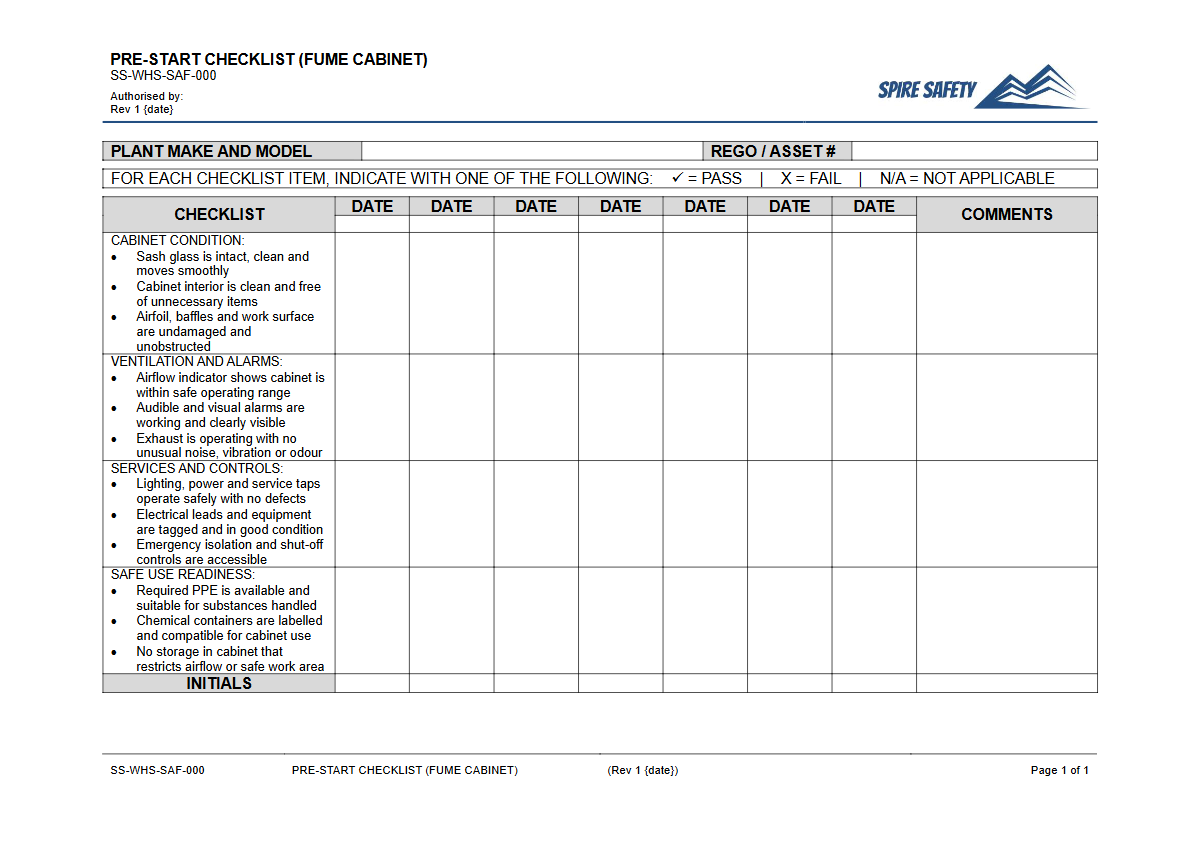
Download our free Pre-Start Checklist for Fume Cabinets. This template (DOCX & PDF) helps formalise daily safety checks. Get your free template today.
Free Pre-Start Checklist (Fume Cabinet) Template
DOCX • 125 KB + PDF
Updated Oct 2026
No signup required
Purpose of the Free Pre-Start Checklist (Fume Cabinet) Template
Fume cabinets are a critical piece of safety equipment, designed to protect workers from hazardous fumes, vapours, and dusts generated during laboratory work or industrial processes. To be effective, they must be in perfect working order.
This is where our Free Pre-Start Checklist (Fume Cabinet) Template comes in. It provides a structured, documented method for verifying that a fume cabinet is functioning correctly and is safe to use before any work begins.
The main purpose of this Pre-Start Checklist is to formalise the inspection process, moving it from a quick glance to a systematic check of essential safety components like airflow indicators, sash operation, and general structural integrity. Using a checklist ensures consistency and helps identify potential failures before they lead to a hazardous exposure.
This routine is a key operational control within broader WHS management systems, helping your organisation meet its duty of care to provide a safe working environment.
How to use the Free Pre-Start Checklist (Fume Cabinet) Template
Using this template is straightforward. After downloading the DOCX or PDF file, operators should follow these steps before commencing work:
- Review each item on the checklist, which covers common inspection points for standard fume cabinets.
- Physically inspect each component and tick off each item as it is confirmed to be in safe, working condition.
- Record the date, operator's name, and the outcome of the inspection.
- If any faults, damage, or concerns are noted (e.g., an alarm is sounding, the sash is cracked, or airflow seems low), the operator must not use the equipment. The issue should be reported to a supervisor immediately, and the fume cabinet should be clearly tagged as 'Out of Service' until it has been repaired and cleared for use by a competent person.
Note: This document is a template and must be customised to your specific workplace. We strongly advise that you add, remove, or modify checklist items to align with the manufacturer’s instructions for your particular fume cabinet model, the specific hazardous substances you handle, and your site's risk assessments.
For instance, a woodworking shop might integrate this with a free Cabinet Making SWMS template to create a comprehensive safety procedure for finishing tasks.
Video walkthrough
When to use this Pre-Start Checklist
This Pre-Start Checklist should be completed before every use, or at a minimum, at the beginning of each shift during which the fume cabinet is expected to be operated. Establishing this as a non-negotiable first step is crucial for its effectiveness.
Consistency helps build strong safety habits among all users and ensures that any gradual deterioration in performance is identified early. To reinforce this behaviour across all equipment, supervisors can facilitate discussions using a Pre-Start Checks and Plant Maintenance Toolbox Talk Template, highlighting the importance of pre-operational inspections.
Who should use it
The checklist is designed for the equipment operators—the laboratory technicians, researchers, manufacturing staff, or any other trained personnel who will be working directly with the fume cabinet. As the individuals most at risk of exposure, they are the best people to conduct the hands-on inspection.
Supervisors and managers also have a responsibility to ensure these checks are being completed consistently and that a clear process is in place for reporting and rectifying faults. These completed checklists form an important part of your safety records and may be reviewed during a WHS compliance auditing process to verify that procedures are being followed correctly.
Benefits of a Formal Fume Cabinet Check
Implementing a formal checklist process provides numerous benefits beyond basic compliance. It transforms safety checks from an assumed, often-missed step into a deliberate, verifiable action.
This enhances operator accountability and provides tangible evidence of an organisation’s commitment to providing a safe workplace. This documented trail of inspections is invaluable for maintenance planning, troubleshooting, and demonstrating due diligence.
If your organisation needs support integrating effective check processes into your daily workflows, specialist WHS consulting can provide expert guidance and system development.
This template offers a solid foundation for building a robust safety procedure around your fume cabinets. For more tools to support your safety management program, feel free to browse our complete free WHS resources library.
Common mistakes
Common mistakes to avoid
- Using the fume cabinet for storing chemicals and equipment, which blocks airflow and reduces efficiency.
- Placing items against the back baffles, preventing proper air extraction from the cabinet.
- Working with the sash raised higher than the recommended safe operating height, compromising containment.
- Failing to verify that the airflow monitor or alarm is active and functioning before starting work.
Legal references
Legal considerations
The following legal requirements may be relevant to this type of work.
- Work Health and Safety Act (Harmonised) — Provides the primary duties for protecting workers and other people from work health and safety risks.
- Work Health and Safety Regulations (Harmonised) — Sets out requirements supporting the management of workplace hazards and risks.
The following codes may be relevant to this type of work.
- Managing WHS Risks Code of Practice — Provides practical guidance on identifying hazards, assessing risks and applying effective controls.
- Work Health and Safety Consultation, Cooperation and Coordination Code of Practice — Provides practical guidance on consulting workers and coordinating with other duty holders.
- Managing the Work Environment and Facilities Code of Practice — Provides practical guidance on safe work environments, workplace facilities and related controls.
Did you know
Face Velocity is Key
The speed of the air moving into the fume cabinet opening is called 'face velocity'. If this speed is too low, contaminants can escape; if it's too high, it can create turbulence that also pulls contaminants out into the room.
The Sash is a Shield
The movable front window (sash) on a fume cabinet doesn't just control airflow; it also acts as a physical barrier, protecting the operator from splashes, sprays, and minor explosions.
FAQ
Frequently asked questions
01What is the main purpose of a fume cabinet pre-start check?
02How often should a fume cabinet be inspected?
03Who is responsible for completing a fume cabinet pre-start checklist?
04Can this fume cabinet checklist template be used for both ducted and ductless hoods?
Share this resource
Free Pre-Start Checklist (Fume Cabinet) Template
Browse Categories
How To Use It
- 1Download and open in Word or PDF.
- 2Replace the placeholders with your business details.
- 3Get it reviewed by a WHS specialist before rollout.
Need it customised?
Our WHS consultants can adapt this template to your site, run a gap analysis, or audit what you already have in place.
Book a Free Consultation WHS consulting servicesor call 1300 156 382