
Free Pre-Start Checklist (Gang Mower) Template
Download our Free Pre-Start Checklist (Gang Mower) Template to formalise equipment inspections. This DOCX & PDF resource helps improve safety. Get yours today.
Free Pre-Start Checklist (Gang Mower) Template
DOCX • 125 KB + PDF
Updated Oct 2026
No signup required
Purpose of the Free Pre-Start Checklist (Gang Mower) Template
Operating a gang mower involves significant risks, from blade contact and rollovers to hydraulic failures and mechanical faults. A systematic pre-start inspection is a critical control measure to ensure the equipment is safe to use before each shift.
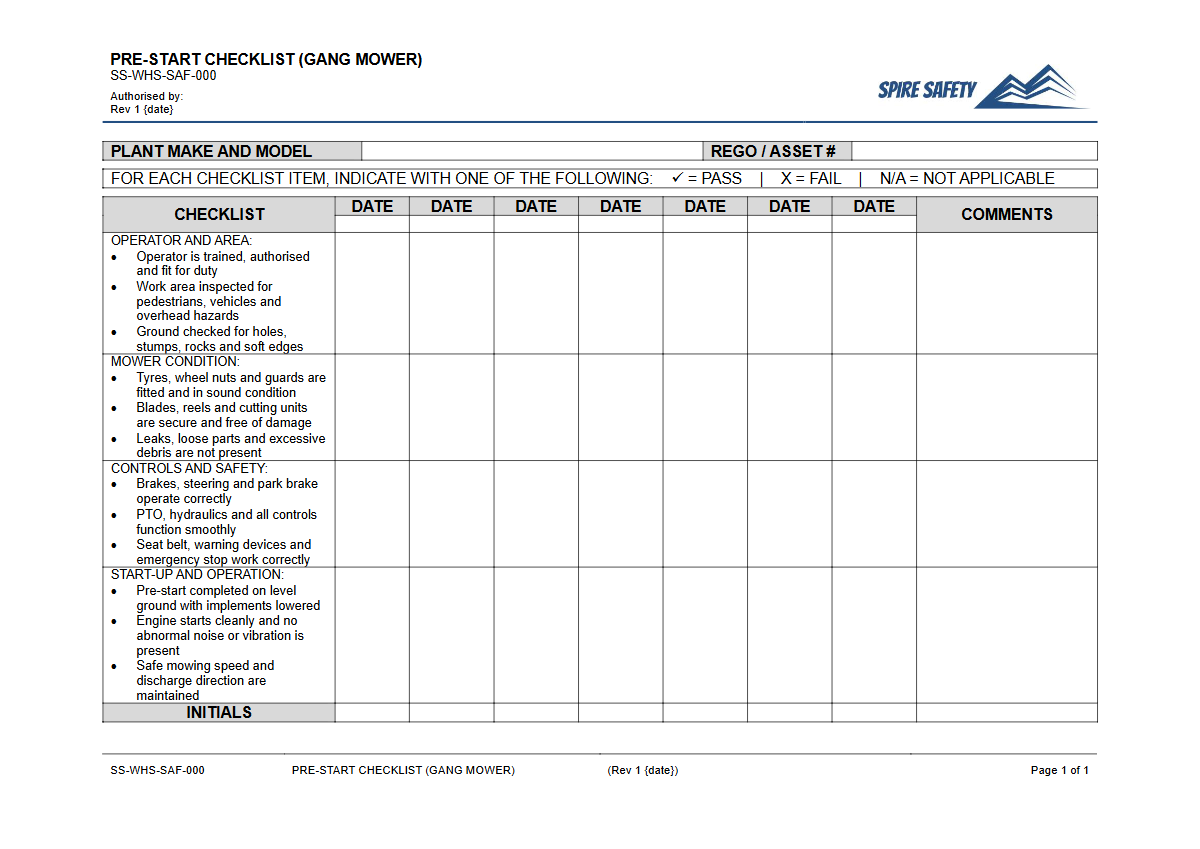
This Free Pre-Start Checklist (Gang Mower) Template provides a structured framework for operators to conduct thorough, consistent inspections, helping your organisation identify and rectify potential hazards before they lead to an incident, injury, or costly downtime.
Using a documented checklist helps fulfil your duty of care as a Person Conducting a Business or Undertaking (PCBU) under Australian WHS laws. It creates a formal record that safety checks are being performed, promotes operator accountability, and supports a proactive maintenance culture.
For further guidance on integrating this into your daily routine, our Pre-Start Checks and Plant Maintenance Toolbox Talk can help reinforce these safety principles with your team.
Video walkthrough
How to use the Free Pre-Start Checklist (Gang Mower) Template
This template is designed for immediate use and easy customisation. Start by downloading the DOCX or PDF file.
While it's aligned with Australian WHS best practices, it is a general template that must be tailored to your specific operational context. It's important to note that this document provides a starting point; we recommend you customise it to reflect the specific make and model of your gang mowers, your unique site conditions (e.g., terrain, public access), and the results of your risk assessments.
Once customised, integrate the checklist into your daily operational procedures. Train all operators on how to complete the checks accurately and what actions to take if a fault is identified (e.g., 'tag out' procedures, reporting to a supervisor).
These documented procedures are a key component of effective WHS management systems, demonstrating a systematic approach to hazard management.
When to use it
A gang mower pre-start checklist should be completed before the equipment is used for the first time each day or at the beginning of every operator's shift. This frequency ensures that any damage or defects that may have occurred overnight, during transport, or from the previous shift are identified promptly.
Making the pre-start check a non-negotiable part of the daily routine is essential for its effectiveness. Consistency is key to building a strong safety culture and preventing complacency.
Who should use it
The checklist should be completed by the person who will be operating the gang mower. This must be a worker who has been deemed competent through adequate information, training, and instruction.
They should have a thorough understanding of the specific mower they are inspecting and the potential hazards associated with its operation. Supervisors or maintenance personnel may also use the checklist to conduct periodic audits or to document repairs after a fault has been reported.
Regular verification that these checks are being performed correctly can be incorporated into your WHS compliance auditing program.
Key Inspection Points for a Gang Mower
While your customised checklist will be more detailed, a thorough inspection should always cover several critical areas:
- Guards & Shields: Check that all safety guards, particularly around belts, pulleys, and cutting reels, are secure and undamaged.
- Blades/Reels: Inspect for sharpness, damage, and security. Ensure they are free from debris.
- Hydraulics: Look for any leaks in hoses, fittings, or cylinders. Check hydraulic fluid levels.
- Tyres: Check for correct inflation, excessive wear, and any visible damage.
- Operator Controls: Test all controls, including steering, brakes, throttle, and blade engagement/disengagement, to ensure they function correctly.
- Emergency Features: Verify the function of the emergency stop button and check the condition of the seatbelt and any rollover protective structure (ROPS).
- General Condition: Check for loose or missing parts, signs of structural damage, and fluid leaks (oil, fuel, coolant).
The same principles of specific, documented checks apply to all types of groundskeeping machinery. For example, our Free Pre-Start Checklist (Aerator) Template provides a similar framework for a different type of specialised plant.
These resources, and many others, are available in our free WHS resources library to help you build out your safety documentation.
Common mistakes
Common mistakes to avoid
- Operator 'pencil-whipping' the checklist without physically inspecting the items.
- Using a generic checklist that doesn't cover the specific features or risks of the mower model.
- Failing to remove faulty equipment from service immediately after a defect is found.
- Inadequate training on how to properly conduct the checks or what each inspection point means.
Legal references
Legal considerations
The following legal requirements may be relevant to this type of work.
- Work Health and Safety Act (Harmonised) — Provides the primary duties for protecting workers and other people from work health and safety risks.
- Work Health and Safety Regulations (Harmonised) — Sets out requirements supporting the management of workplace hazards and risks.
The following codes may be relevant to this type of work.
- Managing WHS Risks Code of Practice — Provides practical guidance on identifying hazards, assessing risks and applying effective controls.
- Work Health and Safety Consultation, Cooperation and Coordination Code of Practice — Provides practical guidance on consulting workers and coordinating with other duty holders.
- Managing the Work Environment and Facilities Code of Practice — Provides practical guidance on safe work environments, workplace facilities and related controls.
Did you know
A Rolling History
The first gang mower was patented by Worthington Mower Company in the USA in 1914. It revolutionised the maintenance of large turf areas like golf courses and parks, which were previously maintained by sheep or horse-drawn mowers.
Mobile Plant Risks
According to Safe Work Australia, vehicle collisions are a leading cause of workplace fatalities. Between 2017 and 2021, 41% of worker fatalities involved a vehicle collision, highlighting the critical importance of pre-start checks for all mobile plant.
FAQ
Frequently asked questions
01Is a gang mower pre-start checklist legally required in Australia?
02What should happen if a fault is found during a pre-start check?
03How often should we review our gang mower checklist?
04Can a digital app be used instead of this paper template?
Share this resource
Free Pre-Start Checklist (Gang Mower) Template
Browse Categories
How To Use It
- 1Download and open in Word or PDF.
- 2Replace the placeholders with your business details.
- 3Get it reviewed by a WHS specialist before rollout.
Need it customised?
Our WHS consultants can adapt this template to your site, run a gap analysis, or audit what you already have in place.
Book a Free Consultation WHS consulting servicesor call 1300 156 382