
Free Pre-Start Checklist (Garbage Truck) Template
Download our free Pre-Start Checklist for Garbage Trucks.
Free Pre-Start Checklist (Garbage Truck) Template
DOCX • 125 KB + PDF
Updated Oct 2026
No signup required
Purpose of the Free Pre-Start Checklist (Garbage Truck) Template
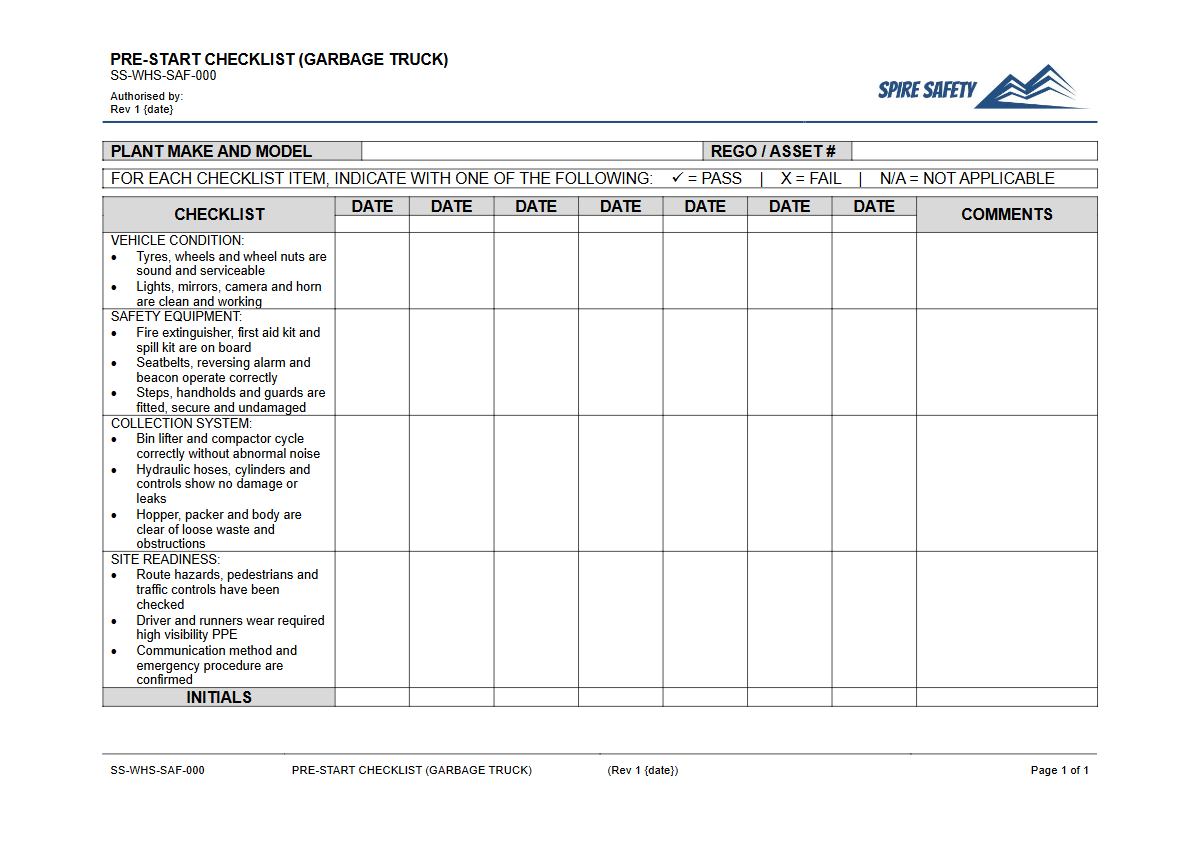
Operating a garbage truck involves significant risks, from road use to the operation of complex hydraulic and compaction systems. This free Pre-Start Checklist (Garbage Truck) Template provides a structured method for operators to conduct thorough pre-operational inspections.
Its primary purpose is to systematically identify any mechanical faults, damage, or safety issues before the vehicle is used for a shift. By formalising this process, your organisation can proactively manage risks, prevent incidents, minimise equipment downtime, and demonstrate due diligence in meeting its WHS obligations.
A consistent pre-start routine helps embed a culture of safety and ensures that critical components like brakes, steering, lights, tyres, and specialised equipment are in safe working order. This checklist is a foundational tool for any waste management operation and serves as a critical record for maintenance and safety audits.
You can reinforce these principles with workers by holding regular safety meetings, such as a Pre-Start Checks and Plant Maintenance Toolbox Talk, to discuss the importance of these daily inspections.
Video walkthrough
How to use the Free Pre-Start Checklist (Garbage Truck) Template
This Pre-Start Checklist is available for download as a DOCX file, which you can easily edit in Microsoft Word, or as a PDF for immediate printing and use. The template is designed as a comprehensive starting point, covering general vehicle safety as well as items specific to waste collection vehicles, such as packer blades, hydraulic systems, and emergency stops.
Important: This document is a template and must be customised. To be effective, you need to adapt it to the specific make, model, and configuration of the garbage trucks in your fleet.
You should also incorporate any unique hazards identified in your site-specific risk assessments. We are not liable for any incidents that may arise from the use of an unmodified or improperly customised template. Once customised, the checklist should be integrated into your broader safety procedures, such as a Safe Work Method Statement for Truck Operation.
Completed checklists create a vital paper trail. They should be reviewed by a supervisor, with any identified faults reported and rectified through your maintenance system before the vehicle is operated.
These records are essential components of effective WHS management systems, providing evidence that safety checks are being consistently performed.
When to use it
The pre-start checklist should be completed by the operator at the beginning of every shift, before the garbage truck is used for the first time that day. It should also be used if there is a change of operator during a shift.
Conducting the check before operation ensures that any issues that may have developed overnight or since the last use are identified before the vehicle enters a public roadway or begins its collection route.
This checklist forms part of a suite of documents for managing heavy vehicle safety. While this document covers pre-operational checks, other high-risk tasks require their own specific procedures.
For example, your safety documentation might also include a SWMS template for vacuum truck operations if your fleet includes such vehicles, or a Safe Work Method Statement for Truck and Float Operation if you transport heavy machinery.
Who should use it
The primary user of this Pre-Start Checklist is the trained and competent garbage truck operator. They are in the best position to physically inspect the vehicle and recognise any changes or potential defects.
It is their responsibility to complete the checklist accurately and honestly before commencing work.
Supervisors, leading hands, and fleet managers also have a key role. They are responsible for ensuring that operators are trained on how to conduct the checks properly, for reviewing completed checklists, and for taking prompt action on any reported defects.
This includes scheduling repairs and making decisions about whether a vehicle is safe to operate. Verifying operator skill is crucial, similar to how one might use a Verification of Competency for a truck-mounted cherry picker to confirm specific equipment skills.
Finally, safety officers and management should periodically review the entire pre-start check process to ensure it remains effective and that records are being properly maintained. This review can be a key input for internal or external WHS compliance auditing, helping to confirm that your safety procedures are being implemented as intended and are effective in controlling risk.
Common mistakes
Common mistakes to avoid
- "Pencil-whipping" the checklist without physically inspecting the items.
- Failing to report or follow up on identified defects, rendering the check pointless.
- Using a generic vehicle checklist that doesn't cover the specific hazards of a garbage truck's lifting and compaction equipment.
- Poor record-keeping, such as losing completed forms or not having a system for supervisor review.
Legal references
Legal considerations
The following legal requirements may be relevant to this type of work.
- Work Health and Safety Act (Harmonised) — Provides the primary duties for protecting workers and other people from work health and safety risks.
- Work Health and Safety Regulations (Harmonised) — Sets out requirements supporting the management of workplace hazards and risks.
The following codes may be relevant to this type of work.
- Managing WHS Risks Code of Practice — Provides practical guidance on identifying hazards, assessing risks and applying effective controls.
- Work Health and Safety Consultation, Cooperation and Coordination Code of Practice — Provides practical guidance on consulting workers and coordinating with other duty holders.
- Managing the Work Environment and Facilities Code of Practice — Provides practical guidance on safe work environments, workplace facilities and related controls.
Did you know
Heavy Vehicle Incidents
According to Safe Work Australia, the Transport, postal and warehousing industry has one of the highest rates of work-related fatalities, with vehicle collisions being a primary cause. Thorough pre-start checks are a critical control measure to prevent vehicle-related incidents.
FAQ
Frequently asked questions
01What should a garbage truck pre-start inspection include?
02How often should pre-start checks be done on a garbage truck?
03Are digital pre-start checklists better than paper ones?
04Who is responsible for ensuring pre-start checks are completed?
Share this resource
Free Pre-Start Checklist (Garbage Truck) Template
Browse Categories
How To Use It
- 1Download and open in Word or PDF.
- 2Replace the placeholders with your business details.
- 3Get it reviewed by a WHS specialist before rollout.
Need it customised?
Our WHS consultants can adapt this template to your site, run a gap analysis, or audit what you already have in place.
Book a Free Consultation WHS consulting servicesor call 1300 156 382