
Free Pre-Start Checklist (Gas Cutter) Template
Download our Free Pre-Start Checklist for Gas Cutters. This structured DOCX & PDF template helps formalise safety checks and manage WHS risks. Get started now.
Free Pre-Start Checklist (Gas Cutter) Template
DOCX • 125 KB + PDF
Updated Oct 2026
No signup required
Purpose of the Free Pre-Start Checklist (Gas Cutter) Template
Using oxy-fuel gas cutting equipment introduces significant workplace hazards, including fire, explosion, and exposure to toxic fumes. A systematic pre-use inspection is a critical control measure to mitigate these risks.
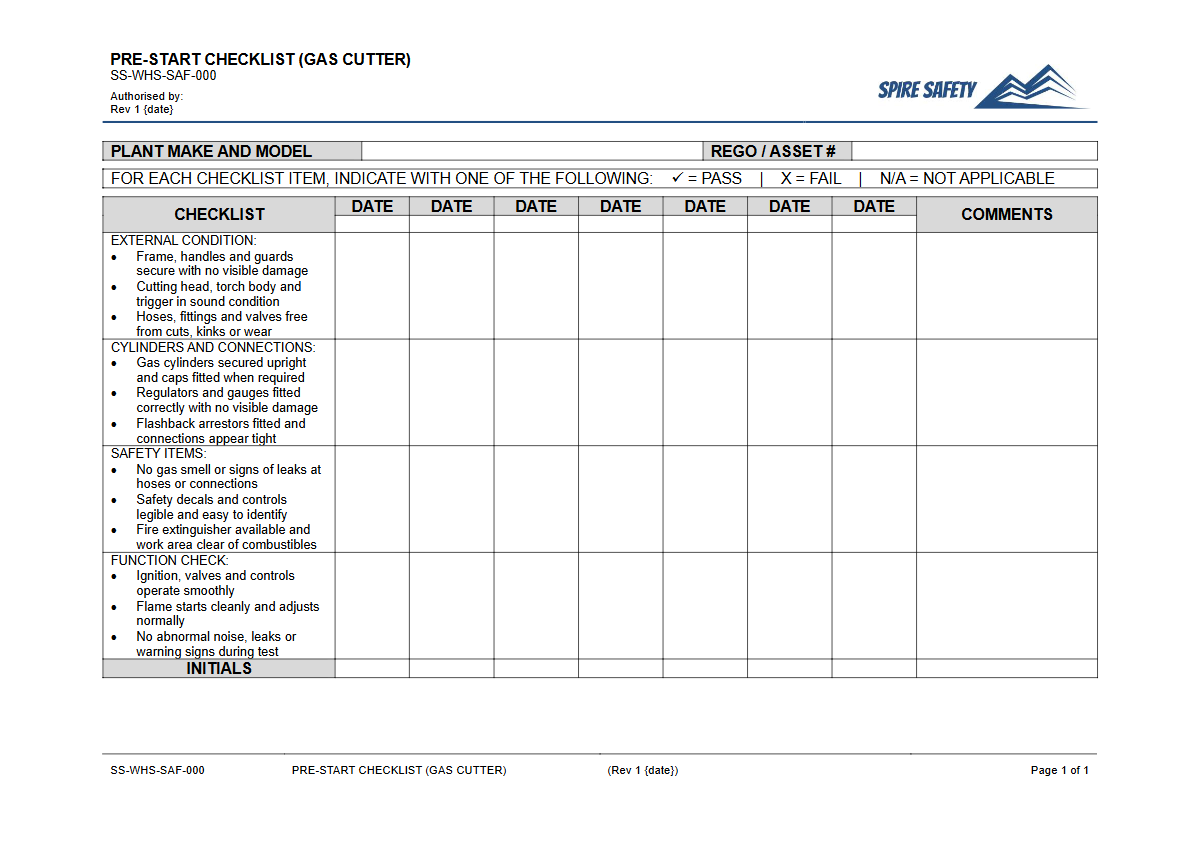
This is where our Free Pre-Start Checklist (Gas Cutter) Template becomes an essential tool for your organisation. It provides a structured format to guide operators through a thorough check of all critical components—from gas cylinders and regulators to hoses and the torch itself—before any hot work begins.
Formalising this process helps identify potential faults early, preventing equipment failure and ensuring a safer working environment. Consistent use of such checklists is a cornerstone of proactive safety management, much like the regular checks recommended in our Free Pre-Start Checklist (Bench Grinder) Template for other workshop equipment.
Video walkthrough
How to use the Free Pre-Start Checklist (Gas Cutter) Template
Our Free Pre-Start Checklist (Gas Cutter) Template is available as a DOCX file for easy customisation and a PDF for straightforward printing. The first step is to adapt the template to your specific workplace.
Please note: This document is a template, not a finished procedure. We have provided a comprehensive starting point, but you must customise it to reflect the specific make and model of your gas cutting equipment, your unique site conditions, and your organisation's internal safety procedures. Once customised, integrate the checklist into your daily routine. Operators should complete it before their first use of the equipment each day. Completed checklists should be filed and reviewed periodically by supervisors to identify recurring issues or training gaps, which is particularly important when dealing with atmospheric hazards managed by equipment detailed in resources like our Free Pre-Start Checklist (Fume Cabinet) Template.
Key Inspection Points
The template guides users through several critical inspection areas to ensure comprehensive checks. This process is a practical element of your overall safety framework, which can be strengthened by implementing robust WHS management systems. Key checks include:
- Gas Cylinders: Stored securely upright, correct gas type, in-test date valid, no visible damage.
- Regulators & Gauges: Correctly fitted, threads are clean and undamaged, gauges are readable and function correctly.
- Hoses: Free from cracks, burns, cuts, or abrasion. Connections are secure and fitted with appropriate clamps.
- Torch & Nozzle: Handpiece and mixer are in good condition, nozzle is correct for the job and free from blockages.
- Flashback Arrestors: Fitted to both torch and regulator ends, and are in good condition.
- Work Area: Clear of flammable and combustible materials, adequate ventilation is present, and a suitable fire extinguisher is readily available.
When to use it
The gas cutter Pre-Start Checklist should be completed before the equipment is used for the first time on any given day or at the beginning of each shift. It is also best practice to perform these checks after the equipment has been moved to a new location, following any maintenance or repair work, or if there is a change in operator.
Regular completion helps create a verifiable record of due diligence and equipment condition over time.
Who should use it
The primary user of the checklist is the trained and competent operator assigned to the gas cutting task. They are the person best placed to physically inspect the equipment they are about to use.
However, safety is a shared responsibility. Supervisors and managers must ensure that operators are not only provided with the checklist but are also trained on how to use it correctly and understand the importance of each check. These managers are also responsible for reviewing the completed records and taking appropriate action on any reported faults, similar to the protocols for other high-risk cutting equipment like that covered in our Free Pre-Start Checklist (Floor Saw) Template.
By embedding this Pre-Start Checklist into your daily operations, you reinforce a safety-first culture and create a documented trail of your risk management efforts. For businesses seeking to formalise this process across all operations, a structured WHS compliance audit can identify gaps and opportunities for improvement in your current systems.
Explore our complete free WHS resources library for more templates and guides to support your safety initiatives.
Common mistakes
Common mistakes to avoid
- Skipping leak tests on connections after changing a cylinder.
- Failing to clear the work area of all combustible materials, not just obvious fuel sources.
- Using incorrect gas pressures, which can lead to poor cut quality and increase the risk of flashback.
- Continuing to use a cutting torch with a damaged or partially blocked nozzle.
Legal references
Legal considerations
The following legal requirements may be relevant to this type of work.
- Work Health and Safety Act (Harmonised) — Provides the primary duties for protecting workers and other people from work health and safety risks.
- Work Health and Safety Regulations (Harmonised) — Sets out requirements supporting the management of workplace hazards and risks.
The following codes may be relevant to this type of work.
- Managing WHS Risks Code of Practice — Provides practical guidance on identifying hazards, assessing risks and applying effective controls.
- Work Health and Safety Consultation, Cooperation and Coordination Code of Practice — Provides practical guidance on consulting workers and coordinating with other duty holders.
- Managing the Work Environment and Facilities Code of Practice — Provides practical guidance on safe work environments, workplace facilities and related controls.
Did you know
Flashback Arrestors
Flashback arrestors are critical safety devices, but they are often a single-use item. If a flashback event occurs, the arrestor must be replaced, even if there is no visible damage.
Hose Condition
Ultraviolet (UV) light from the sun and workshop lighting can degrade gas hoses over time, making them brittle and prone to cracking. Storing equipment away from direct light can extend hose life.
FAQ
Frequently asked questions
01What should I do if I find a fault during a gas cutter pre-start check?
02How often should gas cutting equipment be professionally serviced?
03Is this gas cutter checklist enough to is aligned with the model WHS framework?
04Who is responsible for training workers to use the gas cutter checklist?
Share this resource
Free Pre-Start Checklist (Gas Cutter) Template
Browse Categories
How To Use It
- 1Download and open in Word or PDF.
- 2Replace the placeholders with your business details.
- 3Get it reviewed by a WHS specialist before rollout.
Need it customised?
Our WHS consultants can adapt this template to your site, run a gap analysis, or audit what you already have in place.
Book a Free Consultation WHS consulting servicesor call 1300 156 382