
Free Pre-Start Checklist (Generator Set) Template
Formalise daily equipment inspections with our Free Pre-Start Checklist (Generator Set) Template. Aligned with Australian WHS standards.
Free Pre-Start Checklist (Generator Set) Template
DOCX • 125 KB + PDF
Updated Oct 2026
No signup required
Purpose of the Free Pre-Start Checklist (Generator Set) Template
A generator set is a critical piece of plant on many Australian worksites, providing essential power for tools, lighting, and site amenities. However, it also presents significant risks, including electrical shock, fire, noise, and exposure to hazardous substances like fuel and exhaust fumes.
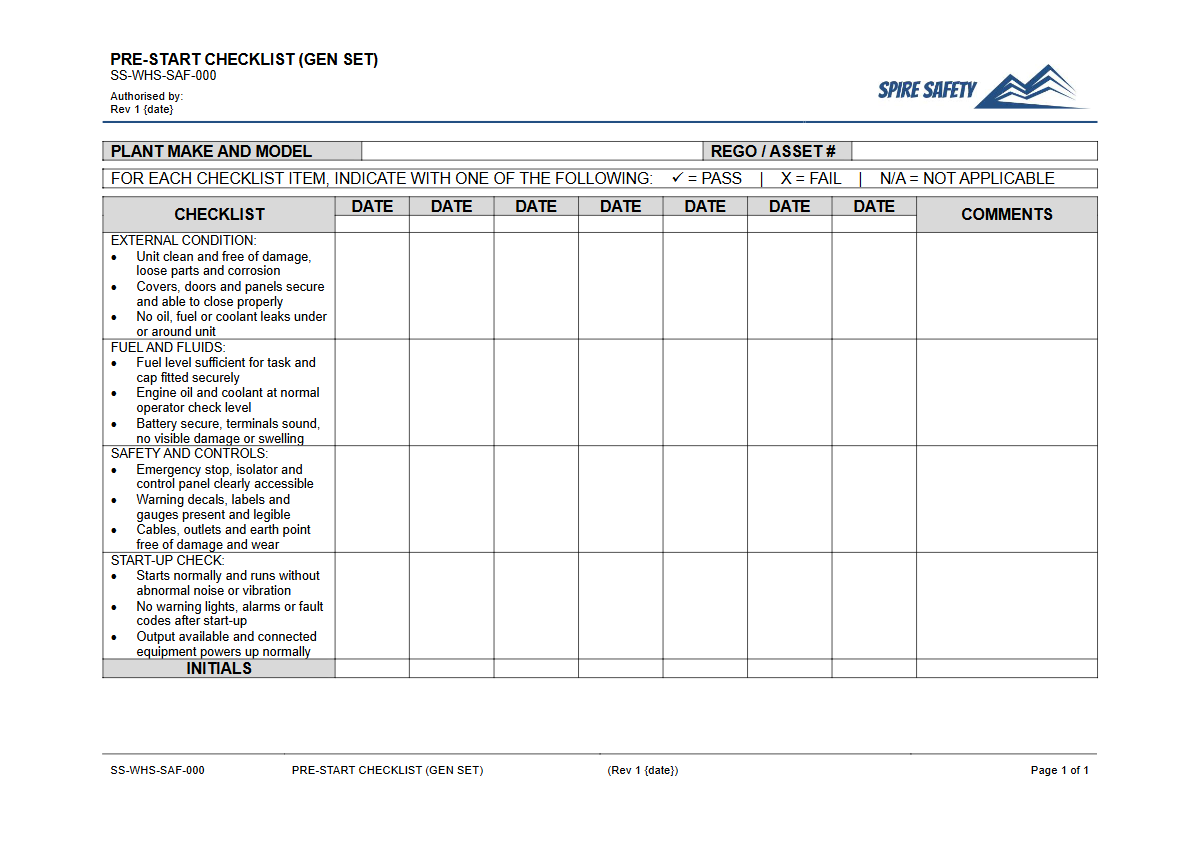
This Free Pre-Start Checklist (Generator Set) Template provides a structured framework for operators to conduct consistent, thorough inspections before use. Systematically checking the equipment's condition helps identify potential faults, damage, or fluid leaks before they can lead to an incident, equipment failure, or costly downtime.
Using a documented pre-start process is a fundamental part of demonstrating due diligence under WHS law. It helps a Person Conducting a Business or Undertaking (PCBU) meet their primary duty of care to provide and maintain safe plant.
These daily checks form an essential, practical component of broader WHS management systems, ensuring that safety procedures are actively implemented at the operational level.
Video walkthrough
How to use the Free Pre-Start Checklist (Generator Set) Template
This template is available as a fully editable DOCX file for easy customisation and as a PDF for immediate printing. The goal is to establish a clear, repeatable inspection routine.
Operators should work through the checklist systematically, visually inspecting each component and testing functions where applicable. Any faults, damage, or concerns identified must be recorded on the checklist and reported to a supervisor immediately.
The generator set should be tagged out of service and not used until it has been inspected by a competent person and cleared for use.
Important: This document is a template only. We have provided a comprehensive starting point, but you must customise it to suit the specific make and model of your generator set, your site conditions, and the outcomes of your risk assessments.
Your final document should be a practical tool that reflects the unique hazards of your workplace.
Customising Your Checklist
To make the template effective, consider adding checks specific to your operational context. This may include:
- Model-specific items listed in the manufacturer's operating manual.
- Checks for ancillary equipment, such as extension leads, distribution boards, and earthing stakes.
- Site-specific environmental checks, such as ensuring adequate ventilation for exhaust fumes, secure and level positioning, and appropriate bunding for fuel storage.
- Confirmation that noise levels are controlled and appropriate hearing protection is available and used.
- For a more specialised application, you might review our free emergency generator checklist for additional ideas.
The effectiveness of your safety procedures, including the use of customised checklists, can be verified through periodic safety walkthroughs and formal WHS compliance auditing.
When to use a Generator Set Pre-Start Checklist
A pre-start inspection should be completed at the beginning of each day or shift before the generator is used for the first time. It should also be performed if the equipment is relocated to a new position on site, as this can affect its stability and ventilation.
A re-inspection is also prudent after any maintenance or repair work has been carried out to verify that the equipment is safe to return to service. This daily discipline is similar to the checks required for other site equipment, such as those detailed in a pre-start for a bench grinder.
Who should use this Pre-Start Checklist
This checklist should be used by workers who are trained, licensed (where required), and deemed competent to operate the specific generator set. This includes site workers, tradespeople, maintenance staff, and event coordinators.
Supervisors should also be familiar with the checklist content to effectively oversee its use and review completed records. Ensuring operators are competent to perform their tasks and complete safety documentation is a key part of any safety system.
While this checklist helps verify equipment condition, the operator's skill is equally important. Similar principles apply to the use of other high-risk plant, where a worker must be able to complete a pre-start checklist for a floor saw before commencing work. For a wider range of document templates, you can browse our complete free WHS resources library.
Common mistakes
Common mistakes to avoid
- Failing to check fuel and oil levels, leading to engine seizure or shutdown.
- Using the generator in an enclosed space (e.g., garage, shed) with poor ventilation.
- Ignoring warning lights or unusual noises, indicating an underlying mechanical issue.
- Using a generic checklist that doesn't cover the specific risks of the generator model or work environment.
Legal references
Legal considerations
The following legal requirements may be relevant to this type of work.
- Work Health and Safety Act (Harmonised) — Provides the primary duties for protecting workers and other people from work health and safety risks.
- Work Health and Safety Regulations (Harmonised) — Sets out requirements supporting the management of workplace hazards and risks.
The following codes may be relevant to this type of work.
- Managing WHS Risks Code of Practice — Provides practical guidance on identifying hazards, assessing risks and applying effective controls.
- Work Health and Safety Consultation, Cooperation and Coordination Code of Practice — Provides practical guidance on consulting workers and coordinating with other duty holders.
- Managing the Work Environment and Facilities Code of Practice — Provides practical guidance on safe work environments, workplace facilities and related controls.
Did you know
The Silent Killer
Carbon monoxide (CO) from generator exhaust is colourless and odourless. Using a generator in an enclosed or poorly ventilated space can be fatal within minutes, making ventilation checks one of the most critical pre-start safety steps.
Power Ratings
Generator sets have a 'continuous' and a 'prime' or 'standby' power rating. Consistently running a generator above its continuous rating can cause overheating and premature failure, a risk that regular inspections help mitigate.
FAQ
Frequently asked questions
01Is a pre-start checklist for a generator a legal requirement in Australia?
02What are the most critical checks on a generator set pre-start?
03Can I use this generator checklist for any brand?
04What happens if a fault is found during the pre-start inspection?
Share this resource
Free Pre-Start Checklist (Generator Set) Template
Browse Categories
How To Use It
- 1Download and open in Word or PDF.
- 2Replace the placeholders with your business details.
- 3Get it reviewed by a WHS specialist before rollout.
Need it customised?
Our WHS consultants can adapt this template to your site, run a gap analysis, or audit what you already have in place.
Book a Free Consultation WHS consulting servicesor call 1300 156 382