
Free Pre-Start Checklist (Golf Cart) Template
Formalise daily safety inspections for your golf carts and utility vehicles with our free template. This structured document helps manage WHS risks.
Free Pre-Start Checklist (Golf Cart) Template
DOCX • 125 KB + PDF
Updated Oct 2026
No signup required
Purpose of the Free Pre-Start Checklist (Golf Cart) Template
Golf carts, or buggies, are common pieces of plant used across many industries, from sporting venues and resorts to large industrial sites and university campuses. While seemingly simple, they pose significant safety risks if not properly maintained.
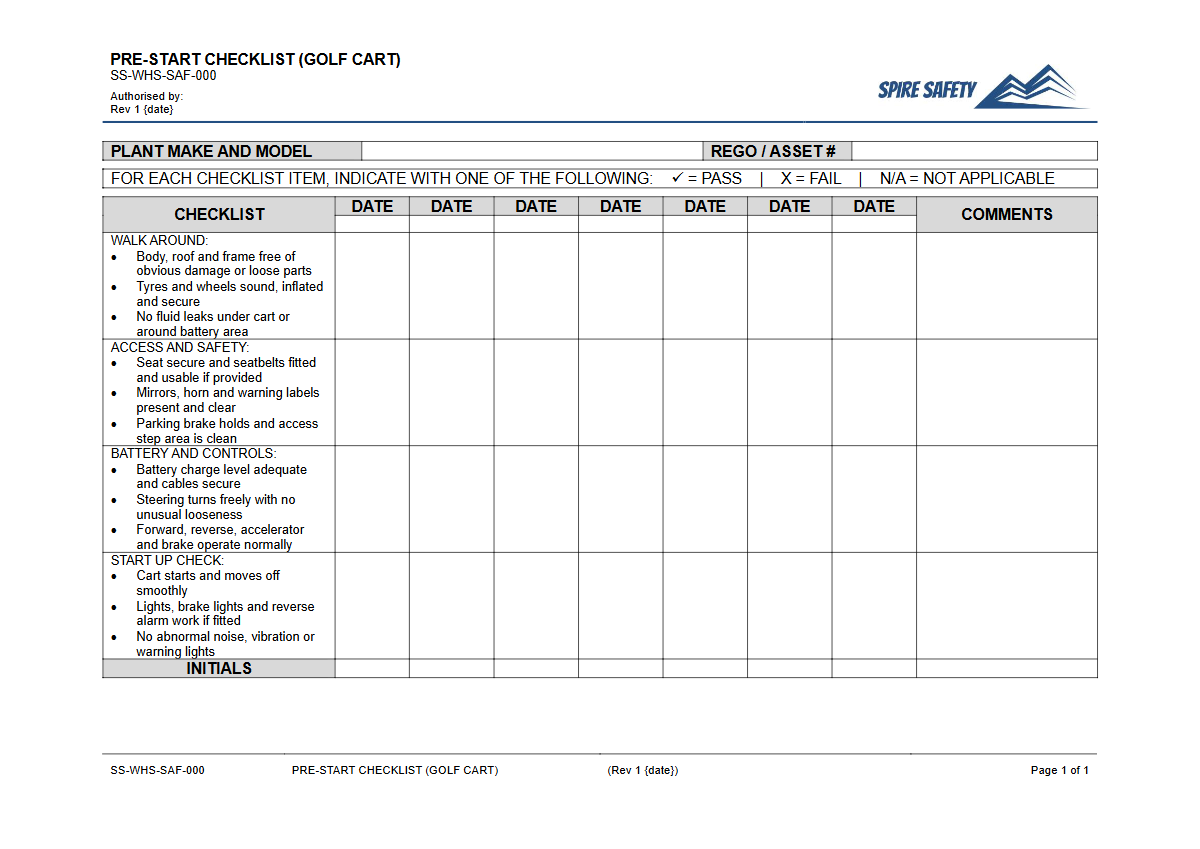
This Free Pre-Start Checklist (Golf Cart) Template provides a structured framework for operators to conduct consistent, documented safety inspections before each use. Implementing these checks helps identify mechanical defects, tyre issues, battery problems, and other potential failures before they lead to an incident.
Regular inspections are a fundamental component of proactive safety management. By formalising this process, your organisation can reduce the risk of accidents, minimise equipment downtime, and demonstrate due diligence in meeting its WHS obligations.
Integrating such procedures is a cornerstone of effective WHS management systems, ensuring that safety is a practical, daily activity rather than an afterthought.
Video walkthrough
How to use the Free Pre-Start Checklist (Golf Cart) Template
Our Free Pre-Start Checklist (Golf Cart) Template is designed as a user-friendly starting point, available in both DOCX and PDF formats for your convenience. The DOCX file is fully editable, allowing you to tailor the content to your specific operational needs. Follow these simple steps to integrate it into your safety procedures:
- Download the template in your preferred format.
- Customise the checklist to include the specific make and model of your golf carts. Add or remove items to reflect your site’s unique environment and the specific tasks the vehicles are used for.
- Incorporate your company branding, such as your logo and name.
- Train all operators on how to correctly perform each check and what the procedure is for reporting faults.
- Implement the checklist as a mandatory step before any golf cart is used for a shift.
Important: This document is a template and must be adapted to suit your workplace. We recommend a thorough review to ensure it aligns with your existing risk assessments, the manufacturer's instructions for your specific equipment, and the unique hazards of your operating environment. This process is similar for other small vehicles, as detailed in our Free Pre-Start Checklist (Lawn Tractor) Template.
Key Items on a Golf Cart Checklist
A comprehensive golf cart pre-start should cover all critical safety and operational components. While our template provides a detailed list, key areas for inspection typically include:
Vehicle Integrity & Safety Features
- Brakes: Test both the service brake and park brake for proper function.
- Steering: Check for responsiveness and any excessive play in the steering wheel.
- Tyres: Inspect for correct inflation, adequate tread, and any signs of damage or wear.
- Lights & Horn: Ensure all lights (if fitted) and the horn are operational.
- Battery: Check battery charge level, look for any corrosion on terminals, and ensure securing brackets are tight. For petrol models, check fuel and oil levels.
- General Structure: Look for any loose parts, damage to the chassis or body, and ensure the windscreen is clean and intact.
These checks ensure the fundamental safety functions of the vehicle are working as intended. The principles of inspecting mobile equipment apply to a wide range of machinery, including more heavy-duty equipment covered in resources like our Free Pre-Start Checklist (Forwarder) Template.
When to Use This Checklist
The pre-start inspection should be carried out before the golf cart is used for the first time each day or at the beginning of each new operator's shift. This frequency ensures that any damage or defects that may have occurred during previous operation or while parked are identified promptly.
If a fault is discovered that poses a safety risk, the operator must immediately tag the vehicle out of service and report the issue to a supervisor or maintenance team, as per your organisation's procedures.
Regularly reviewing completed checklists can also help identify recurring issues, informing maintenance schedules and procurement decisions. This data is invaluable during a formal WHS compliance auditing process, providing tangible evidence of your safety management activities.
Who Should Use This Checklist
This checklist is designed to be used by trained and competent golf cart operators. The responsibility for physically conducting the checks lies with the person who will be driving the vehicle.
Supervisors and managers also have a critical role; they are responsible for ensuring the system is implemented, that operators are adequately trained, and that completed records are reviewed and stored correctly. A well-managed pre-start system fosters a strong safety culture where everyone takes ownership of workplace safety. For more guidance on establishing robust WHS practices, explore our complete free WHS resources library.
Common mistakes
Common mistakes to avoid
- "Pencil-whipping" the checklist without physically inspecting the items.
- Failing to remove a faulty golf cart from service after a defect is found.
- Using a generic checklist that doesn't cover the specific features or risks of the model in use.
- Neglecting to provide operators with adequate training on how to conduct the checks properly.
Legal references
Legal considerations
The following legal requirements may be relevant to this type of work.
- Work Health and Safety Act (Harmonised) — Provides the primary duties for protecting workers and other people from work health and safety risks.
- Work Health and Safety Regulations (Harmonised) — Sets out requirements supporting the management of workplace hazards and risks.
The following codes may be relevant to this type of work.
- Managing WHS Risks Code of Practice — Provides practical guidance on identifying hazards, assessing risks and applying effective controls.
- Work Health and Safety Consultation, Cooperation and Coordination Code of Practice — Provides practical guidance on consulting workers and coordinating with other duty holders.
- Managing the Work Environment and Facilities Code of Practice — Provides practical guidance on safe work environments, workplace facilities and related controls.
Did you know
Beyond the Fairway
Golf carts are classified as 'plant' under Australian WHS laws. They are commonly used in various industries beyond golf, including airports, university campuses, large industrial sites, and resorts for transport and utility purposes.
FAQ
Frequently asked questions
01Is a pre-start checklist for a golf cart legally required in Australia?
02What are the most common hazards associated with golf carts?
03Who is responsible for ensuring golf cart pre-start checks are completed?
04What should an operator do if they find a fault during a pre-start check?
Share this resource
Free Pre-Start Checklist (Golf Cart) Template
Browse Categories
How To Use It
- 1Download and open in Word or PDF.
- 2Replace the placeholders with your business details.
- 3Get it reviewed by a WHS specialist before rollout.
Need it customised?
Our WHS consultants can adapt this template to your site, run a gap analysis, or audit what you already have in place.
Book a Free Consultation WHS consulting servicesor call 1300 156 382