
Free Pre-Start Checklist (Grain Auger) Template
Formalise daily safety inspections for agricultural machinery with our free Pre-Start Checklist for Grain Augers. Download the DOCX & PDF template now.
Free Pre-Start Checklist (Grain Auger) Template
DOCX • 125 KB + PDF
Updated Oct 2026
No signup required
Purpose of the Free Pre-Start Checklist (Grain Auger) Template
Operating a grain auger introduces significant safety risks, primarily from entanglement in the rotating screw, but also from mechanical failure, structural collapse, and manual handling injuries. Proactive hazard identification is critical to preventing incidents.
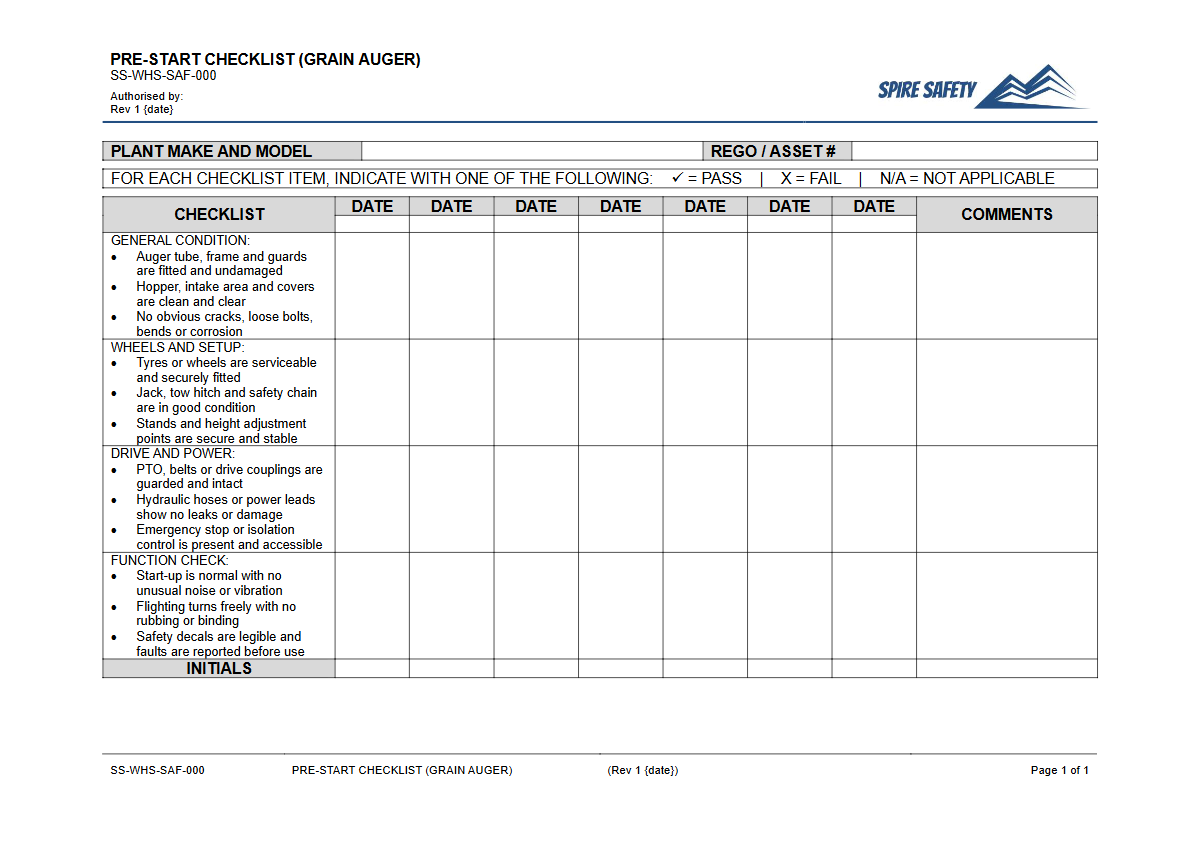
This is where our Free Pre-Start Checklist (Grain Auger) Template becomes an essential tool for any agricultural or grain-handling business. A systematic pre-start check helps formalise the inspection process, ensuring that operators verify the auger's condition before it is used for a shift.
Using this template helps to identify potential faults or damage that could lead to injury, equipment failure, or costly downtime.
Integrating this checklist into your daily operations serves several key functions. It creates a documented record of inspections, demonstrating due diligence in managing plant-related risks.
It prompts operators to physically check critical components like guards, emergency stops, and hydraulic systems, reinforcing safe behaviour. Regular use of this checklist forms a vital part of your broader safety framework, supporting a proactive safety culture and contributing to the effectiveness of your overall WHS management systems.
Video walkthrough
How to use the Free Pre-Start Checklist (Grain Auger) Template
This template is designed for straightforward implementation. After downloading the DOCX or PDF file, you can integrate it into your operational procedures.
The process typically involves providing the checklist to operators, ensuring they complete it before their first use of the auger each day or shift, and having a supervisor review and sign off on the completed forms. These records should then be filed and retained as part of your safety documentation.
IMPORTANT: This template is a starting point. We have developed it to be aligned with general Australian WHS principles, but it must be customised to your specific make and model of grain auger, your site conditions, and your operational procedures.
You should add, remove, or modify checklist items to reflect the unique features and hazards of your equipment and work environment.
Key Inspection Points
While you must customise the document, a comprehensive grain auger pre-start checklist generally covers:
- Guards and Shields: Ensuring all guards, especially over the intake, drive mechanism, and rotating shafts, are securely in place and undamaged.
- Drive Mechanism: Checking belts, chains, and gearboxes for correct tension, wear, and lubrication.
- Frame and Structure: Inspecting the main tube, undercarriage, and support structures for cracks, bends, or corrosion.
- Wheels and Tyres: Verifying tyre pressure, condition, and the security of wheel nuts.
- Winch and Cables: For augers with a winch system, checking the cable for fraying or damage and ensuring the winch mechanism operates smoothly.
- Hydraulic System: Looking for leaks in hoses and connections and checking fluid levels.
- Emergency Controls: Testing any emergency stop buttons or shut-off mechanisms to ensure they function correctly.
- General Condition: A final check for any loose parts, debris, or other visible hazards.
These checks are similar in principle to those for other heavy-duty equipment, such as what you might find in a Pre-Start Checklist for Forwarders used in forestry operations.
When to use it
The Pre-Start Checklist for a Grain Auger should be completed before the equipment is used for the first time each day or at the beginning of every shift. If the auger has been idle for an extended period or has been moved to a new location, conducting a pre-start check is also a good practice.
It is a tool for routine, operator-level inspection and is not a replacement for scheduled preventative maintenance or detailed mechanical servicing performed by a qualified technician. These daily checks are the first line of defence against incidents caused by equipment faults.
For organisations managing a variety of plant, consistent daily checks are crucial. The same rigour applied to augers should be applied to other machinery, such as with a bin lifter pre-start checklist in waste management or logistics.
Who should use it
The checklist must be completed by a person who is competent and has received adequate training and instruction on the safe operation of the specific grain auger. This is typically the operator assigned to use the equipment for that shift.
They must understand what each checkpoint means and how to identify a potential fault or hazard. Supervisors or managers also have a role in the process; they should ensure that operators are completing the checks correctly and take appropriate action when faults are reported.
Completed checklists can be periodically reviewed as part of a WHS compliance auditing program to verify that safety procedures are being followed consistently.
For more templates covering different types of industrial and processing equipment, such as our Granulator Pre-Start Checklist, explore our full free WHS resources library.
Common mistakes
Common mistakes to avoid
- Operator 'pencil-whipping' the form without physically inspecting the equipment.
- Failing to immediately tag out and remove a faulty auger from service after a defect is found.
- Using a generic, non-customised checklist that doesn't match the specific make and model of the auger.
- Neglecting to provide operators with adequate training on how to correctly perform each check and identify potential hazards.
Legal references
Legal considerations
The following legal requirements may be relevant to this type of work.
- Work Health and Safety Act (Harmonised) — Provides the primary duties for protecting workers and other people from work health and safety risks.
- Work Health and Safety Regulations (Harmonised) — Sets out requirements supporting the management of workplace hazards and risks.
The following codes may be relevant to this type of work.
- Managing WHS Risks Code of Practice — Provides practical guidance on identifying hazards, assessing risks and applying effective controls.
- Work Health and Safety Consultation, Cooperation and Coordination Code of Practice — Provides practical guidance on consulting workers and coordinating with other duty holders.
- Managing the Work Environment and Facilities Code of Practice — Provides practical guidance on safe work environments, workplace facilities and related controls.
Did you know
Auger Entanglement Risk
A grain auger can catch and entangle loose clothing, hair, or limbs in less than a second. The majority of serious auger-related incidents occur at the exposed intake end of the screw.
Ancient Origins
The principle behind the grain auger is the Archimedes' screw, a machine invented by the ancient Greek scientist Archimedes in the 3rd century BC to transfer water from a low-lying body of water into irrigation ditches.
FAQ
Frequently asked questions
01Why is a pre-start check for a grain auger so important?
02What happens if an operator finds a fault during a pre-start check?
03Is using this grain auger checklist a legal requirement in Australia?
04How often should a grain auger be fully inspected?
Share this resource
Free Pre-Start Checklist (Grain Auger) Template
Browse Categories
How To Use It
- 1Download and open in Word or PDF.
- 2Replace the placeholders with your business details.
- 3Get it reviewed by a WHS specialist before rollout.
Need it customised?
Our WHS consultants can adapt this template to your site, run a gap analysis, or audit what you already have in place.
Book a Free Consultation WHS consulting servicesor call 1300 156 382