
Free Pre-Start Checklist (Grapple) Template
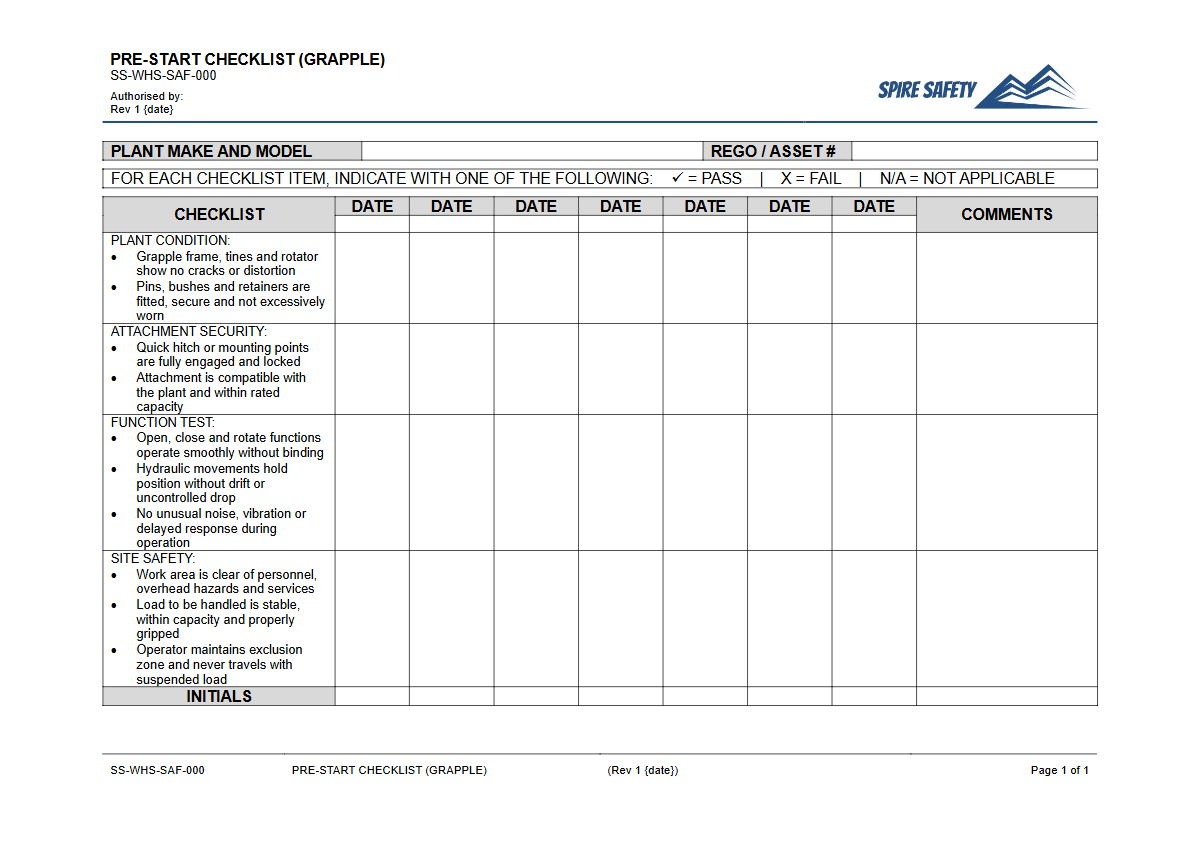
Download our free Pre-Start Checklist (Grapple) Template. This structured Word & PDF document helps formalise daily equipment checks. Get your template.
Free Pre-Start Checklist (Grapple) Template
DOCX • 125 KB + PDF
Updated Oct 2026
No signup required
Purpose of the Free Pre-Start Checklist (Grapple) Template
Using this Free Pre-Start Checklist (Grapple) Template is a critical step in ensuring the safe operation of grapple attachments and the machinery they are fitted to, such as excavators, cranes, or forestry equipment. A documented pre-start inspection formalises the process of verifying that the equipment is safe to use before any work begins.
Regular checks help identify wear, damage, or hydraulic faults that could lead to catastrophic failure, equipment damage, or serious injury. By integrating this checklist into your daily routine, you create a verifiable record of due diligence and demonstrate a proactive approach to risk management.
These routine checks form a fundamental component of a site's overall safety framework. A well-documented pre-start process provides essential data for maintenance scheduling, operator accountability, and hazard identification.
This data is invaluable for developing and refining your broader WHS management systems to continually improve workplace safety.
Video walkthrough
How to use the Free Pre-Start Checklist (Grapple) Template
This template provides a structured starting point for developing a site-specific checklist. To implement it effectively, first download the DOCX file and add your company branding and specific site details.
Walk through the checklist items with a competent person, such as an experienced operator or maintenance fitter, and add or remove checks to match the exact make and model of your grapple and its carrier machine. Key areas for inspection include hydraulic hoses and connectors, grapple tines for cracks or wear, the rotator mechanism, and all pins and bushings.
Once customised, ensure all operators are trained on how to complete the checklist thoroughly. This training can be supported with practical demonstrations and a session using a resource like our Pre-Start Checks and Plant Maintenance Toolbox Talk. Operators must understand that it is not a 'tick and flick' exercise; it is a critical safety function.
Completed checklists should be reviewed by a supervisor and filed for record-keeping purposes.
Important Customisation Note
Please note: This template is a starting point aligned with general Australian WHS practice. We have designed it to be customised. You must adapt it to reflect the specific hazards, controls, and operational context of your workplace, machinery, and tasks to support your safety obligations.
When to use the grapple checklist
A pre-start checklist for a grapple should be completed before the first use on every shift. If the operator changes during a shift, the incoming operator should also perform a check to verify the equipment's condition before they commence work.
It is also best practice to conduct an inspection after the equipment has undergone maintenance or repair to ensure it has been returned to a safe operational state. The consistency and frequency of these checks are often a key focus during a formal WHS compliance auditing process, as they provide clear evidence of a functioning safety procedure.
Who should use it
The pre-start inspection must be carried out by a person who is trained and competent in the operation of the specific plant. This is typically the machine operator assigned to use the equipment for the shift.
The check should be performed by a worker who has been verified as competent, a process that can be formalised using a document like our Verification of Competency (Pipe Threader) Template as a structural guide. Supervisors have a responsibility to ensure these checks are being completed correctly and to action any reported defects.
Maintenance personnel will also use the information from completed checklists to schedule preventative maintenance and address any faults identified by operators.
The findings from a pre-start check directly inform the dynamic risk assessment that an operator undertakes before starting a task. If a significant hazard is identified, it must be controlled according to established procedures, which are often detailed in a relevant Safe Work Method Statement (Concrete Truck Operation) Template or equivalent document for the plant being used. For more templates and safety documents, browse our complete free WHS resources library.
Common mistakes
Common mistakes to avoid
- "Pencil-whipping" the form without physically inspecting the equipment.
- Ignoring minor hydraulic leaks or weeping hoses, which can indicate imminent failure.
- Using a generic checklist that doesn't cover specific features or known issues of the grapple model.
- Failing to immediately isolate and tag out faulty equipment, allowing it to be used inadvertently.
Legal references
Legal considerations
The following legal requirements may be relevant to this type of work.
- Work Health and Safety Act (Harmonised) — Provides the primary duties for protecting workers and other people from work health and safety risks.
- Work Health and Safety Regulations (Harmonised) — Sets out requirements supporting the management of workplace hazards and risks.
The following codes may be relevant to this type of work.
- Managing WHS Risks Code of Practice — Provides practical guidance on identifying hazards, assessing risks and applying effective controls.
- Work Health and Safety Consultation, Cooperation and Coordination Code of Practice — Provides practical guidance on consulting workers and coordinating with other duty holders.
- Managing the Work Environment and Facilities Code of Practice — Provides practical guidance on safe work environments, workplace facilities and related controls.
Did you know
Hydraulic Hazards
Hydraulic system failures are a leading cause of mobile plant incidents. A pinhole leak in a high-pressure hydraulic hose can release fluid at a velocity capable of penetrating skin and causing severe, life-threatening injuries.
FAQ
Frequently asked questions
01What is the primary purpose of a grapple pre-start checklist?
02How often should grapple pre-start inspections be performed?
03Is this grapple pre-start template compliant with Australian WHS law?
04What should an operator do if a fault is found during a pre-start check?
Share this resource
Free Pre-Start Checklist (Grapple) Template
Browse Categories
How To Use It
- 1Download and open in Word or PDF.
- 2Replace the placeholders with your business details.
- 3Get it reviewed by a WHS specialist before rollout.
Need it customised?
Our WHS consultants can adapt this template to your site, run a gap analysis, or audit what you already have in place.
Book a Free Consultation WHS consulting servicesor call 1300 156 382