
Free Pre-Start Checklist (Griddle) Template
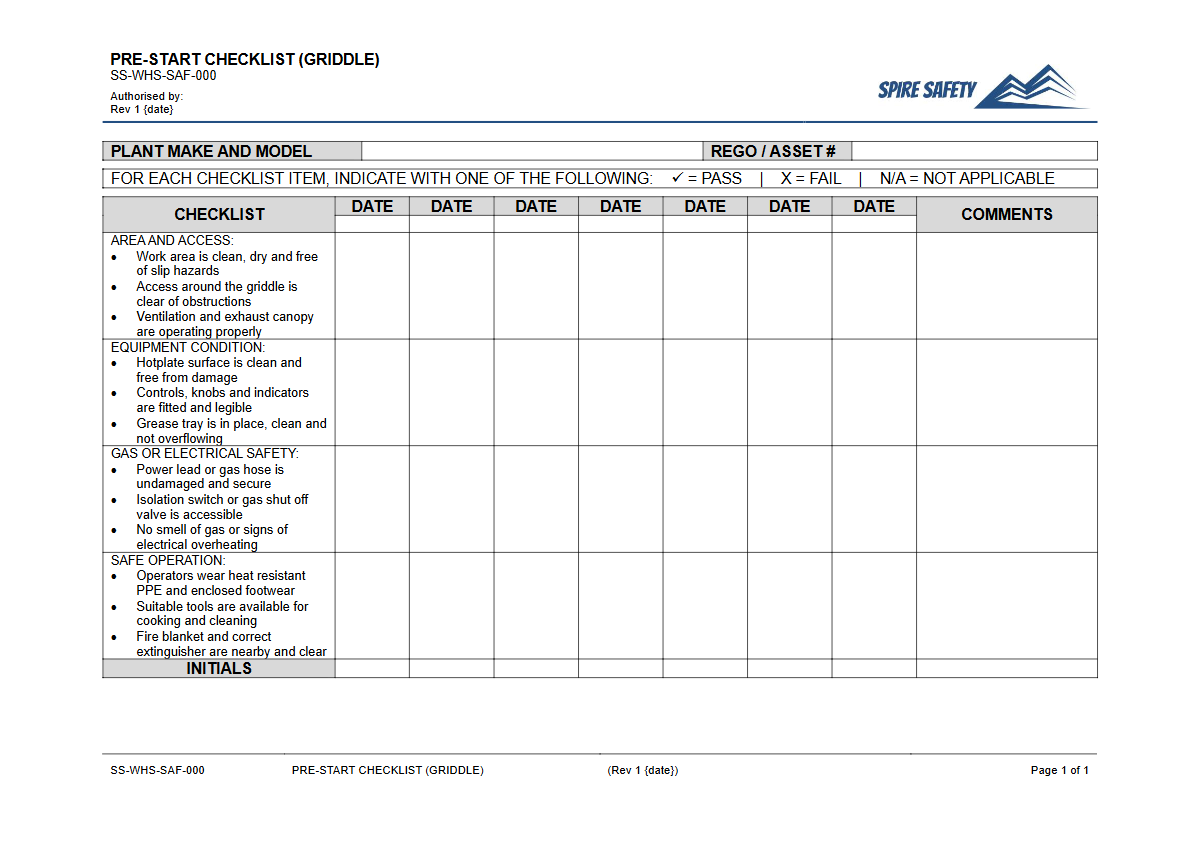
Formalise your kitchen safety checks with our free Pre-Start Checklist (Griddle) Template. This structured DOCX and PDF helps identify hazards before use.
Free Pre-Start Checklist (Griddle) Template
DOCX • 125 KB + PDF
Updated Oct 2026
No signup required
Purpose of the Free Pre-Start Checklist (Griddle) Template
Conducting consistent pre-start checks on commercial kitchen equipment is a fundamental aspect of maintaining a safe workplace. Our Free Pre-Start Checklist (Griddle) Template provides a structured framework to help your organisation formalise this critical safety process.
Using this template helps kitchen staff systematically inspect a griddle before they begin cooking, identifying potential hazards like damaged power cords, gas leaks, faulty controls, or unstable surfaces. This proactive approach not only helps prevent burns, electrical shocks, and fires but also creates a documented record of due diligence.
By integrating this checklist into your daily operations, you demonstrate a commitment to risk management and worker safety. It serves as a practical tool for hazard identification, encouraging a safety-conscious culture where potential issues are reported and rectified promptly. Formalising these inspections can be a key component of your overall safety management system, a topic you can reinforce with staff using a Pre-Start Checks and Plant Maintenance Toolbox Talk.
Video walkthrough
How to use the Free Pre-Start Checklist (Griddle) Template
This template is designed for ease of use and customisation. Follow these steps to integrate it into your workplace safety procedures:
- Download: Choose between the DOCX file for easy editing or the PDF for immediate printing.
- Customise: Adapt the checklist to the specific make and model of the griddles used in your kitchen. Consider the power source (electric or gas), unique features, and surrounding environment.
- Train: Ensure all relevant workers, including chefs, cooks, and kitchen hands, are trained on how to properly complete the checklist, what each item means, and the procedure for reporting faults.
- Implement: Make the checklist a mandatory step before the first use of the griddle each day or at the start of every shift. Store completed checklists in a designated location for record-keeping.
- Review: Periodically review the checklist's effectiveness and update it following any incidents, changes to equipment, or feedback from staff.
Important: This document is a template and must be customised to your specific workplace, griddle models, and operational risks. We have included common checkpoints, but you must add, remove, or modify items to reflect the unique hazards present in your kitchen.
Consultation with workers who operate the equipment is essential to ensure the checklist is practical and effective.
Incorporating tailored checklists like this one is a practical step in developing robust WHS management systems that address the specific risks of your operations.
Key Inspection Points for a Griddle
While customisation is vital, a comprehensive griddle checklist should generally cover the following areas:
- General Condition: Check that the griddle surface is clean, free from excessive carbon build-up, and has no visible damage.
- Surrounding Area: Ensure the area is clear of combustible materials, slip hazards (like grease on the floor), and obstructions.
- Controls & Dials: Verify that temperature controls and power switches are clearly labelled, functional, and not damaged.
- Power Source (Electric): Inspect cords, plugs, and connections for signs of wear, fraying, or damage. Ensure it's connected to an appropriate outlet.
- Power Source (Gas): Check that gas lines and connections are secure and show no signs of damage or leaks. Ensure pilot lights ignite correctly.
- Ventilation: Confirm that overhead extraction fans or ventilation systems are switched on and operating effectively.
- Stability: Ensure the griddle is on a stable, level surface and does not rock or move during use.
The principles of this checklist can be applied across various appliances. You can find a similar template for other kitchen equipment, such as our Free Pre-Start Checklist (Coffee Grinder) Template, to build a consistent safety inspection program.
When to use it
A pre-start check should be completed at the beginning of each workday or shift before the griddle is used for the first time. It should also be performed if the equipment has been moved, undergone maintenance, or if there is any reason to suspect a fault.
The goal is to catch issues before the griddle is heated, minimising the risk of incidents during operation. The documented completion of these checks can form part of the evidence reviewed during a WHS compliance auditing process.
Who should use it
This checklist is intended for the person operating the equipment. This includes chefs, line cooks, and other kitchen staff tasked with using the griddle.
Supervisors and managers are responsible for ensuring the checks are being completed correctly and that any reported faults are addressed in a timely manner. They play a crucial role in enforcing the procedure and fostering a workplace where safety checks are taken seriously.
While this checklist is for a common piece of kitchen equipment, similar principles apply to checks for more complex machinery, like our Free Pre-Start Checklist (CNC Router) Template, highlighting the universal importance of pre-use inspections.
This document is one of many tools designed to help Australian businesses improve their safety processes. For more templates and guides, browse our complete free WHS resources library.
Common mistakes
Common mistakes to avoid
- Failing to customise the template to the specific griddle model and workplace environment.
- "Pencil-whipping" the form without performing the physical checks.
- Not training staff on the procedure for reporting and rectifying faults found during the check.
- Allowing checklists to be completed incorrectly or incompletely without follow-up.
Legal references
Legal considerations
The following legal requirements may be relevant to this type of work.
- Work Health and Safety Act (Harmonised) — Provides the primary duties for protecting workers and other people from work health and safety risks.
- Work Health and Safety Regulations (Harmonised) — Sets out requirements supporting the management of workplace hazards and risks.
The following codes may be relevant to this type of work.
- Managing WHS Risks Code of Practice — Provides practical guidance on identifying hazards, assessing risks and applying effective controls.
- Work Health and Safety Consultation, Cooperation and Coordination Code of Practice — Provides practical guidance on consulting workers and coordinating with other duty holders.
- Managing the Work Environment and Facilities Code of Practice — Provides practical guidance on safe work environments, workplace facilities and related controls.
Did you know
A Leading Cause of Injury
Contact with hot surfaces, liquids, and steam is a leading cause of serious injury claims in the hospitality industry. Regular equipment checks help prevent incidents caused by faulty temperature controls or damaged components.
Gas Safety
For gas-powered griddles, checking for leaks is a critical step. A simple but effective method is the 'soapy water test' on connections, which should be part of any detailed pre-start procedure if leaks are suspected.
FAQ
Frequently asked questions
01Is a pre-start check legally required for a commercial griddle?
02How often should we review and update our griddle checklist?
03What is the difference between a pre-start check and regular maintenance?
04Can I use this template for my oven or deep fryer?
Share this resource
Free Pre-Start Checklist (Griddle) Template
Browse Categories
How To Use It
- 1Download and open in Word or PDF.
- 2Replace the placeholders with your business details.
- 3Get it reviewed by a WHS specialist before rollout.
Need it customised?
Our WHS consultants can adapt this template to your site, run a gap analysis, or audit what you already have in place.
Book a Free Consultation WHS consulting servicesor call 1300 156 382