
Free Pre-Start Checklist (Hammer Mill) Template
Download our free Pre-Start Checklist (Hammer Mill) Template. This DOCX & PDF resource helps formalise equipment safety inspections before use. Download now.
Free Pre-Start Checklist (Hammer Mill) Template
DOCX • 125 KB + PDF
Updated Oct 2026
No signup required
Purpose of the Free Pre-Start Checklist (Hammer Mill) Template
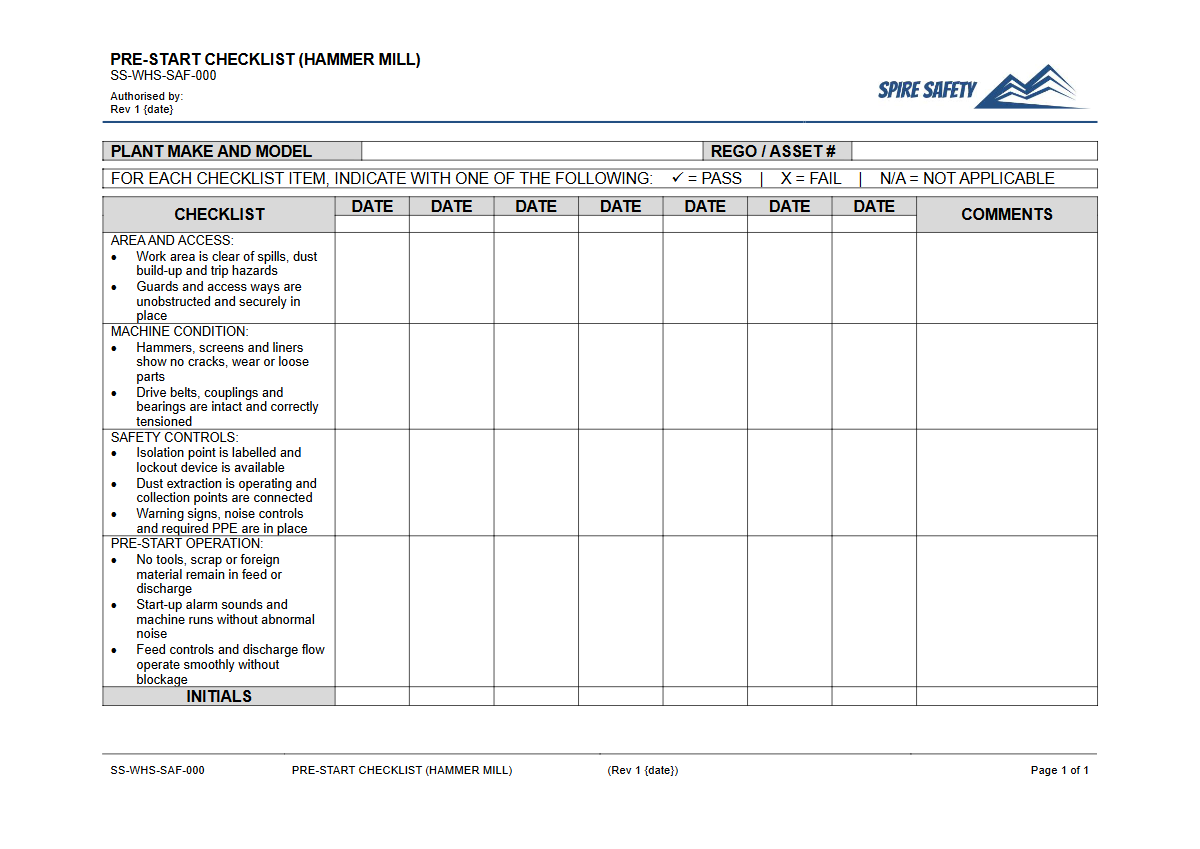
Operating machinery like a hammer mill introduces significant risks that must be carefully managed. Our Free Pre-Start Checklist (Hammer Mill) Template provides a structured starting point for organisations to formalise their daily equipment inspections.
Using a checklist ensures that key safety components and operational functions are systematically checked before the equipment is used, helping to identify potential faults or hazards before they can cause an incident. This documented process is a fundamental part of proactive WHS management, demonstrating due diligence and a commitment to worker safety.
Regularly completing these checks helps maintain the equipment in safe working order, reduce downtime, and foster a stronger safety culture. For broader safety discussions, our Pre-Start Checks and Plant Maintenance Toolbox Talk Template is an excellent complementary resource.
Video walkthrough
How to use the Free Pre-Start Checklist (Hammer Mill) Template
This template is provided in both DOCX and PDF formats for your convenience. The DOCX version is fully editable, allowing you to tailor it to the specific make, model, and configuration of the hammer mill used in your workplace.
The PDF is ready for immediate printing and use.
To use the template effectively:
- Download the DOCX file.
- Review the checklist items against your hammer mill’s operating manual and your site-specific risk assessment.
- Add, remove, or modify checklist items to reflect the unique features and hazards of your equipment, such as specific guards, emergency stops, feeding mechanisms, or discharge systems.
- Incorporate company branding, site details, and relevant personnel information.
- Train operators on the purpose and correct use of the customised checklist.
Important: This is a template, not a finished legal document. We cannot guarantee it covers every specific hazard for your particular machine and operational context.
You must customise this checklist to ensure it is suitable for your workplace, equipment, and processes. A pre-start checklist is often used alongside other key safety documents, such as a detailed Hammer Drill SWMS (Safe Work Method Statement) Template that outlines the step-by-step process for associated tasks.
When to use the Hammer Mill Pre-Start Checklist
A pre-start checklist should be completed by the operator before every shift or before the first use of the hammer mill each day. It should also be used any time a new operator takes over the equipment during a shift.
This ensures a consistent state of operational readiness and safety. Additional checks may be necessary after maintenance or repairs have been performed to verify that the equipment has been returned to a safe state.
A clear FREE Hammer Drill SOP (Safe Operating Procedure) Template can provide further guidance on the standard processes for using the equipment, reinforcing the checks outlined in the pre-start.
Who should use this Pre-Start Checklist
The checklist is designed to be completed by the person operating the hammer mill. Competent operators are in the best position to notice subtle changes in the machine’s performance or condition.
They have a primary responsibility to ensure the equipment they are about to use is safe. Supervisors and managers also play a crucial role.
They are responsible for providing the checklist, ensuring operators are trained to use it correctly, and reviewing completed checklists to identify any recurring issues or maintenance needs. This process forms a critical feedback loop within your broader WHS management systems, helping to track asset condition and safety performance over time.
While this template is specific to hammer mills, the principles can be adapted for other plant, and you can find templates like our Free Pre-Start Checklist (CNC Router) Template for other equipment types. Explore our full free WHS resources library for more templates to support your safety initiatives.
Common mistakes
Common mistakes to avoid
- Ticking boxes without physically inspecting the corresponding item ('pencil whipping').
- Failing to report minor defects that can escalate into major failures.
- Proceeding with work even after identifying a fault on the checklist.
- Using a generic checklist that doesn't cover the specific features and risks of the hammer mill model in use.
Legal references
Legal considerations
The following legal requirements may be relevant to this type of work.
- Work Health and Safety Act (Harmonised) — Provides the primary duties for protecting workers and other people from work health and safety risks.
- Work Health and Safety Regulations (Harmonised) — Sets out requirements supporting the management of workplace hazards and risks.
The following codes may be relevant to this type of work.
- Managing WHS Risks Code of Practice — Provides practical guidance on identifying hazards, assessing risks and applying effective controls.
- Work Health and Safety Consultation, Cooperation and Coordination Code of Practice — Provides practical guidance on consulting workers and coordinating with other duty holders.
- Managing the Work Environment and Facilities Code of Practice — Provides practical guidance on safe work environments, workplace facilities and related controls.
Did you know
Lockout/Tagout (LOTO)
During maintenance, cleaning, or clearing a jam, a hammer mill must be de-energised and locked out. A pre-start check is the last line of defence to ensure LOTO has been properly removed before operation.
Machine Guarding
According to Safe Work Australia, inadequate machine guarding is a leading cause of workplace injury. Pre-start checks are critical for verifying that all guards are in place and functioning correctly before work begins.
FAQ
Frequently asked questions
01What are the primary hazards associated with a hammer mill?
02How often should a hammer mill pre-start check be completed?
03What should an operator do if they find a fault during a pre-start check?
04Can this template be used for other types of industrial plant?
Share this resource
Free Pre-Start Checklist (Hammer Mill) Template
Browse Categories
How To Use It
- 1Download and open in Word or PDF.
- 2Replace the placeholders with your business details.
- 3Get it reviewed by a WHS specialist before rollout.
Need it customised?
Our WHS consultants can adapt this template to your site, run a gap analysis, or audit what you already have in place.
Book a Free Consultation WHS consulting servicesor call 1300 156 382