
Free Pre-Start Checklist (Hay Elevator) Template
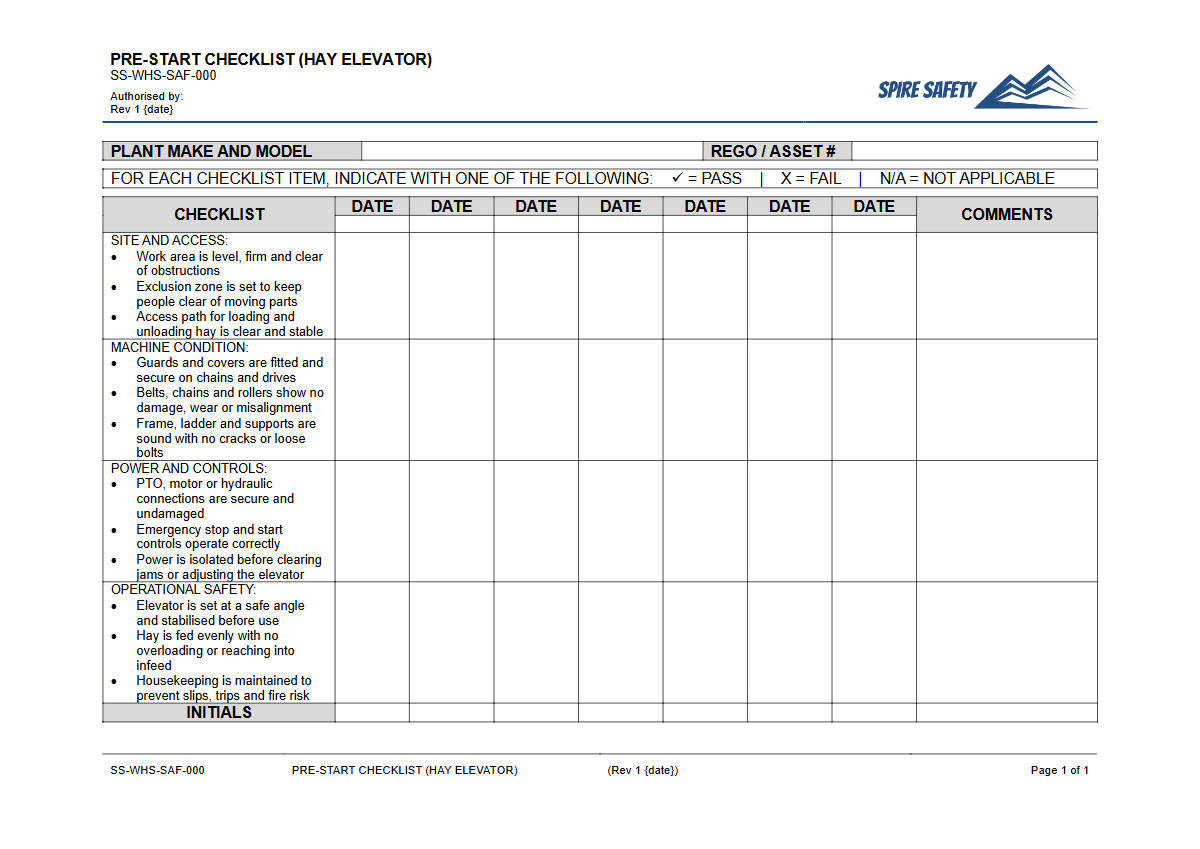
Download our free Pre-Start Checklist (Hay Elevator) Template. This DOCX & PDF resource helps formalise safety checks for agricultural and farm equipment.
Free Pre-Start Checklist (Hay Elevator) Template
DOCX • 125 KB + PDF
Updated Oct 2026
No signup required
Purpose of the Free Pre-Start Checklist (Hay Elevator) Template
This Free Pre-Start Checklist (Hay Elevator) Template provides a structured starting point for formalising the daily safety inspection of hay elevators and similar conveyors. Regular, documented checks are a critical component of any effective plant safety program, helping to identify mechanical faults, damage, or other hazards before they can lead to an incident.
Using a checklist helps ensure that inspections are performed consistently and that no critical safety components are overlooked. It creates a verifiable record that demonstrates due diligence in managing workplace risks.
Integrating this Pre-Start Checklist into your daily operations helps build a proactive safety culture where equipment condition is actively monitored. It is a practical tool that supports the broader framework of your WHS management systems by providing tangible evidence of risk control measures.
By identifying issues such as worn belts, missing guards, or faulty emergency stops early, organisations can prevent serious injuries related to entanglement, crushing, and manual handling.
A consistent inspection process also aids in preventative maintenance scheduling, reducing costly downtime and extending the operational life of the equipment. For further training on this topic, our Pre-Start Checks and Plant Maintenance Toolbox Talk can help reinforce the importance of these inspections with your team.
Video walkthrough
How to use the Free Pre-Start Checklist (Hay Elevator) Template
This template is designed for straightforward implementation. First, download the document in your preferred format, DOCX for easy editing or PDF for direct printing.
The next step is the most critical: customisation. The checklist items provided are general and based on common safety features, but every piece of equipment is different.
You must adapt the checklist to suit the specific make and model of your hay elevator, your site conditions, and any unique risks identified in your workplace.
Important: This template provides a structured foundation aligned with Australian WHS practice, but it is not a finished document. We strongly advise that you customise it to reflect the specific make, model, and condition of your hay elevator, as well as your unique operational environment and risks.
You may need to add, remove, or modify checklist items to ensure they are relevant and comprehensive for your machinery. For comparison, you can see how checks differ for other agricultural equipment by reviewing our free Pre-Start Checklist (Aerator) template.
Once customised, train all operators on how to use the checklist correctly. This training should cover not just how to tick the boxes, but how to properly inspect each component.
Finally, establish a clear procedure for what operators should do if they find a fault, including who to report it to and how to isolate the equipment to prevent its use until it is repaired.
When to use it
A pre-start checklist for a hay elevator should be completed before the first use on every shift or day of operation. This frequency ensures the equipment's condition is verified before work commences, minimising the risk of incidents caused by faults that may have developed overnight or during previous use.
In some high-use or high-risk environments, a risk assessment may determine that checks are required more frequently.
The checklist should also be used after any maintenance or repair work to confirm the equipment is safe to return to service. It is a crucial part of the safety lifecycle for plant and machinery, complementing other safety documents.
For example, the principles of structured risk management seen in this checklist are also fundamental when developing a SWMS for Concrete Truck Operation or other high-risk plant.
Who should use it
The hay elevator Pre-Start Checklist should be completed by a competent person who is trained and authorised to operate the equipment. This is typically the operator assigned to use the machine for that shift.
Competency means they not only know how to operate the hay elevator but also understand its specific hazards and how to properly inspect its safety features. Supervisors should periodically review completed checklists to ensure they are being filled out correctly and to monitor for recurring equipment issues.
If your organisation lacks the in-house expertise to confidently customise safety documentation or develop robust inspection procedures, engaging external WHS consulting services can provide the necessary guidance and assurance. Maintenance personnel may also use the checklist as a reference when performing repairs or scheduled servicing.
This document is one of many tools designed to help you build a safer workplace. You can explore our complete free WHS resources library for more templates, toolbox talks, and guidance materials to support your safety management efforts.
Common mistakes
Common mistakes to avoid
- Failing to customise the template for the specific make and model of hay elevator.
- Treating the checklist as a 'tick and flick' exercise without physically verifying each item.
- Neglecting to remove faulty equipment from service immediately after a defect is identified.
- Poor record-keeping or failing to report identified issues to a supervisor for corrective action.
Legal references
Legal considerations
The following legal requirements may be relevant to this type of work.
- Work Health and Safety Act (Harmonised) — Provides the primary duties for protecting workers and other people from work health and safety risks.
- Work Health and Safety Regulations (Harmonised) — Sets out requirements supporting the management of workplace hazards and risks.
The following codes may be relevant to this type of work.
- Managing WHS Risks Code of Practice — Provides practical guidance on identifying hazards, assessing risks and applying effective controls.
- Work Health and Safety Consultation, Cooperation and Coordination Code of Practice — Provides practical guidance on consulting workers and coordinating with other duty holders.
- Managing the Work Environment and Facilities Code of Practice — Provides practical guidance on safe work environments, workplace facilities and related controls.
Did you know
Conveyor Dangers
Entanglement is a leading cause of serious injury and fatalities involving conveyors like hay elevators. Most incidents occur during maintenance or when trying to clear blockages while the machine is still energised.
Australian Standards
The AS/NZS 4024 series on Safety of Machinery provides a comprehensive framework for machinery design, guarding, and risk assessment that is highly relevant to equipment like hay elevators.
FAQ
Frequently asked questions
01What should be included in a hay elevator pre-start inspection?
02Why are pre-start checklists important for farm machinery?
03How often should a hay elevator pre-start check be done?
04Who is responsible for completing the hay elevator pre-start checklist?
Share this resource
Free Pre-Start Checklist (Hay Elevator) Template
Browse Categories
How To Use It
- 1Download and open in Word or PDF.
- 2Replace the placeholders with your business details.
- 3Get it reviewed by a WHS specialist before rollout.
Need it customised?
Our WHS consultants can adapt this template to your site, run a gap analysis, or audit what you already have in place.
Book a Free Consultation WHS consulting servicesor call 1300 156 382