
Free Pre-Start Checklist (Hay Mower) Template
Download our free Pre-Start Checklist for Hay Mowers. This template helps formalise daily equipment inspections and improve workplace safety.
Free Pre-Start Checklist (Hay Mower) Template
DOCX • 125 KB + PDF
Updated Oct 2026
No signup required
Purpose of the Free Pre-Start Checklist (Hay Mower) Template
Operating a hay mower involves significant risks, including entanglement with rotating parts, blade contact, and projectiles. A systematic inspection before each use is a critical control measure to ensure the equipment is safe to operate.
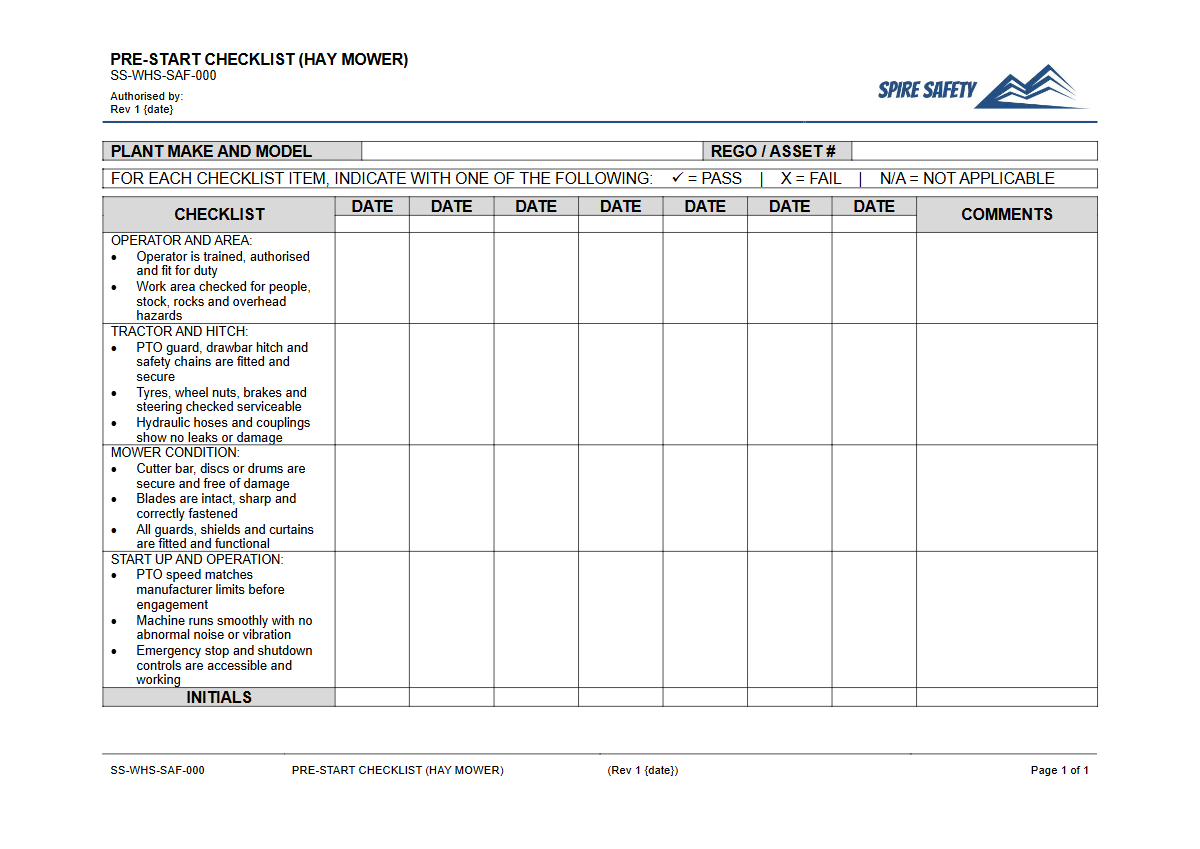
This free Pre-Start Checklist (Hay Mower) Template provides a structured format for operators to verify the condition of the mower, identify potential faults, and document their checks. Regular use helps create a proactive safety culture, reduces the likelihood of incidents, and provides valuable records for maintenance scheduling.
It formalises a key part of any organisation's WHS duties concerning plant safety.
Implementing routine checks is a cornerstone of a safe workplace. To help reinforce these practices with your team, consider using a targeted discussion guide like our Pre-Start Checks and Plant Maintenance Toolbox Talk Template to drive the message home.
Video walkthrough
How to Use the Free Pre-Start Checklist (Hay Mower) Template
Using this template is a straightforward process designed to integrate seamlessly into your daily operations. First, download the document in your preferred format—DOCX for easy customisation or PDF for immediate printing.
The checklist is structured to cover key components of a typical hay mower, including guards, blades, hydraulic systems, and power take-off (PTO) components. Operators should be trained to walk through each item, physically checking its condition and marking it as satisfactory or identifying a fault.
Completed checklists should be signed, dated, and stored as part of your safety records.
Important: This document provides a foundational structure. We have designed it as a starting point, but you must customise this pre-start checklist to suit the specific make and model of your hay mower, its unique attachments, your site conditions, and operational procedures.
Involving operators and maintenance staff in the customisation process is essential for creating a relevant and effective checklist.
Integrating this process into your broader safety framework ensures consistency and accountability. For organisations looking to formalise their procedures, Spire Safety can help you develop comprehensive WHS management systems that embed best practices across all your operations.
When to Use It
A pre-start checklist for a hay mower should be completed before the start of every shift or before the equipment is used for the first time each day. It is a pre-operational check, not a replacement for scheduled maintenance.
The check should also be performed after any maintenance or repair work to verify that the equipment has been safely returned to service. Documenting these checks provides a clear record of due diligence and helps track the condition of the equipment over time, often highlighting developing issues before they lead to a breakdown or an incident.
This principle of pre-operational checks applies to a wide range of agricultural and groundskeeping machinery. For example, if your operations also involve soil maintenance, you might find a similar structure useful in our free aerator pre-start checklist.
Who Should Use It
The pre-start check should be conducted by the person assigned to operate the hay mower for that shift. This operator must be a competent person, meaning they have received the necessary information, instruction, training, and supervision to perform the task safely and to correctly identify potential hazards associated with the equipment.
Supervisors and managers also have a role in ensuring the checks are being completed correctly and consistently. They should periodically review the completed checklists to monitor compliance and identify any recurring equipment issues that may require further investigation. This oversight is a key part of any effective safety program, and a process that can be verified through WHS compliance auditing.
While this checklist addresses pre-operational safety, managing the risks during operation requires a separate control, such as a Safe Work Method Statement (SWMS). For other high-risk mobile plant, a procedural document like a SWMS for concrete truck operation provides an example of how to manage hazards during the task itself.
If you need assistance developing these documents or implementing safety processes, our specialist WHS consulting services can provide tailored support. This template is one of many tools available in our free WHS resources library, designed to help Australian businesses improve their safety practices.
Common mistakes
Common mistakes to avoid
- Completing the checklist from memory without physically inspecting each item ('pencil-whipping').
- Using a generic checklist that doesn't cover the specific safety features or hazards of the mower model in use.
- Failing to immediately tag out and remove faulty equipment from service, allowing it to be used by others.
- Neglecting to train operators on what to look for and why each checkpoint is important.
Legal references
Legal considerations
The following legal requirements may be relevant to this type of work.
- Work Health and Safety Act (Harmonised) — Provides the primary duties for protecting workers and other people from work health and safety risks.
- Work Health and Safety Regulations (Harmonised) — Sets out requirements supporting the management of workplace hazards and risks.
The following codes may be relevant to this type of work.
- Managing WHS Risks Code of Practice — Provides practical guidance on identifying hazards, assessing risks and applying effective controls.
- Work Health and Safety Consultation, Cooperation and Coordination Code of Practice — Provides practical guidance on consulting workers and coordinating with other duty holders.
- Managing the Work Environment and Facilities Code of Practice — Provides practical guidance on safe work environments, workplace facilities and related controls.
Did you know
Entanglement Risk
A rotating Power Take-Off (PTO) shaft, common on hay mowers, can wrap clothing, hair, or limbs around it in less than a second, even at slow speeds. This makes proper guarding absolutely critical.
FAQ
Frequently asked questions
01What is the primary purpose of a pre-start check for a hay mower?
02Is this hay mower checklist template compliant with Australian WHS laws?
03How often should I conduct a pre-start inspection on a hay mower?
04What should an operator do if they find a fault during the pre-start check?
Share this resource
Free Pre-Start Checklist (Hay Mower) Template
Browse Categories
How To Use It
- 1Download and open in Word or PDF.
- 2Replace the placeholders with your business details.
- 3Get it reviewed by a WHS specialist before rollout.
Need it customised?
Our WHS consultants can adapt this template to your site, run a gap analysis, or audit what you already have in place.
Book a Free Consultation WHS consulting servicesor call 1300 156 382