
Free Pre-Start Checklist (Heat Press) Template
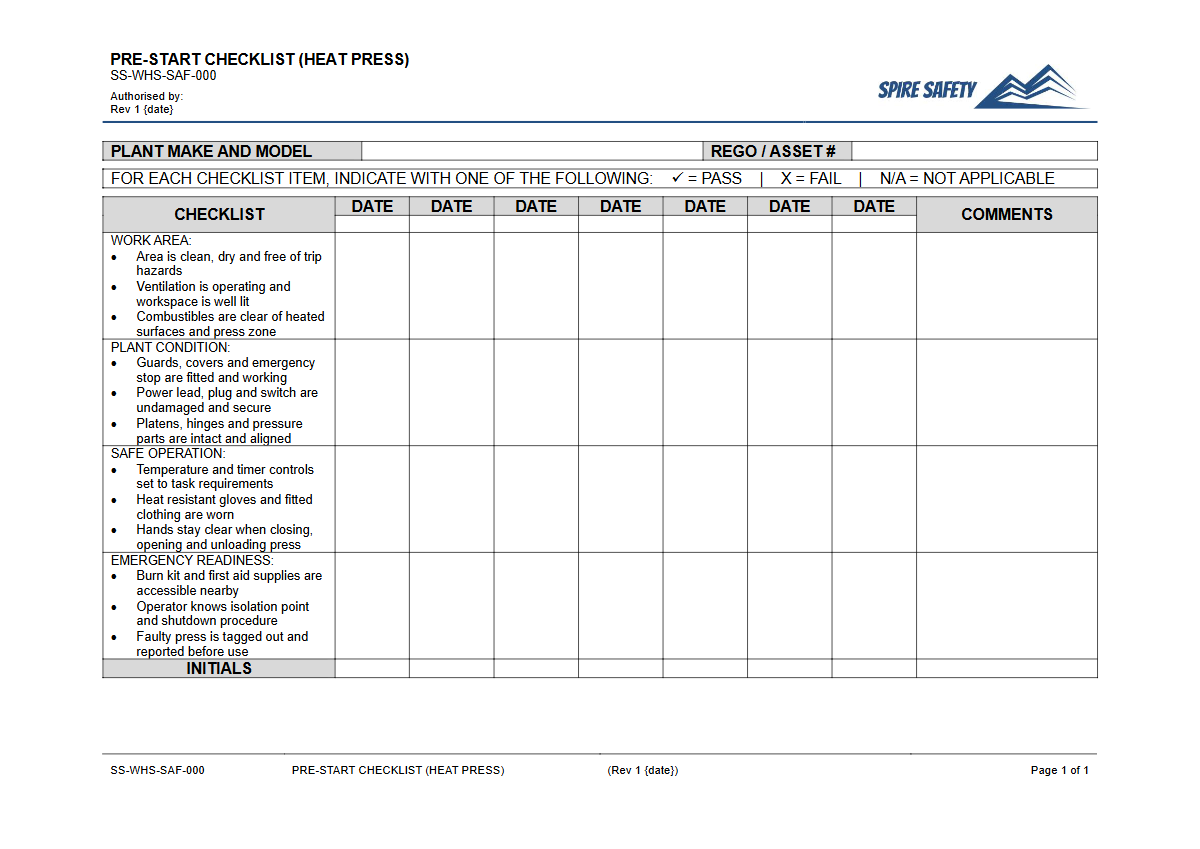
Download our free Pre-Start Checklist (Heat Press) Template (DOCX & PDF). Formalise your daily equipment inspections and improve safety in your workplace.
Free Pre-Start Checklist (Heat Press) Template
DOCX • 125 KB + PDF
Updated Oct 2026
No signup required
Purpose of the Free Pre-Start Checklist (Heat Press) Template
A heat press combines high temperatures and significant pressure, creating inherent risks of serious burns, crushing injuries, and electrical hazards. This Free Pre-Start Checklist (Heat Press) Template provides a structured framework for operators to systematically inspect the equipment before use.
Regular pre-start checks are a fundamental part of a safe system of work, helping to identify and control potential hazards before they lead to an incident. By formalising this process, you create a consistent record that the equipment was in a safe condition at the beginning of each shift.
Using this checklist helps your organisation meet its duty of care by proactively managing the risks associated with plant and equipment. It prompts the user to verify that critical safety components, such as guards, emergency stops, and temperature controls, are functioning correctly. Formalising procedures with documents like this is a core component of effective WHS management, similar to the structured approach outlined in our free Hydraulic Press SOP (Safe Operating Procedure) Template.
Video walkthrough
How to use the Free Pre-Start Checklist (Heat Press) Template
This checklist is provided as a starting point and is not a substitute for a comprehensive risk assessment. After downloading the DOCX file, you must customise it to suit the specific make and model of the heat press(es) in your workplace, as well as the environment and the types of tasks performed.
Different machines have unique features, controls, and failure points.
Your customisation should include:
- Adding brand or model-specific checks.
- Removing items not relevant to your equipment.
- Incorporating specific requirements from the manufacturer's instructions.
- Aligning the checklist with your organisation's existing safe work procedures.
Note: We have developed this as a general template. You must adapt it to reflect the specific hazards and control measures relevant to your workplace. Integrating customised safety documents into your operational processes is a key part of developing robust WHS management systems, ensuring they are practical and effective.
When to use it
A pre-start checklist should be completed before the heat press is used for the first time each day or at the beginning of every shift. If the equipment is used by multiple operators throughout the day, it may be appropriate for each new operator to conduct their own check before commencing work.
The goal is to ensure the machine's safety is verified before any work begins, preventing the use of faulty or unsafe equipment.
The frequency and timing of these checks should be determined by your workplace risk assessment. For high-use equipment or in demanding environments, more frequent checks may be necessary.
Consistent use can be reinforced through regular workplace discussions, for which our Pre-Start Checks and Plant Maintenance Toolbox Talk provides a useful guide.
Who should use it
The pre-start check should be conducted by the person who will be operating the heat press. Operators have the most hands-on experience with the equipment and are best positioned to notice small changes, unusual noises, or faults.
It is crucial that operators are trained and competent not only in using the heat press but also in how to conduct a thorough pre-start inspection and what to do if a fault is identified.
Supervisors and managers also have a role. They are responsible for ensuring that operators are completing the checklists correctly and for reviewing the completed records.
These records can help identify recurring issues, inform maintenance schedules, and demonstrate due diligence. Part of ensuring an operator is competent involves formal assessment, a process that can be documented using a tool like our Free Heat Gun VOC (Verification of Competency) Template, which is relevant for other heat-related tools.
What to do if a Fault is Found
If any check fails or a fault is identified, the operator must immediately stop and not use the equipment. The heat press should be isolated from its power source, and a "Danger - Do Not Operate" tag should be affixed to it.
The fault must be reported to a supervisor or manager immediately, following your workplace's established reporting procedure. The equipment must not be used again until it has been inspected, repaired by a competent person, and cleared for use.
Developing a clear tag-out and reporting procedure can be complex; engaging expert WHS consulting can help ensure your process is robust and effective.
For a complete library of other templates and safety documents, you can browse our free WHS resources library for more tools to support your safety management system.
Common mistakes
Common mistakes to avoid
- Using a generic checklist without customising it for the specific heat press model.
- Ticking items on the list without physically and visually inspecting the component.
- Continuing to use the equipment after noticing a minor fault or unusual noise.
- Failing to document completed checks or report identified faults to a supervisor.
Legal references
Legal considerations
The following legal requirements may be relevant to this type of work.
- Work Health and Safety Act (Harmonised) — Provides the primary duties for protecting workers and other people from work health and safety risks.
- Work Health and Safety Regulations (Harmonised) — Sets out requirements supporting the management of workplace hazards and risks.
The following codes may be relevant to this type of work.
- Managing WHS Risks Code of Practice — Provides practical guidance on identifying hazards, assessing risks and applying effective controls.
- Work Health and Safety Consultation, Cooperation and Coordination Code of Practice — Provides practical guidance on consulting workers and coordinating with other duty holders.
- Managing the Work Environment and Facilities Code of Practice — Provides practical guidance on safe work environments, workplace facilities and related controls.
Did you know
Extreme Temperatures
The heated platens on commercial heat presses can reach temperatures exceeding 200°C (400°F). Contact with these surfaces, even for a fraction of a second, can cause severe, third-degree burns.
Force and Pressure
A heat press doesn't just use heat; it also uses significant force. Even a manual clamshell press can exert hundreds of kilograms of closing force, posing a serious crushing hazard to hands and fingers if safety guards are bypassed or faulty.
FAQ
Frequently asked questions
01What is a heat press pre-start checklist?
02Why are pre-start checks important for heat presses?
03Who is responsible for completing the heat press checklist?
04What should I do if the heat press fails a check?
Share this resource
Free Pre-Start Checklist (Heat Press) Template
Browse Categories
How To Use It
- 1Download and open in Word or PDF.
- 2Replace the placeholders with your business details.
- 3Get it reviewed by a WHS specialist before rollout.
Need it customised?
Our WHS consultants can adapt this template to your site, run a gap analysis, or audit what you already have in place.
Book a Free Consultation WHS consulting servicesor call 1300 156 382