
Free Pre-Start Checklist (Heat Pump) Template
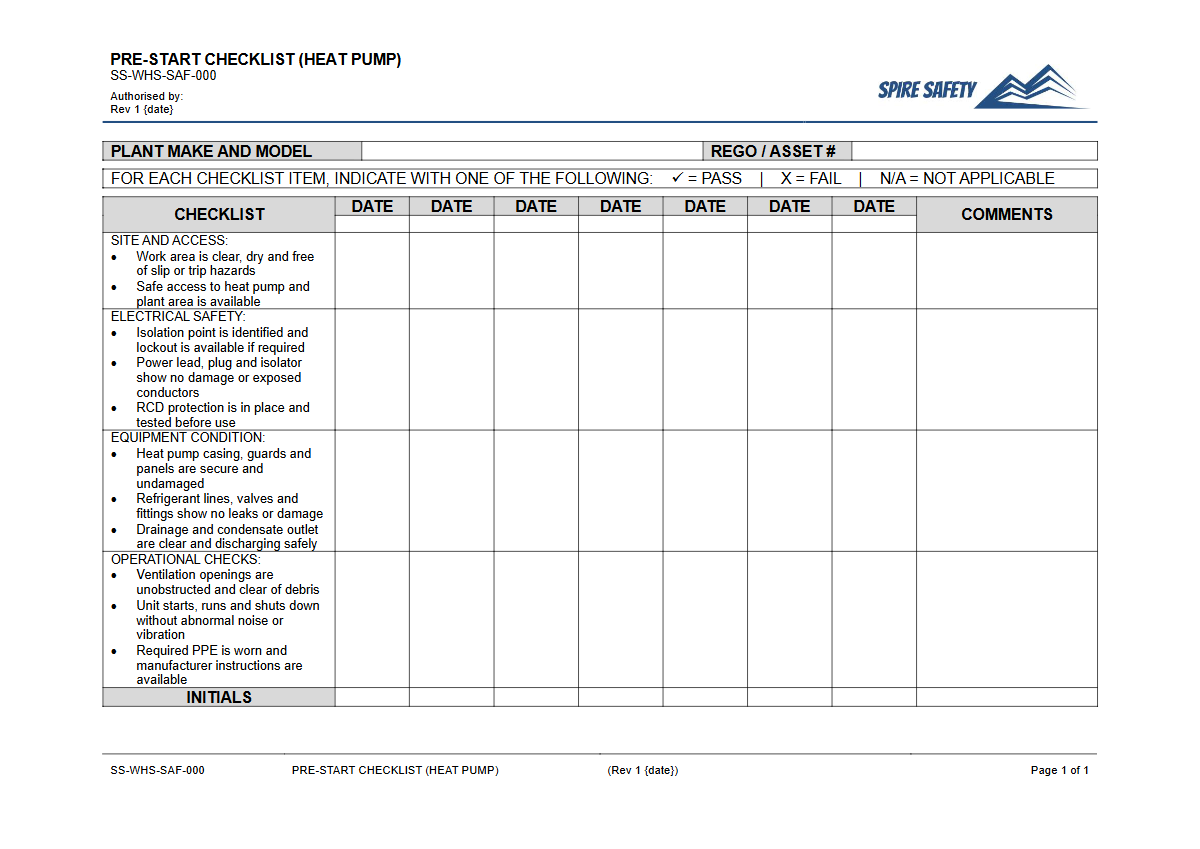
Download our free Pre-Start Checklist (Heat Pump) Template. This DOCX & PDF resource helps formalise daily equipment inspections for Australian workplaces.
Free Pre-Start Checklist (Heat Pump) Template
DOCX • 125 KB + PDF
Updated Oct 2026
No signup required
Purpose of the Free Pre-Start Checklist (Heat Pump) Template
Regularly inspecting plant and equipment before use is a fundamental safety practice in Australian workplaces. This Free Pre-Start Checklist (Heat Pump) Template provides a structured framework for operators to conduct consistent, documented safety checks on heat pump systems.
Using a checklist helps formalise the inspection process, ensuring that key components like electrical connections, refrigerant lines, fans, and safety guards are in good working order before operation begins. Proactively identifying potential faults, leaks, or damage minimises the risk of equipment failure, electrical shock, or exposure to hazardous substances, thereby preventing injuries and costly downtime.
A systematic pre-start check is a critical part of a proactive approach to safety management. It serves as a practical control measure to manage risks associated with plant operation.
To gain a deeper understanding of the potential hazards involved, you might find our Water Pump Risk Assessment template useful for identifying and assessing related risks.
Video walkthrough
How to use the Free Pre-Start Checklist (Heat Pump) Template
This resource is available for download as both a DOCX file for easy editing and a PDF for immediate printing. To use it, simply download the format that best suits your needs.
The checklist is designed as a comprehensive starting point, but it must be tailored to your specific operational context. Different models of heat pumps have unique features and potential failure points, so it's vital to review and amend the checklist accordingly.
Please note: this template is a starting point. We recommend you customise it to reflect your specific heat pump models, operational environment, and the unique risks present in your workplace.
Integrating this check into your broader safety procedures, such as a Heat Gun SWMS template, creates a more robust safe system of work.
When to use it
A pre-start checklist for a heat pump should be completed before the equipment is used for the first time on any given day or shift. This frequency ensures that any issues that may have developed overnight, during transport, or since the last use are identified before the equipment is energised.
For equipment that runs continuously, these checks might be integrated into a daily or weekly maintenance schedule. Regular safety discussions can reinforce the importance of these checks; a Pre-Start Checks and Plant Maintenance Toolbox Talk can be an effective way to maintain focus on this routine task.
Who should use it
The pre-start checklist should be completed by a person who is competent to operate the heat pump. This is typically the operator assigned to use the equipment for that shift.
The user must be trained not only in the safe operation of the machine but also in how to conduct the inspection and what to look for. Supervisors or maintenance personnel may also use the checklist to conduct periodic spot-checks or more detailed inspections.
Verifying a worker's ability to safely operate plant is crucial, and a document like a Heat Gun VOC template provides a framework for assessing this competency.
Integrating pre-start checks into your organisation’s safety framework is key to demonstrating due diligence. These records provide tangible evidence that safety procedures are being followed and form an important part of well-structured WHS management systems. They create a clear audit trail and help foster a culture of safety-consciousness among all team members.
To ensure these procedures are effective and consistently applied, organisations can benefit from periodic reviews of their processes. A formal WHS compliance auditing process can verify that pre-start checks are being completed correctly and that any identified issues are being resolved in a timely manner.
This helps close the loop on your safety procedures and drives continuous improvement.
This document is one of many tools designed to help Australian businesses improve their safety processes. For more templates covering a wide range of plant and equipment, browse our complete free WHS resources library.
Common mistakes
Common mistakes to avoid
- Using a generic checklist that hasn't been customised for the specific make and model of the heat pump.
- Pencil-whipping the checklist without physically inspecting each item.
- Failing to tag out and report faulty equipment, leading to its use by an unsuspecting colleague.
- Poor record-keeping, making it impossible to track recurring faults or prove that inspections were completed.
Legal references
Legal considerations
The following legal requirements may be relevant to this type of work.
- Work Health and Safety Act (Harmonised) — Provides the primary duties for protecting workers and other people from work health and safety risks.
- Work Health and Safety Regulations (Harmonised) — Sets out requirements supporting the management of workplace hazards and risks.
The following codes may be relevant to this type of work.
- Managing WHS Risks Code of Practice — Provides practical guidance on identifying hazards, assessing risks and applying effective controls.
- Work Health and Safety Consultation, Cooperation and Coordination Code of Practice — Provides practical guidance on consulting workers and coordinating with other duty holders.
- Managing the Work Environment and Facilities Code of Practice — Provides practical guidance on safe work environments, workplace facilities and related controls.
Did you know
Incredible Efficiency
Modern heat pumps don't create heat; they move it. This process allows them to achieve energy efficiency ratings of over 400%, meaning they can transfer four units of heat energy for every one unit of electrical energy consumed.
Refrigerant Risks
The refrigerants used in heat pumps can pose health and environmental risks if they leak. They can displace oxygen in enclosed spaces and many are potent greenhouse gases, making leak detection a critical part of any pre-start inspection.
FAQ
Frequently asked questions
01What should be included in a heat pump pre-start checklist?
02How often should a heat pump pre-start check be performed?
03What happens if a fault is found during a heat pump pre-start check?
04Is a digital pre-start checklist better than a paper one?
Share this resource
Free Pre-Start Checklist (Heat Pump) Template
Browse Categories
How To Use It
- 1Download and open in Word or PDF.
- 2Replace the placeholders with your business details.
- 3Get it reviewed by a WHS specialist before rollout.
Need it customised?
Our WHS consultants can adapt this template to your site, run a gap analysis, or audit what you already have in place.
Book a Free Consultation WHS consulting servicesor call 1300 156 382