
Free Pre-Start Checklist (Heat Treat Oven) Template
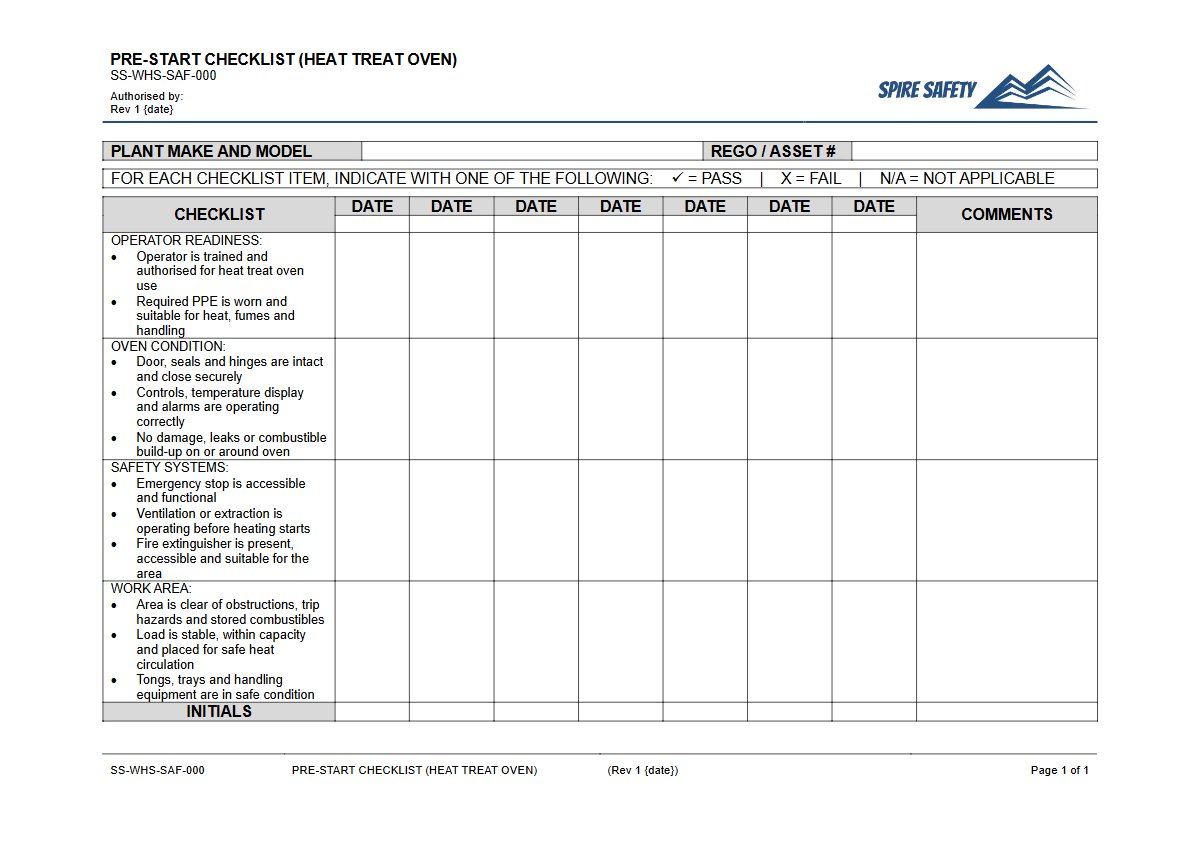
Download our free Pre-Start Checklist for Heat Treat Ovens. This DOCX & PDF template helps formalise daily equipment safety checks and supports your WHS system.
Free Pre-Start Checklist (Heat Treat Oven) Template
DOCX • 125 KB + PDF
Updated Oct 2026
No signup required
Purpose of the Free Pre-Start Checklist (Heat Treat Oven) Template
Operating industrial equipment like a heat treat oven involves significant risks, including extreme temperatures, pressure hazards, and potential for mechanical failure. This free Pre-Start Checklist (Heat treat Oven) Template provides a structured framework for operators to conduct thorough safety and operational checks before commencing work.
Regular pre-start inspections are a fundamental part of a proactive safety culture, helping to identify and control hazards before they can cause an incident. Formalising this process ensures consistency, creates a verifiable record of due diligence, and encourages a mindset where safety is the first step of every task. Integrating these checks into daily operations is a key topic covered in our Pre-Start Checks and Plant Maintenance toolbox talk.
Using a standardised checklist helps ensure that no critical safety component is overlooked, from emergency stops and interlocks to temperature controllers and ventilation systems. This document serves as a practical tool within your broader WHS management systems, providing tangible evidence that your organisation is taking proactive steps to manage plant-related risks.
It helps formalise the inspection process, moving it from an ad-hoc check to a recorded, accountable procedure that supports your overall safety objectives and risk management framework.
Video walkthrough
How to use the Free Pre-Start Checklist (Heat Treat Oven) Template
This resource is available for download as a DOCX file for easy editing and a PDF for immediate use. The checklist is categorised into logical sections, covering general area safety, mechanical components, control systems, and safety features.
Operators should work through the checklist systematically, physically verifying each item and noting its condition. Any identified defects, faults, or concerns must be recorded and immediately reported to a supervisor for corrective action before the oven is used.
The equipment should be tagged out of service if a critical safety fault is found.
Important: This document is a template and must be adapted for your specific workplace. We have provided a comprehensive starting point aligned with Australian WHS principles, but you must customise it to reflect the unique makes, models, configurations, and associated hazards of the heat treat ovens you use.
A thorough risk assessment of your equipment and processes should inform the final version of your checklist. For other high-risk thermal processes, you may also need documents like a Heat Gun SWMS template to manage associated risks.
When to use it
A pre-start checklist for a heat treat oven should be completed before every shift or before the first use of the day. This frequency ensures that the equipment's condition is verified before it is energised and put into operation, catching any issues that may have developed overnight or during a previous shift.
It can also be a valuable tool after maintenance or repair work to confirm the oven is safe to return to service. Establishing this routine is crucial for maintaining a consistent state of operational readiness and safety.
A documented procedure, such as a Heat Gun Safe Operating Procedure (SOP) for related tools, helps reinforce the importance of these routine checks.
Who should use it
The primary user of this checklist is the trained and authorised operator of the heat treat oven. These individuals have the hands-on knowledge to accurately assess the equipment's condition.
Supervisors also have a key role in reviewing completed checklists, ensuring the process is being followed correctly, and initiating action on any reported defects. Maintenance personnel may also use the checklist as a reference when diagnosing faults or to confirm that all systems are functional after repairs.
Ensuring operators are competent is vital, and a process similar to our free Heat Gun VOC template can be adapted to verify these skills.
Periodically, WHS managers or safety officers should review the completed records as part of their assurance activities. These records provide valuable data on equipment reliability, recurring issues, and the overall effectiveness of the pre-start inspection process. This information is essential during internal safety reviews or formal WHS compliance audits. You can find many more helpful documents for your safety program in our free WHS resources library.
Common mistakes
Common mistakes to avoid
- Using a generic checklist not customised for the specific oven model and its unique features.
- "Pencil-whipping" or ticking boxes without physically verifying each item on the checklist.
- Failing to immediately report and 'tag out' equipment with critical safety defects.
- Not reviewing or updating the checklist after an incident, near miss, or when equipment is modified.
Legal references
Legal considerations
The following legal requirements may be relevant to this type of work.
- Work Health and Safety Act (Harmonised) — Provides the primary duties for protecting workers and other people from work health and safety risks.
- Work Health and Safety Regulations (Harmonised) — Sets out requirements supporting the management of workplace hazards and risks.
The following codes may be relevant to this type of work.
- Managing WHS Risks Code of Practice — Provides practical guidance on identifying hazards, assessing risks and applying effective controls.
- Work Health and Safety Consultation, Cooperation and Coordination Code of Practice — Provides practical guidance on consulting workers and coordinating with other duty holders.
- Managing the Work Environment and Facilities Code of Practice — Provides practical guidance on safe work environments, workplace facilities and related controls.
Did you know
Atmospheric Control
Many heat treating processes require specific atmospheres inside the oven (e.g., nitrogen, argon, or carburising gases) to achieve the desired metallurgical properties. Leaks in these systems pose significant hazards, from asphyxiation to fire or explosion.
Quench Tank Hazards
The process often involves rapid cooling or 'quenching' in oil or water. This step introduces additional hazards like fire, intense steam generation, and slip risks, which must be managed alongside the oven operation itself.
FAQ
Frequently asked questions
01What items should be on a pre-start checklist for a heat treat oven?
02How often should heat treat oven pre-start checks be completed?
03Who is responsible for signing off on a pre-start checklist?
04Is a digital pre-start checklist acceptable for WHS records?
Share this resource
Free Pre-Start Checklist (Heat Treat Oven) Template
Browse Categories
How To Use It
- 1Download and open in Word or PDF.
- 2Replace the placeholders with your business details.
- 3Get it reviewed by a WHS specialist before rollout.
Need it customised?
Our WHS consultants can adapt this template to your site, run a gap analysis, or audit what you already have in place.
Book a Free Consultation WHS consulting servicesor call 1300 156 382