
Free Pre-Start Checklist (Hopper) Template
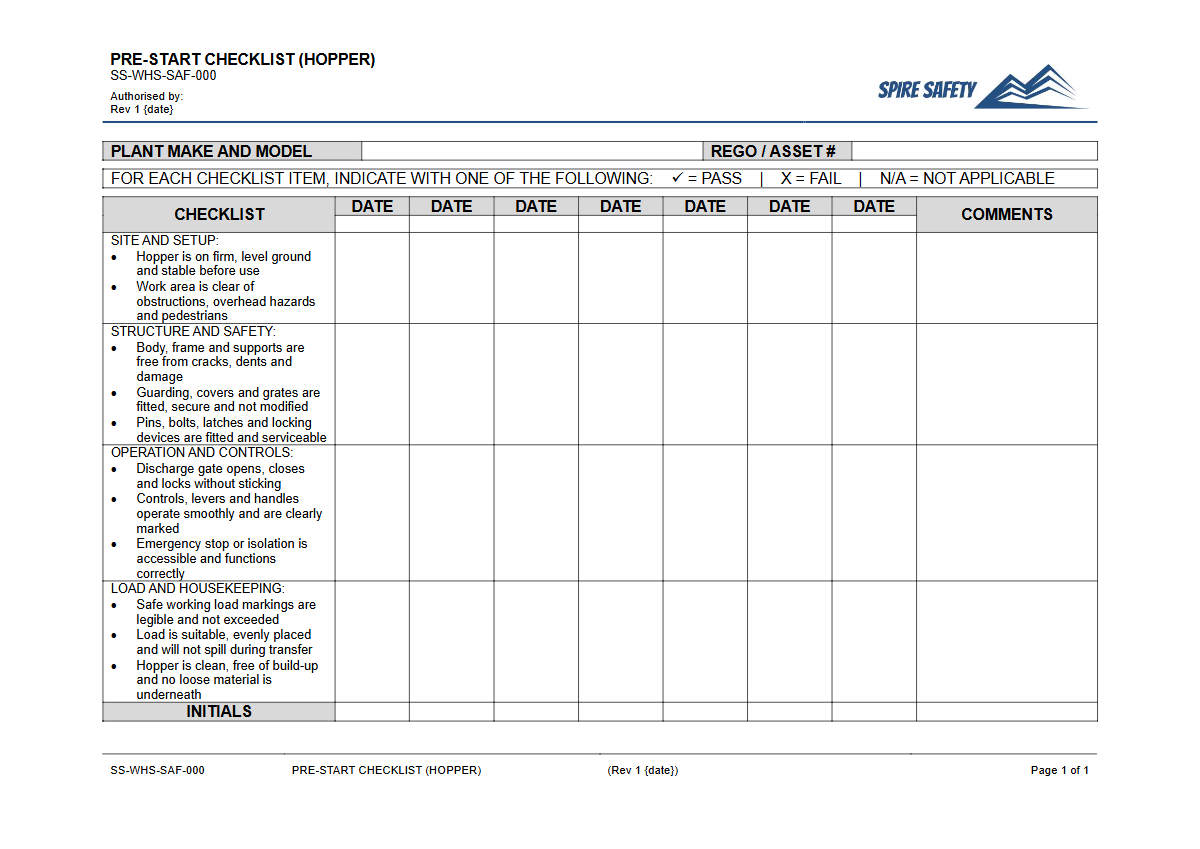
Download our Free Pre-Start Checklist (Hopper) Template (DOCX & PDF). A structured starting point for formalising daily equipment safety inspections.
Free Pre-Start Checklist (Hopper) Template
DOCX • 125 KB + PDF
Updated Oct 2026
No signup required
Purpose of the Free Pre-Start Checklist (Hopper) Template
This free Pre-Start Checklist (Hopper) Template provides a structured starting point for organisations to formalise their daily equipment inspections. Using a hopper, like any piece of plant or equipment, introduces risks into the workplace.
A systematic pre-start check is a fundamental control measure designed to identify mechanical faults, damage, or wear and tear before the equipment is put into service. This simple process helps prevent incidents, minimise downtime, and ensure the hopper is operationally safe for use.
By documenting these daily checks, organisations can demonstrate due diligence and create a historical record of the equipment's condition. This checklist is a practical tool aligned with Australian WHS best practices for plant management.
It serves as a critical component of a broader safety framework, complementing other key documents like a Safe Work Method Statement (SWMS) for Concrete Truck Operations, which outlines procedures for high-risk tasks involving such equipment.
What is a Pre-Start Checklist?
A Pre-Start Checklist is a formal list of items and functions that an operator must inspect on a piece of equipment before starting work. It guides the operator through a consistent and thorough inspection process, covering critical safety components, fluid levels, guards, and operational controls.
The goal is to catch potential problems early, ensuring the plant is safe to operate and preventing minor issues from escalating into major failures or safety incidents.
Video walkthrough
How to use the Free Pre-Start Checklist (Hopper) Template
To get the most value from this Free Pre-Start Checklist (Hopper) Template, it requires customisation and correct implementation. The resource is available as a DOCX file, which is fully editable, and a PDF file for immediate printing and use.
We recommend downloading the DOCX version to tailor the checklist to your specific operational needs. This allows you to add your company logo, specific site details, and equipment identifiers.
Note: This template is a guide only. It is essential that you customise this document to suit the specific make and model of the hopper, its configuration, your operational environment, and your organisation's unique risks.
We cannot know your specific workplace hazards, so adapting the checklist is a critical step.
When customising, consider adding check items relevant to your hopper, such as the condition of the frame, welds, gate mechanism, hydraulic or pneumatic systems, safety guards, and emergency stop functions. The modified checklist should be reviewed and approved by a competent person and then integrated into your overarching WHS management system.
When to use it
The hopper Pre-Start Checklist should be completed before the start of every shift or before the equipment is used for the first time each day. This routine is crucial because a hopper's condition can change overnight or between shifts due to damage, environmental factors, or incomplete handovers.
Integrating this check into the daily startup procedure ensures no operation begins with faulty equipment.
This check is a foundational step in the daily work routine. It should be conducted by the operator as part of their initial tasks, potentially following a daily pre-start meeting where safety issues and the day's tasks are discussed.
The principle applies across various types of machinery; just as you would use a specific pre-start checklist for an agitator, the hopper requires its own tailored inspection.
Who should use it
The primary person responsible for completing the Pre-Start Checklist is the trained and competent operator assigned to use the hopper for that shift. The operator has the most direct interaction with the equipment and is best positioned to notice subtle changes or developing faults.
It is their responsibility to conduct the check thoroughly and honestly.
Supervisors and managers also have a role. They are responsible for ensuring the checks are being completed correctly and for reviewing the completed forms.
They must establish a clear process for what an operator should do if a fault is identified, such as tagging the equipment out of service and reporting it to maintenance. You can use our Pre-Start Checks and Plant Maintenance Toolbox Talk to reinforce these procedures with your team.
Finally, maintenance personnel use the information from these checklists to schedule repairs and conduct preventative maintenance. The system's effectiveness can also be verified during routine WHS compliance audits. For more tools to help manage your workplace safety, explore our complete free WHS resources library.
Common mistakes
Common mistakes to avoid
- Failing to customise the generic template for the specific hopper model and workplace risks.
- Operators 'pencil-whipping' the form without physically conducting the checks.
- Not having a clear procedure for reporting and rectifying faults, leading to unsafe equipment remaining in service.
- Neglecting to train operators on how to properly inspect each item on the checklist.
Legal references
Legal considerations
The following legal requirements may be relevant to this type of work.
- Work Health and Safety Act (Harmonised) — Provides the primary duties for protecting workers and other people from work health and safety risks.
- Work Health and Safety Regulations (Harmonised) — Sets out requirements supporting the management of workplace hazards and risks.
The following codes may be relevant to this type of work.
- Managing WHS Risks Code of Practice — Provides practical guidance on identifying hazards, assessing risks and applying effective controls.
- Work Health and Safety Consultation, Cooperation and Coordination Code of Practice — Provides practical guidance on consulting workers and coordinating with other duty holders.
- Managing the Work Environment and Facilities Code of Practice — Provides practical guidance on safe work environments, workplace facilities and related controls.
Did you know
Plant-Related Injuries
According to Safe Work Australia, incidents involving plant and equipment are a significant cause of workplace injuries. Systematic inspections, like pre-start checks, are a primary defence against these preventable incidents.
Industrial Hoppers
In an industrial context, a hopper is a large, funnel-shaped container used to store and dispense bulk materials like grain, coal, or powders. They are distinct from standard bins or silos due to their tapered bottom, which facilitates controlled discharge.
FAQ
Frequently asked questions
01What is a hopper pre-start checklist?
02Why are daily hopper inspections important?
03Can I use this template for any type of hopper?
04Who is responsible for acting on faults found during a pre-start check?
Share this resource
Free Pre-Start Checklist (Hopper) Template
Browse Categories
How To Use It
- 1Download and open in Word or PDF.
- 2Replace the placeholders with your business details.
- 3Get it reviewed by a WHS specialist before rollout.
Need it customised?
Our WHS consultants can adapt this template to your site, run a gap analysis, or audit what you already have in place.
Book a Free Consultation WHS consulting servicesor call 1300 156 382