
Free Pre-Start Checklist (Hot Water Unit) Template
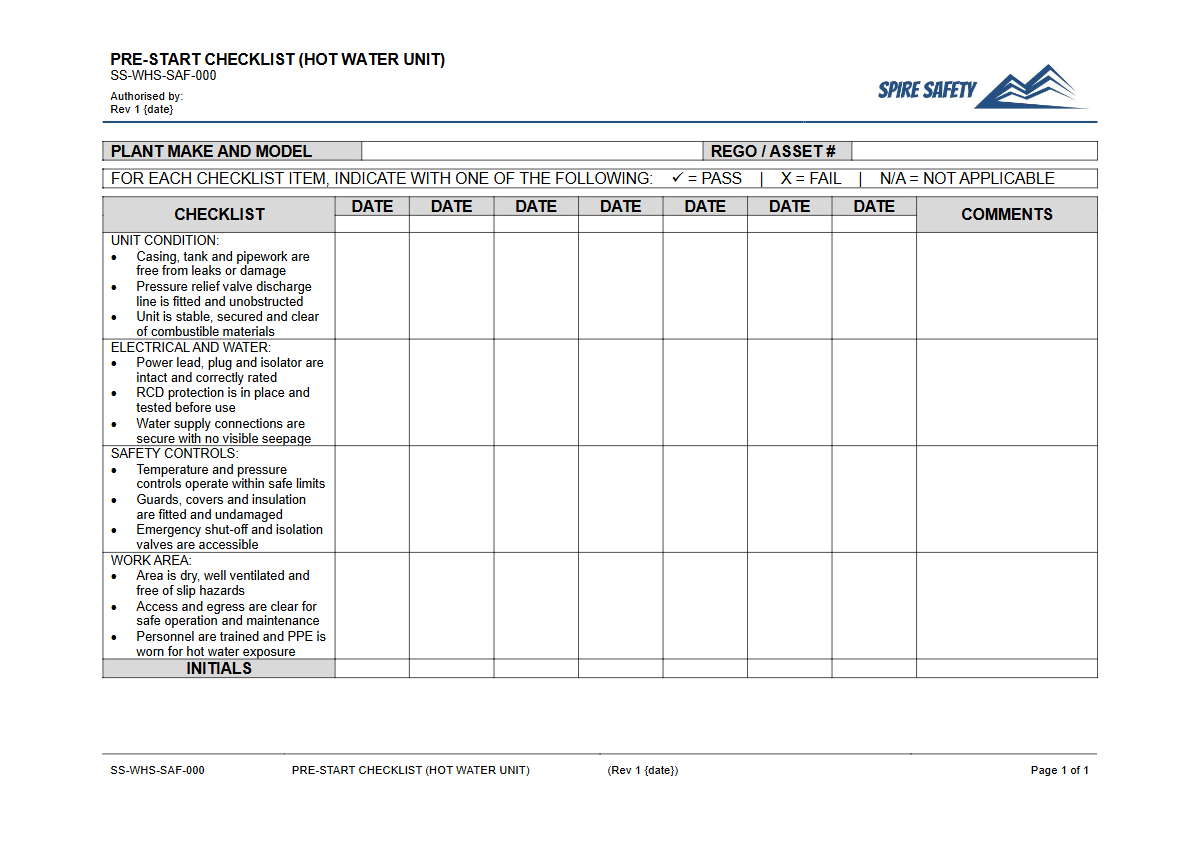
Formalise your equipment safety checks with our free Pre-Start Checklist (Hot Water Unit) Template.
Free Pre-Start Checklist (Hot Water Unit) Template
DOCX • 125 KB + PDF
Updated Oct 2026
No signup required
Purpose of the Free Pre-Start Checklist (Hot Water Unit) Template
A hot water unit, whether electric, gas, or solar, presents significant workplace hazards if not properly maintained. Risks include scalding, burns, electrical shock, gas leaks, and even explosion from pressure build-up.
Using this Free Pre-Start Checklist (Hot Water Unit) Template helps formalise the process of inspecting the unit before it is used or at the start of a shift. It provides a structured way for operators and maintenance staff to identify and report potential faults before they lead to an incident.
Regular pre-start inspections are a fundamental part of a proactive safety culture and a key requirement under Australian WHS regulations for managing the risks of plant. Integrating this checklist into your daily routine ensures that safety is a practical consideration, not just a document.
For broader team engagement, our Pre-Start Checks and Plant Maintenance Toolbox Talk can help reinforce this crucial behaviour.
Video walkthrough
How to use the Free Pre-Start Checklist (Hot Water Unit) Template
This checklist is provided in both DOCX and PDF formats for your convenience. The DOCX version is fully editable, allowing you to add, remove, or modify checks to suit the specific hot water system in your workplace.
The PDF is ideal for quick printing and immediate use.
Important: This document is a template and must be customised to suit the specific make, model, and operating environment of the hot water unit at your workplace. We provide it as a starting point to help you develop your own site-specific safety documentation.
Your risk assessment process should inform the final content of your checklist.
Key Inspection Points
Your customised checklist should prompt the user to inspect several critical areas of the hot water unit:
- Visual Inspection: Check the unit's casing, pipework, and connections for any signs of damage, corrosion, or leaks. Water stains or mineral deposits can indicate a slow leak that needs attention.
- Valves: Ensure the temperature and pressure relief (TPR) valve is unobstructed and shows no signs of leaking. This is a critical safety device that prevents catastrophic failure from over-pressurisation.
- Power Source: For electric units, check that wiring is secure and undamaged. For gas units, inspect gas lines for integrity and listen for any signs of a leak. Consider using a soapy water test on joints if a leak is suspected.
- Controls and Gauges: Verify that the thermostat is set to the correct temperature (typically above 60°C in the tank to prevent Legionella growth) and that any pressure gauges are within the normal operating range.
- Surrounding Area: The area around the unit should be clear of combustible or flammable materials. For indoor gas units, ensure there is adequate ventilation to prevent carbon monoxide build-up.
Water-related plant carries inherent risks, including the potential for water damage from leaks. A comprehensive Water Pump Risk Assessment can help you identify related hazards in your overall water system.
When to use it
A pre-start check for a hot water unit should be conducted:
- At the beginning of each day or shift in a commercial setting (e.g., kitchens, wash-down bays).
- Before using the unit after it has been shut down for an extended period.
- Following any maintenance, repair, or modification work.
- As part of a regular periodic inspection schedule (e.g., weekly) in lower-use environments.
Completed checklists should be filed as a record of inspection and maintenance. These records form an important part of your broader WHS management systems, demonstrating due diligence in managing plant safety.
Who should use it
This checklist is designed for use by competent personnel, including:
- Maintenance workers
- Plumbers
- Facility managers
- Boiler operators
- Any other worker tasked with the operation or routine inspection of hot water systems.
Supervisors and managers should also use the form to verify that checks are being completed correctly and to action any reported defects. For related trade tasks, confirming worker skill is crucial; for example, a Verification of Competency (Pipe Threader) Template may be useful for plumbing work.
Periodically reviewing completed checklists is a key activity during a WHS compliance audit to ensure procedures are being followed.
Common mistakes
Common mistakes to avoid
- Forgetting to manually operate the temperature and pressure relief (TPR) valve lever to check for blockages.
- Ignoring small leaks or signs of corrosion, which can be early warnings of imminent tank failure.
- Failing to ensure adequate ventilation for indoor gas-fired units, creating a carbon monoxide risk.
- 'Pencil-whipping' the checklist without physically performing each inspection step.
Legal references
Legal considerations
The following legal requirements may be relevant to this type of work.
- Work Health and Safety Act (Harmonised) — Provides the primary duties for protecting workers and other people from work health and safety risks.
- Work Health and Safety Regulations (Harmonised) — Sets out requirements supporting the management of workplace hazards and risks.
The following codes may be relevant to this type of work.
- Managing WHS Risks Code of Practice — Provides practical guidance on identifying hazards, assessing risks and applying effective controls.
- Work Health and Safety Consultation, Cooperation and Coordination Code of Practice — Provides practical guidance on consulting workers and coordinating with other duty holders.
- Managing the Work Environment and Facilities Code of Practice — Provides practical guidance on safe work environments, workplace facilities and related controls.
Did you know
Tempering Valves
Australian standards require tempering valves on new installations to limit water delivery to 50°C at outlets used for personal hygiene (e.g., showers, basins) to prevent severe scalding, making them a critical inspection item.
Legionella Risk
Hot water storage units must be kept at a minimum of 60°C to prevent the growth of Legionella bacteria, which causes the serious lung infection Legionnaires' disease. This temperature check is a vital part of health and safety management.
FAQ
Frequently asked questions
01What are the main hazards associated with hot water units?
02How often should a hot water unit pre-start check be performed?
03Is this checklist sufficient for WHS compliance?
04What should be done if a fault is found during a pre-start check?
Share this resource
Free Pre-Start Checklist (Hot Water Unit) Template
Browse Categories
How To Use It
- 1Download and open in Word or PDF.
- 2Replace the placeholders with your business details.
- 3Get it reviewed by a WHS specialist before rollout.
Need it customised?
Our WHS consultants can adapt this template to your site, run a gap analysis, or audit what you already have in place.
Book a Free Consultation WHS consulting servicesor call 1300 156 382