
Free Pre-Start Checklist (Hydraulic Hammer) Template
Download our free Pre-Start Checklist (Hydraulic Hammer) Template. This structured DOCX & PDF helps formalise daily safety inspections. Get started now.
Free Pre-Start Checklist (Hydraulic Hammer) Template
DOCX • 125 KB + PDF
Updated Oct 2026
No signup required
Purpose of the Free Pre-Start Checklist (Hydraulic Hammer) Template
A hydraulic hammer, or rock breaker, is a powerful attachment that exposes both the equipment and the operator to significant force, vibration, and hydraulic pressure. Using this Free Pre-Start Checklist (Hydraulic Hammer) Template helps your organisation formalise the inspection process, ensuring operators systematically check the equipment before every use.
Regular pre-start inspections are a practical way to identify potential hazards such as worn components, hydraulic leaks, or insecure fittings before they can lead to catastrophic failure, serious injury, or environmental contamination. This process helps a Person Conducting a Business or Undertaking (PCBU) meet their primary duty of care under Australian WHS legislation.
Implementing routine checks with a structured template demonstrates a commitment to proactive safety management. It forms a critical component of your overall safety framework, integrating daily operational tasks with your broader WHS management systems. Documenting these checks creates a valuable record for maintenance tracking, incident investigations, and demonstrating due diligence.
Video walkthrough
How to use the Free Pre-Start Checklist (Hydraulic Hammer) Template
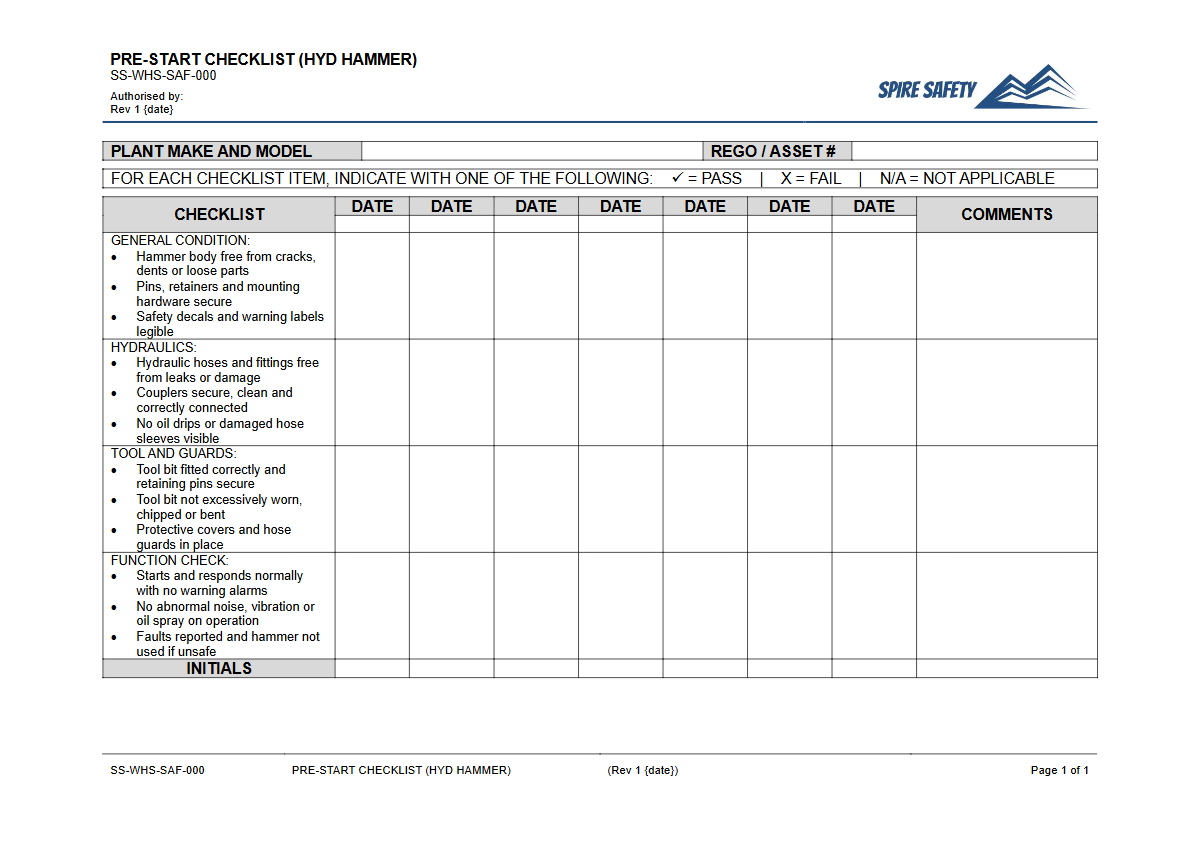
This resource is available as a DOCX file for easy editing and a PDF for immediate printing. The template provides a solid foundation based on common industry practice for inspecting hydraulic hammer attachments.
It includes checks for the hammer body, tool bit, hoses, couplings, and mounting connections to the carrier machine (e.g., excavator or skid steer). It is designed as a starting point for developing a workplace-specific document.
Important: To ensure this template meets the specific needs of your workplace, you MUST customise it. We recommend involving operators and maintenance personnel in this process to capture all relevant checks for your specific models and tasks.
You should add details such as your company name, specific hydraulic hammer models, and any unique hazards present on your site, such as working near the public or around sensitive infrastructure.
This structured approach to inspections is vital for all high-risk construction equipment. Similar principles apply when conducting pre-start checks for floor saws and other powerful tools, ensuring a consistent safety methodology across your site.
When to use it
The Pre-Start Checklist for a hydraulic hammer should be completed by the operator before the start of every shift or before the first use of the day. The high-vibration nature of the work means that components can loosen or fail without warning, making daily checks essential.
If the equipment is used by multiple operators in one day, a new check should be considered at handover to ensure continuity of safety and accountability.
If any defects, damage, or concerns are noted during the pre-start inspection, the equipment must be tagged out of service and not used until it has been inspected by a competent person (such as a mechanic) and cleared for use. This process prevents a minor issue from escalating into a major incident.
These inspection principles are transferable to other heavy equipment, as seen in our Forwarder Pre-Start Checklist for forestry operations.
Who should use it
This checklist should be used by personnel who are trained, licensed (where required), and deemed competent to operate the carrier machine and the hydraulic hammer attachment. The operator has the most direct control over the equipment and is best placed to notice small changes in its condition or performance.
Competency should include a thorough understanding of the manufacturer’s operating manual and specific training on the risks associated with hydraulic attachments.
Supervisors and managers also have a role. They are responsible for ensuring operators are completing the checklists correctly, reviewing the completed records, and taking prompt action to address any reported faults.
These records are key evidence of a functioning safety system and are often reviewed during WHS compliance auditing to verify that procedures are being followed in practice.
For workshop equipment, a similar logic applies; for example, our bench grinder pre-start checklist helps ensure even fixed plant is inspected before use by a trained operator. You can explore our complete free WHS resources library for more templates to support your safety processes.
Common mistakes
Common mistakes to avoid
- Ignoring small hydraulic fluid weeps or leaks, which can indicate a looming hose or seal failure.
- Failing to check the condition and security of the tool bit (e.g., chisel, moil), which can be ejected at force if not properly retained.
- Neglecting to inspect the mounting pins and safety retainers connecting the hammer to the carrier machine.
- Conducting the check from memory instead of using a physical or digital checklist, leading to missed steps.
Legal references
Legal considerations
The following legal requirements may be relevant to this type of work.
- Work Health and Safety Act (Harmonised) — Provides the primary duties for protecting workers and other people from work health and safety risks.
- Work Health and Safety Regulations (Harmonised) — Sets out requirements supporting the management of workplace hazards and risks.
The following codes may be relevant to this type of work.
- Managing WHS Risks Code of Practice — Provides practical guidance on identifying hazards, assessing risks and applying effective controls.
- Work Health and Safety Consultation, Cooperation and Coordination Code of Practice — Provides practical guidance on consulting workers and coordinating with other duty holders.
- Managing the Work Environment and Facilities Code of Practice — Provides practical guidance on safe work environments, workplace facilities and related controls.
Did you know
Hydraulic Pressure Hazard
Hydraulic systems on machinery operate at extremely high pressures. A pinhole leak in a hose can eject fluid at a velocity high enough to penetrate skin, causing severe injection injuries that require immediate specialist medical attention.
The Power of Impact
A large hydraulic hammer can deliver over 1,000 blows per minute, with each impact generating immense energy. This repetitive, high-energy work is why daily inspections for stress fractures and component wear are so critical.
FAQ
Frequently asked questions
01How often should a hydraulic hammer pre-start be done?
02Who is responsible for completing the hydraulic hammer checklist?
03What's the difference between a hydraulic hammer and a rock breaker?
04Does this checklist cover the excavator or carrier machine?
Share this resource
Free Pre-Start Checklist (Hydraulic Hammer) Template
Browse Categories
How To Use It
- 1Download and open in Word or PDF.
- 2Replace the placeholders with your business details.
- 3Get it reviewed by a WHS specialist before rollout.
Need it customised?
Our WHS consultants can adapt this template to your site, run a gap analysis, or audit what you already have in place.
Book a Free Consultation WHS consulting servicesor call 1300 156 382