
Free Pre-Start Checklist (Ice Machine) Template
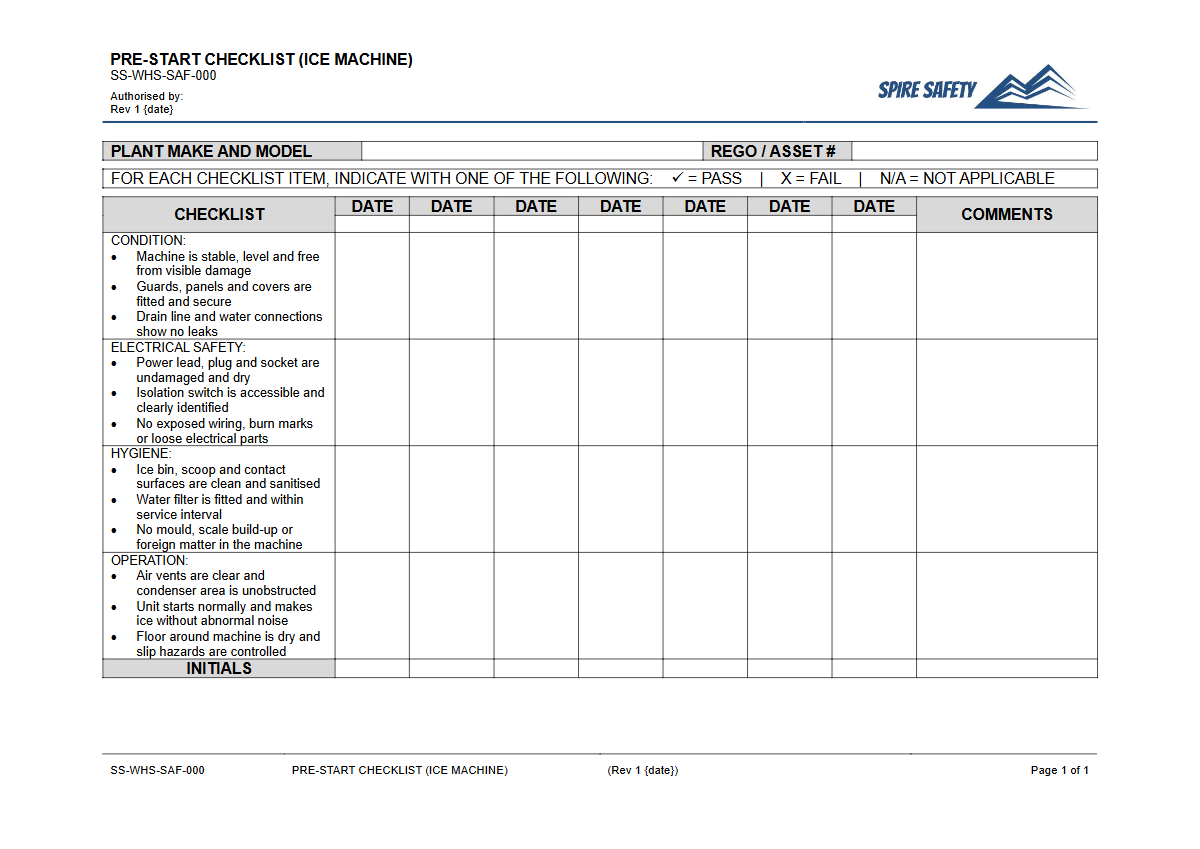
Formalise your daily equipment inspections with our free Pre-Start Checklist (Ice Machine) Template. Aligned with Australian WHS practice.
Free Pre-Start Checklist (Ice Machine) Template
DOCX • 125 KB + PDF
Updated Oct 2026
No signup required
Purpose of the Free Pre-Start Checklist (Ice Machine) Template
This Free Pre-Start Checklist (Ice Machine) Template provides a structured starting point for formalising daily safety and hygiene inspections for commercial ice machines. Regular pre-start checks are essential for identifying potential faults, electrical hazards, water leaks, and hygiene issues before they lead to equipment failure, contamination, or injury.
Using a standardised checklist helps ensure that no steps are missed and creates a verifiable record of due diligence.
Integrating these checks into your daily operations promotes a proactive safety culture where equipment condition is actively monitored. It forms a critical component of broader WHS management systems, helping your organisation meet its duty of care.
By catching minor issues early—such as a clogged filter, unusual noises, or mould growth—you can schedule maintenance proactively, extending the life of the asset and preventing costly emergency repairs.
The fundamental principles of performing these operator-level inspections are a core safety concept. To reinforce this behaviour with your teams, you may find our Pre-Start Checks and Plant Maintenance Toolbox Talk Template a useful training aid.
Video walkthrough
How to use the Free Pre-Start Checklist (Ice Machine) Template
This resource is available as a DOCX file for easy editing and customisation, and as a PDF for immediate printing and use. Download the template and adapt it to the specific requirements of your workplace and the particular make and model of your ice machine.
The checklist guides the operator through inspecting key components for safety, cleanliness, and operational readiness.
IMPORTANT: This document is a template and requires customisation. We cannot know the specific hazards of your workplace or the unique features of your equipment.
You must adapt this checklist to reflect your operational context and conduct your own risk assessment. This may include adding checks for specific components (e.g., water filter status, ice bin sensor, harvest cycle indicator), PPE requirements, or location-specific hazards.
The process is similar for other small commercial appliances. If your workplace also uses other equipment, you might find our Free Pre-Start Checklist (Coffee Grinder) Template helpful for standardising your approach.
For workplaces with complex equipment or unique risk profiles, seeking professional advice during the customisation phase can provide additional assurance. You can explore our WHS consulting services for tailored support.
When to use it
An ice machine pre-start checklist should be completed before the first use of the machine each day or at the beginning of every shift in a continuous operation. This frequency ensures the machine's condition is verified before it begins a production cycle.
If any faults or 'fail' items are noted on the checklist, the machine should be tagged out of service and the issue reported to a supervisor or maintenance personnel immediately. Do not operate faulty equipment.
Completed checklists should be signed, dated, and stored as a record of your safety and maintenance activities. These records are valuable for tracking equipment performance, identifying recurring faults, and demonstrating procedural diligence during a safety review or WHS compliance auditing process.
Who should use it
This Pre-Start Checklist is designed for use by any person operating the ice machine. This typically includes kitchen hands, bar staff, or food service workers who have been trained and deemed competent in its safe and hygienic operation.
Supervisors and managers should also use the document to verify that checks are being completed correctly and to follow up on any reported defects. WHS personnel can use this template as a basis for standardising equipment safety documentation across a facility or organisation.
By providing structured templates like this, we aim to help you build a comprehensive library of safety documents. You can explore our full range in the free WHS resources library to find other useful templates.
Common mistakes
Common mistakes to avoid
- Failing to check internal components like the evaporator and water reservoir for slime or mould.
- 'Pencil-whipping' the form without physically inspecting the machine.
- Ignoring minor water drips or leaks, which can indicate a larger problem or create a serious slip hazard.
- Not training operators on what to look for or what constitutes a 'fail' on the checklist.
Legal references
Legal considerations
The following legal requirements may be relevant to this type of work.
- Work Health and Safety Act (Harmonised) — Provides the primary duties for protecting workers and other people from work health and safety risks.
- Work Health and Safety Regulations (Harmonised) — Sets out requirements supporting the management of workplace hazards and risks.
The following codes may be relevant to this type of work.
- Managing WHS Risks Code of Practice — Provides practical guidance on identifying hazards, assessing risks and applying effective controls.
- Work Health and Safety Consultation, Cooperation and Coordination Code of Practice — Provides practical guidance on consulting workers and coordinating with other duty holders.
- Managing the Work Environment and Facilities Code of Practice — Provides practical guidance on safe work environments, workplace facilities and related controls.
Did you know
A Breeding Ground
Poorly maintained ice machines are notorious for harbouring mould and bacteria, including Listeria, Salmonella, and E. coli. Regular cleaning and inspection are critical public health controls, not just equipment maintenance tasks.
FAQ
Frequently asked questions
01What are the main hazards associated with commercial ice machines?
02How often should an ice machine be professionally cleaned and sanitised?
03Why can't I just use a generic equipment checklist?
04Who is responsible for ensuring pre-start checks are done?
Share this resource
Free Pre-Start Checklist (Ice Machine) Template
Browse Categories
How To Use It
- 1Download and open in Word or PDF.
- 2Replace the placeholders with your business details.
- 3Get it reviewed by a WHS specialist before rollout.
Need it customised?
Our WHS consultants can adapt this template to your site, run a gap analysis, or audit what you already have in place.
Book a Free Consultation WHS consulting servicesor call 1300 156 382