
Free Pre-Start Checklist (Impact Wrench) Template
Download our free Pre-Start Checklist (Impact Wrench) Template. This structured DOCX & PDF tool helps workers formalise daily safety inspections.
Free Pre-Start Checklist (Impact Wrench) Template
DOCX • 125 KB + PDF
Updated Oct 2026
No signup required
Purpose of the Free Pre-Start Checklist (Impact Wrench) Template
An impact wrench is a powerful tool used across many industries, from automotive repair to construction. Its high torque and rapid rotational action introduce significant workplace hazards, including musculoskeletal injuries from vibration and torque reaction, hearing loss, and impact injuries from projectiles.
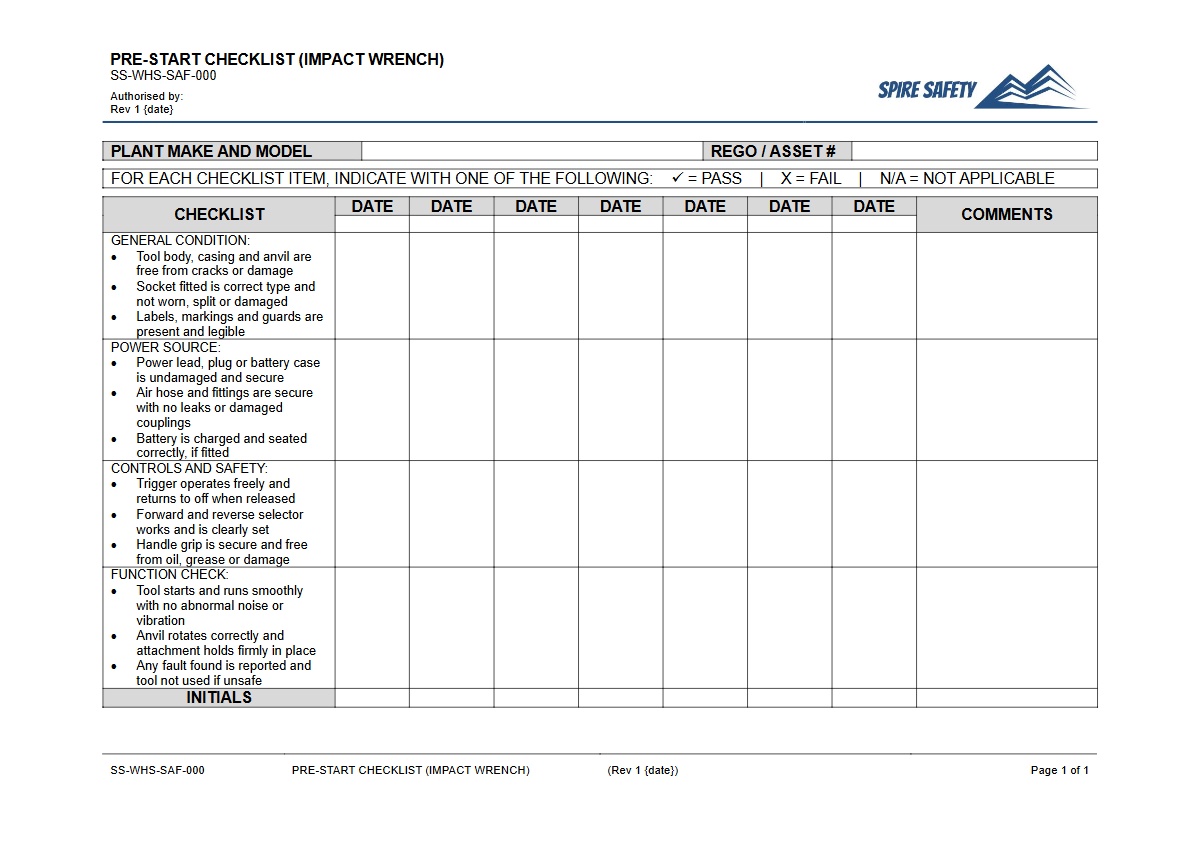
This free Pre-Start Checklist (Impact Wrench) Template provides a structured framework for operators to inspect the tool before use, helping to identify potential faults or damage that could lead to an incident. A systematic check helps formalise the inspection process, ensuring that operators consistently look for common faults.
This proactive approach is crucial for managing hazards associated with many workshop tools, from impact wrenches to stationary equipment. You can apply a similar structured process using our free pre-start checklist for bench grinders. By identifying issues such as cracked housings, worn anvils, or faulty triggers early, organisations can take corrective action before the tool is used, significantly reducing the risk of injury.
This simple process is a key part of demonstrating a commitment to worker safety and meeting duties under Australian WHS laws.
Video walkthrough
How to use the Free Pre-Start Checklist (Impact Wrench) Template
Using this template effectively involves more than just downloading the file. Follow these steps to integrate it into your safety procedures:
- Download: Choose between the DOCX and PDF formats. The DOCX file is fully editable, allowing for easy customisation.
- Customise: This is the most critical step. You must adapt the checklist to your specific workplace. Add your company branding, and most importantly, adjust the checklist items to reflect the exact models of impact wrenches you use (e.g., pneumatic, cordless, corded), the types of tasks they are used for, and your unique operational risks.
- Train: Ensure all operators and supervisors are trained on why the check is necessary, what each item means, and what to do if a fault is found. This includes the procedure for taking a faulty tool out of service.
- Implement: Make the checklist readily available to operators at the point of work. This could be a laminated hard copy kept with the tool, or a digital version accessible on a tablet or phone.
- Review: Periodically review the completed checklists and the template itself to ensure it remains relevant and effective.
Note: We have provided a solid foundation aligned with good WHS practice. However, the ultimate responsibility for creating a safe system of work rests with the PCBU (Person Conducting a Business or Undertaking). This principle of customisation applies to all high-risk equipment, including tools covered by our free pre-start checklist for floor saws.
When to use the Pre-Start Checklist
A pre-start inspection should be completed:
- Before the first use of the impact wrench on any given day or shift.
- By each new operator if the tool is shared during a shift.
- After any incident where the tool has been dropped, subjected to excessive force, or is suspected of being damaged.
Integrating these checks into daily routines is a fundamental component of effective WHS management systems, creating a documented history of equipment condition and operator diligence.
Who should use the Pre-Start Checklist
The primary user of the checklist should be the tool operator—the person who will be using the impact wrench. They are in the best position to conduct a hands-on inspection before they begin work.
Supervisors also have a key role. They are responsible for ensuring operators are trained and competent to perform the checks, that the checks are actually being completed, and for verifying that corrective actions are taken when faults are identified and reported. Completed checklists should be retained as records, as they provide valuable evidence of due diligence during a WHS compliance audit.
Key Inspection Points for Impact Wrenches
A thorough pre-start check on an impact wrench should cover several key areas. While your customised checklist will be more detailed, it should address these general points:
- General Condition: Look for any cracks, damage, or excessive wear on the tool's housing. Ensure all labels and warnings are legible.
- Anvil & Socket Retention: Check the anvil (the square drive) for wear or damage. Ensure the socket retention mechanism (pin detent or hog ring) is functioning correctly and will hold a socket securely.
- Trigger & Controls: Test the trigger for smooth operation. Ensure any forward/reverse switches or power regulators work as intended and are not stuck.
- Power Source: For pneumatic tools, inspect the air hose and couplings for leaks or damage. For cordless tools, check the battery for damage and ensure it locks securely into the tool.
- Sockets & Accessories: Crucially, confirm that only impact-rated sockets are being used. Standard chrome sockets can shatter under the force of an impact wrench, creating dangerous projectiles.
If you are unsure how to identify specific hazards or develop robust controls for your power tools, engaging professional WHS consulting can provide expert guidance tailored to your business needs.
Common mistakes
Common mistakes to avoid
- Using non-impact rated (chrome) sockets which can shatter under load.
- Failing to check that the anvil's socket retention pin or ring is working.
- Ignoring signs of damage like cracks in the housing or frayed air hoses.
- Neglecting to wear appropriate PPE, especially safety glasses and gloves.
Legal references
Legal considerations
The following legal requirements may be relevant to this type of work.
- Work Health and Safety Act (Harmonised) — Provides the primary duties for protecting workers and other people from work health and safety risks.
- Work Health and Safety Regulations (Harmonised) — Sets out requirements supporting the management of workplace hazards and risks.
The following codes may be relevant to this type of work.
- Managing WHS Risks Code of Practice — Provides practical guidance on identifying hazards, assessing risks and applying effective controls.
- Work Health and Safety Consultation, Cooperation and Coordination Code of Practice — Provides practical guidance on consulting workers and coordinating with other duty holders.
- Managing the Work Environment and Facilities Code of Practice — Provides practical guidance on safe work environments, workplace facilities and related controls.
Did you know
Impact-Rated Sockets
Standard chrome sockets are brittle and can shatter when used on an impact wrench. Impact sockets are made from a softer, more ductile steel (like chrome-molybdenum) that can withstand the rapid, high-torque impacts without fracturing.
Hand-Arm Vibration
Prolonged exposure to vibration from tools like impact wrenches can lead to Hand-Arm Vibration Syndrome (HAVS), a painful and disabling condition affecting blood vessels, nerves, and joints.
FAQ
Frequently asked questions
01What are the main hazards of using an impact wrench?
02Is a pre-start check legally required for an impact wrench in Australia?
03How often should an impact wrench be professionally serviced?
04Can I add extra items to this checklist template?
Share this resource
Free Pre-Start Checklist (Impact Wrench) Template
Browse Categories
How To Use It
- 1Download and open in Word or PDF.
- 2Replace the placeholders with your business details.
- 3Get it reviewed by a WHS specialist before rollout.
Need it customised?
Our WHS consultants can adapt this template to your site, run a gap analysis, or audit what you already have in place.
Book a Free Consultation WHS consulting servicesor call 1300 156 382