
Free Pre-Start Checklist (Infusion Pump) Template
Download our Free Pre-Start Checklist (Infusion Pump) Template in an editable DOCX format.
Free Pre-Start Checklist (Infusion Pump) Template
DOCX • 125 KB + PDF
Updated Oct 2026
No signup required
Purpose of the Free Pre-Start Checklist (Infusion Pump) Template
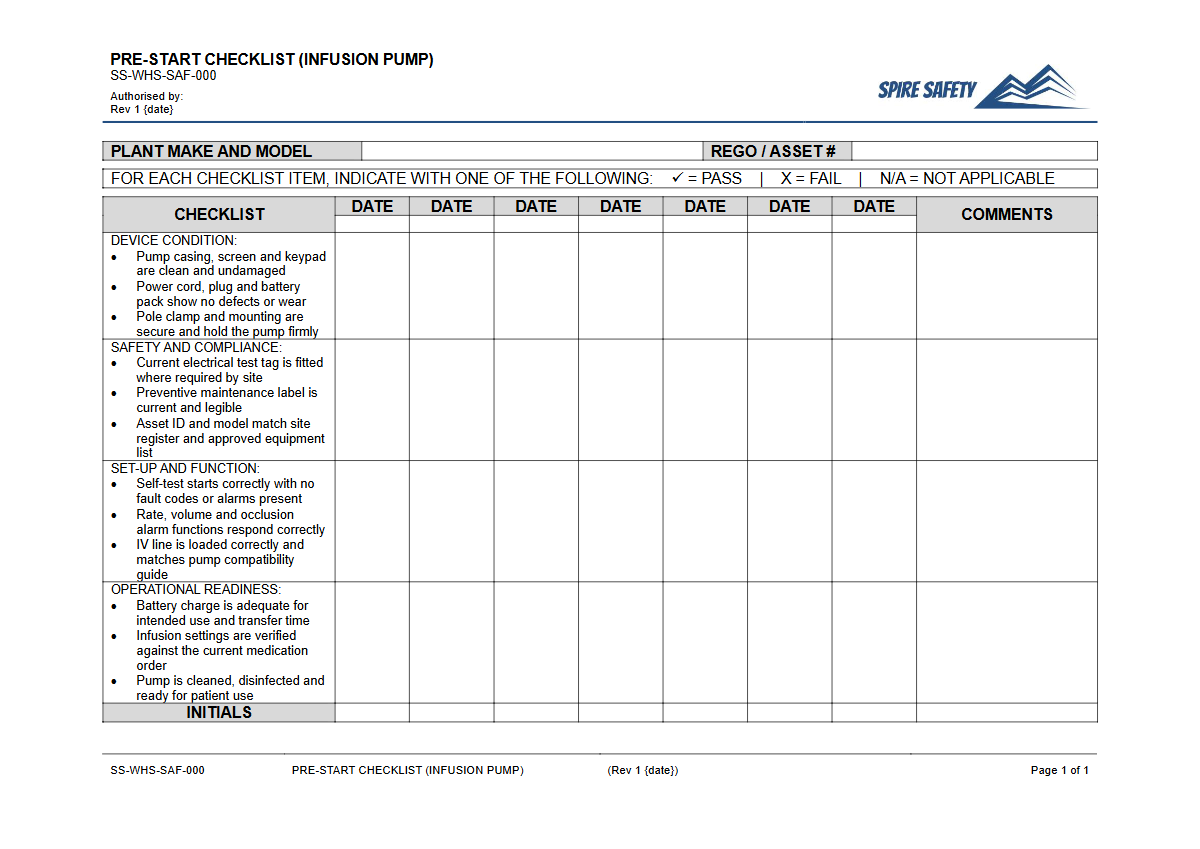
Infusion pumps are critical pieces of equipment in healthcare settings, and their reliable function is paramount to patient safety. This Free Pre-Start Checklist (Infusion Pump) Template provides a structured framework for operators to conduct consistent and thorough safety inspections before use.
Implementing regular checks helps identify potential faults, damage, or calibration issues early, preventing malfunctions that could lead to incorrect dosage or equipment failure. Formalising this process demonstrates a commitment to proactive risk management and helps create a safer environment for both patients and healthcare professionals.
Using a standardised checklist ensures that no critical safety item is overlooked, promoting a consistent standard of care and operational readiness. Reinforcing the importance of these inspections can be effectively done through regular training, such as with a Pre-Start Checks and Plant Maintenance Toolbox Talk Template.
Video walkthrough
How to use the Free Pre-Start Checklist (Infusion Pump) Template
This template is provided in both DOCX and PDF formats for your convenience. The DOCX file is fully editable, allowing you to tailor the checklist to the specific models of infusion pumps used in your facility, as well as any unique environmental or procedural requirements.
To use it, download the file and open it in a word processor like Microsoft Word or Google Docs.
Review the default checklist items and add, remove, or modify them to align with the manufacturer’s instructions and your internal safety protocols. Key areas to inspect typically include the power cord and plug, casing integrity, display screen function, alarm tests, and the condition of tubing clamps and sensors.
Once customised, the checklist can be integrated into your facility's operational procedures.
Important Customisation Note
This document is a template and not a complete, out-of-the-box solution. It is essential that you customise this checklist to suit the specific equipment, tasks, and risks present in your workplace.
We are not liable for any incidents that may occur from the use of this document. It should be incorporated into your broader WHS management systems as part of a comprehensive approach to safety.
When to use it
An infusion pump pre-start checklist should be completed before the first use of the pump each day or at the beginning of each shift where the pump will be in operation. It should also be used when a pump is brought into a new clinical area or if there is any doubt about its operational status.
The goal is to verify the equipment's safety and functionality immediately prior to it being used for patient care. For comprehensive safety, this daily check should complement a FREE Pump SOP (Safe Operating Procedure) Template that outlines the full lifecycle of safe operation, from setup to cleaning and storage.
Who should use it
This checklist is designed to be used by the primary operators of the equipment, such as nurses, clinicians, and other trained healthcare professionals who are responsible for setting up and administering infusions. Their direct involvement ensures that the person using the device is confident in its safety and readiness.
Supervisors, clinical managers, and biomedical engineering staff may also use the completed checklists for auditing, maintenance scheduling, and quality assurance purposes. In settings like residential care, reinforcing safety protocols is crucial, and this checklist can be used alongside resources like an Aged Care Manual Handling Toolbox Talk Template to build a strong safety culture.
Furthermore, WHS managers or officers have a role in ensuring these procedures are correctly implemented and consistently followed. They can periodically review the completed checklists to identify trends, supports your compliance efforts, and verify the effectiveness of the pre-start inspection process.
This can be a key activity within regular WHS compliance auditing to confirm that safety protocols are being upheld on the ground. For more tools to support your safety framework, you can browse our complete free WHS resources library.
Common mistakes
Common mistakes to avoid
- Signing off the checklist without physically inspecting each item.
- Ignoring minor issues like frayed power cords or small cracks in the casing.
- Using a generic checklist that doesn't match the specific pump model.
- Failing to remove a faulty pump from service and report the defect immediately.
Legal references
Legal considerations
The following legal requirements may be relevant to this type of work.
- Work Health and Safety Act (Harmonised) — Provides the primary duties for protecting workers and other people from work health and safety risks.
- Work Health and Safety Regulations (Harmonised) — Sets out requirements supporting the management of workplace hazards and risks.
The following codes may be relevant to this type of work.
- Managing WHS Risks Code of Practice — Provides practical guidance on identifying hazards, assessing risks and applying effective controls.
- Work Health and Safety Consultation, Cooperation and Coordination Code of Practice — Provides practical guidance on consulting workers and coordinating with other duty holders.
- Managing the Work Environment and Facilities Code of Practice — Provides practical guidance on safe work environments, workplace facilities and related controls.
Did you know
A Known Risk
Studies have shown that errors related to infusion pumps are one of the most common causes of adverse drug events in hospitals, highlighting the critical need for rigorous checks and user training.
FAQ
Frequently asked questions
01What should be included in an infusion pump pre-start checklist?
02Why are pre-start checks for medical equipment important?
03How often should infusion pump checks be performed?
04Is this template suitable for all types of infusion pumps?
Share this resource
Free Pre-Start Checklist (Infusion Pump) Template
Browse Categories
How To Use It
- 1Download and open in Word or PDF.
- 2Replace the placeholders with your business details.
- 3Get it reviewed by a WHS specialist before rollout.
Need it customised?
Our WHS consultants can adapt this template to your site, run a gap analysis, or audit what you already have in place.
Book a Free Consultation WHS consulting servicesor call 1300 156 382