
Free Pre-Start Checklist (Irrigator) Template
Download our free Pre-Start Checklist (Irrigator) Template. This DOCX & PDF resource helps formalise safety checks for agricultural irrigators. Start today.
Free Pre-Start Checklist (Irrigator) Template
DOCX • 125 KB + PDF
Updated Oct 2026
No signup required
Purpose of the Free Pre-Start Checklist (Irrigator) Template
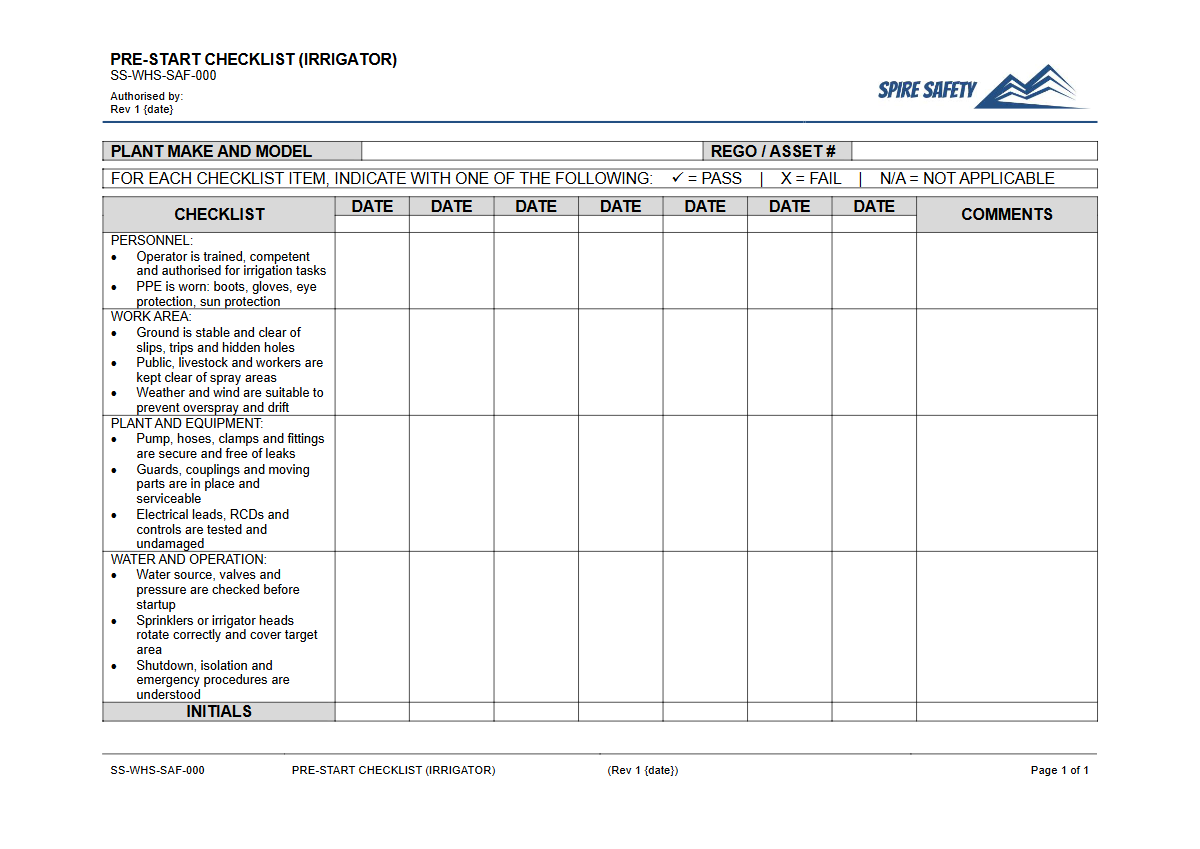
Regularly inspecting agricultural equipment is a fundamental part of maintaining a safe workplace. Our Free Pre-Start Checklist (Irrigator) Template provides a structured starting point for formalising daily safety inspections of centre pivot, lateral move, or travelling irrigators.
Using a checklist helps operators systematically identify and report potential faults before they lead to incidents, equipment damage, or costly downtime. This is crucial for managing hazards associated with large-scale irrigation systems, such as entanglement in moving parts, high-pressure water release, structural instability, electrical faults, and interaction with other vehicles.
A formal pre-start process demonstrates a commitment to proactive risk management and is a key element of any effective plant safety program. To further embed this practice within your team, consider using a Pre-Start Checks and Plant Maintenance Toolbox Talk to reinforce the importance of these daily inspections and discuss recent findings.
Video walkthrough
How to use the Free Pre-Start Checklist (Irrigator) Template
This template is provided in both DOCX and PDF formats to suit your operational needs. The DOCX file is fully editable, allowing you to add, remove, or modify checklist items to reflect the specific make, model, and configuration of the irrigators used at your workplace.
This customisation is a critical step to ensure the checklist is relevant and effective.
Follow these steps for implementation:
- Download: Select the DOCX or PDF version of the template.
- Customise: Adapt the checklist to match your specific irrigator models, site conditions, and operational risks. Add your company branding and specific safe operating procedures.
- Train: Ensure all operators are trained on how to use the checklist correctly and understand what each item refers to.
- Implement: Integrate the checklist into your daily start-up procedure. Store completed records for auditing and maintenance tracking.
- Review: Periodically review the checklist's effectiveness and update it as equipment is modified or new hazards are identified.
Note: This document is a template only. It is not a substitute for a comprehensive risk assessment.
It is your responsibility to ensure it is adapted to the specific plant, tasks, and environment of your workplace. We recommend incorporating it into your broader WHS management systems to ensure it aligns with your overall safety strategy.
When to use it
An irrigator pre-start check should be completed before the equipment is used for the first time each day or at the beginning of each shift. This ensures the equipment was left in a safe state by the previous operator and that no damage has occurred overnight.
Performing the check before operation allows any identified faults to be addressed before the equipment is put under load, preventing potential failures during use.
This process is often conducted alongside daily team briefings or pre-work meetings. You can use our free Pre-Start Meeting Template to help structure these discussions and formally document safety communications, including the outcomes of equipment checks.
Who should use it
This Pre-Start Checklist should be completed by the person operating the irrigator. Operators have the most hands-on interaction with the equipment and are best placed to notice small changes or developing issues.
They must be deemed competent and have received adequate training on both the safe operation of the irrigator and the correct procedure for completing the checklist.
Supervisors and farm managers also have a role in overseeing the process. They are responsible for ensuring checks are being completed consistently and correctly, reviewing completed checklists, and taking prompt action to rectify any reported faults. An organisation's WHS processes, including pre-start checks, can be verified through a systematic review or a WHS compliance audit.
While this checklist is specific to irrigators, the principles apply to all workplace plant and equipment. For other common agricultural or groundskeeping machinery, you may need a different document, such as our pre-start checklist for aerators. You can explore our full range of templates in our free WHS resources library to find documents suited to your other operational needs.
Common mistakes
Common mistakes to avoid
- Using a generic checklist without customising it for the specific irrigator model and site conditions.
- Rushing through the checklist and 'ticking and flicking' without physically verifying each component's condition.
- Failing to immediately isolate and tag out faulty equipment, allowing it to remain in service.
- Poor record-keeping, such as failing to retain completed checklists for maintenance tracking and safety audits.
Legal references
Legal considerations
The following legal requirements may be relevant to this type of work.
- Work Health and Safety Act (Harmonised) — Provides the primary duties for protecting workers and other people from work health and safety risks.
- Work Health and Safety Regulations (Harmonised) — Sets out requirements supporting the management of workplace hazards and risks.
The following codes may be relevant to this type of work.
- Managing WHS Risks Code of Practice — Provides practical guidance on identifying hazards, assessing risks and applying effective controls.
- Work Health and Safety Consultation, Cooperation and Coordination Code of Practice — Provides practical guidance on consulting workers and coordinating with other duty holders.
- Managing the Work Environment and Facilities Code of Practice — Provides practical guidance on safe work environments, workplace facilities and related controls.
Did you know
Water Use
In Australia, agriculture is the largest consumer of water. Irrigation accounts for approximately 70% of the total water used, highlighting the critical role that efficient and well-maintained irrigation systems play in national production.
Entanglement Risk
According to Safe Work Australia, around 10 workers are killed each year in incidents involving vehicle or mobile plant collisions. Entanglement in moving parts, such as irrigator driveshafts and wheels, is a significant and often underestimated hazard.
FAQ
Frequently asked questions
01What should an irrigator pre-start checklist include?
02How often should irrigator pre-start checks be done?
03Are pre-start checklists a legal requirement in Australia?
04What happens if a fault is found during a pre-start check?
Share this resource
Free Pre-Start Checklist (Irrigator) Template
Browse Categories
How To Use It
- 1Download and open in Word or PDF.
- 2Replace the placeholders with your business details.
- 3Get it reviewed by a WHS specialist before rollout.
Need it customised?
Our WHS consultants can adapt this template to your site, run a gap analysis, or audit what you already have in place.
Book a Free Consultation WHS consulting servicesor call 1300 156 382