
Free Pre-Start Checklist (Jib Attachment) Template
Formalise safety inspections for forklift jib attachments with our free template. Manage WHS risks and document daily checks.
Free Pre-Start Checklist (Jib Attachment) Template
DOCX • 125 KB + PDF
Updated Oct 2026
No signup required
Purpose of the Free Pre-Start Checklist (Jib Attachment) Template
Using a jib attachment transforms equipment like a forklift or telehandler into a mobile crane, introducing significant risks if not managed correctly. These attachments alter the machine's centre of gravity and operational limits.
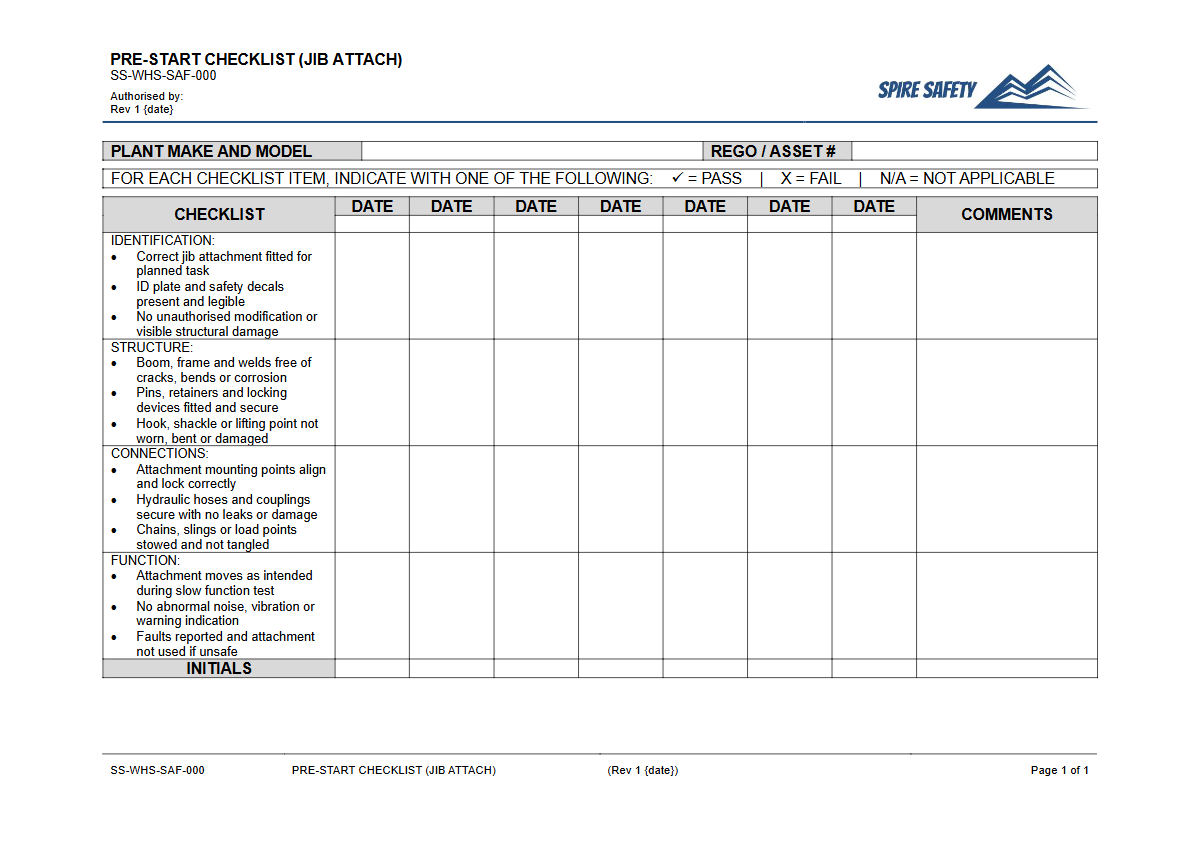
This Free Pre-Start Checklist (Jib Attachment) Template provides a structured framework for operators to conduct thorough, documented inspections before each use. It helps identify potential defects such as cracks in welds, damaged hooks, missing safety latches, or unreadable load capacity plates.
Formalising these checks is a critical step in preventing equipment failure, load dropping, and potential rollovers.
By integrating this checklist into your daily operations, you create a verifiable record of due diligence, demonstrating a proactive approach to safety. Consistent use of pre-start checklists is a cornerstone of effective WHS management systems, helping to ensure that only safe and properly functioning equipment is used on site.
Key Inspection Areas
A comprehensive pre-start inspection for a jib attachment should cover several critical areas, including:
- Structural Integrity: Checking for cracks, bending, or damage to the jib arm, frame, and mounting points.
- Attachment Points: Ensuring the locking pins or mechanisms that secure the jib to the host machine are present, undamaged, and correctly engaged.
- Lifting Components: Inspecting the hook, shackle, and safety latch for wear, deformation, and proper function. The safety latch is crucial for preventing the load from slipping off the hook.
- Safety Chains: Verifying the presence and condition of the safety chain used to secure the jib to the forklift carriage.
- Rating Plate: Confirming the manufacturer's data plate is legible, showing the model, serial number, and, most importantly, the load chart or safe working load (SWL) at various extensions.
Video walkthrough
How to use the Free Pre-Start Checklist (Jib Attachment) Template
This Free Pre-Start Checklist (Jib Attachment) Template is designed as a user-friendly starting point. First, download the template in your preferred format (DOCX for easy editing or PDF).
Next, and most importantly, you must review and adapt the checklist to your specific workplace. This includes adding details relevant to the make and model of your jib attachments, the host machines they are used on (e.g., specific forklift models), and any unique environmental or operational risks at your site.
Once customised, integrate the checklist into your Standard Operating Procedures (SOPs) for lifting operations. Train all relevant operators and supervisors on how and when to complete the checklist, what to do if a fault is found (the 'tag out' procedure), and where to file the completed records.
If you require assistance in tailoring safety documents to your specific operational needs, engaging with a professional for WHS consulting can provide expert guidance.
When to use it
A pre-start checklist for a jib attachment should be completed by the operator before the first use of the equipment on every shift. It is not a weekly or monthly check; it is a critical pre-operational safety routine.
If the attachment is removed and re-fitted during a shift, a new check should be performed to ensure it has been correctly re-secured. This consistent routine helps catch damage or defects that may have occurred during previous use or while the equipment was stored, preventing them from escalating into a serious incident. These checks for lifting equipment are a common requirement, similar to those you might find in our Free Pre-Start Checklist (Bin Lifter) Template.
Who should use it
The pre-start checklist must be completed by a person who is trained, competent, and authorised to operate the specific host machine and jib attachment combination. This responsibility lies with the operator who will be using the equipment.
Supervisors and managers also have a role; they are responsible for ensuring the pre-start check system is implemented, that operators are completing the checks correctly, and that any reported faults are addressed promptly before the equipment is used again. Regular reviews of completed checklists can be a key input for a WHS compliance auditing program, verifying that safety procedures are being followed in practice.
You can find many other helpful templates and guides in our complete free WHS resources library, covering a wide range of equipment and safety procedures.
Common mistakes
Common mistakes to avoid
- Failing to de-rate the forklift's capacity according to the jib's load chart.
- Using the jib attachment for a purpose it was not designed for, such as dragging loads sideways.
- Completing the checklist from memory without physically inspecting each item ('pencil-whipping').
- Neglecting to inspect the safety chain that secures the jib to the forklift carriage.
Legal references
Legal considerations
The following legal requirements may be relevant to this type of work.
- Work Health and Safety Act (Harmonised) — Provides the primary duties for protecting workers and other people from work health and safety risks.
- Work Health and Safety Regulations (Harmonised) — Sets out requirements supporting the management of workplace hazards and risks.
The following codes may be relevant to this type of work.
- Managing WHS Risks Code of Practice — Provides practical guidance on identifying hazards, assessing risks and applying effective controls.
- Work Health and Safety Consultation, Cooperation and Coordination Code of Practice — Provides practical guidance on consulting workers and coordinating with other duty holders.
- Managing the Work Environment and Facilities Code of Practice — Provides practical guidance on safe work environments, workplace facilities and related controls.
Did you know
Centre of Gravity Shift
Attaching a jib to a forklift significantly moves the combined centre of gravity forward. This drastically reduces the forklift's safe lifting capacity compared to when using its forks.
Chain Reaction
The failure of a single small component, like a safety latch on a hook or a locking pin, can lead to a catastrophic failure of the entire lift. This is why inspecting every component during a pre-start check is vital.
FAQ
Frequently asked questions
01What key items should be checked on a forklift jib attachment before use?
02Is a jib attachment considered a lifting device under WHS law?
03How often should a pre-start check for a jib attachment be completed?
04Can I use this template for any type of crane or forklift?
Share this resource
Free Pre-Start Checklist (Jib Attachment) Template
Browse Categories
How To Use It
- 1Download and open in Word or PDF.
- 2Replace the placeholders with your business details.
- 3Get it reviewed by a WHS specialist before rollout.
Need it customised?
Our WHS consultants can adapt this template to your site, run a gap analysis, or audit what you already have in place.
Book a Free Consultation WHS consulting servicesor call 1300 156 382