
Free Pre-Start Checklist (Keg Washer) Template
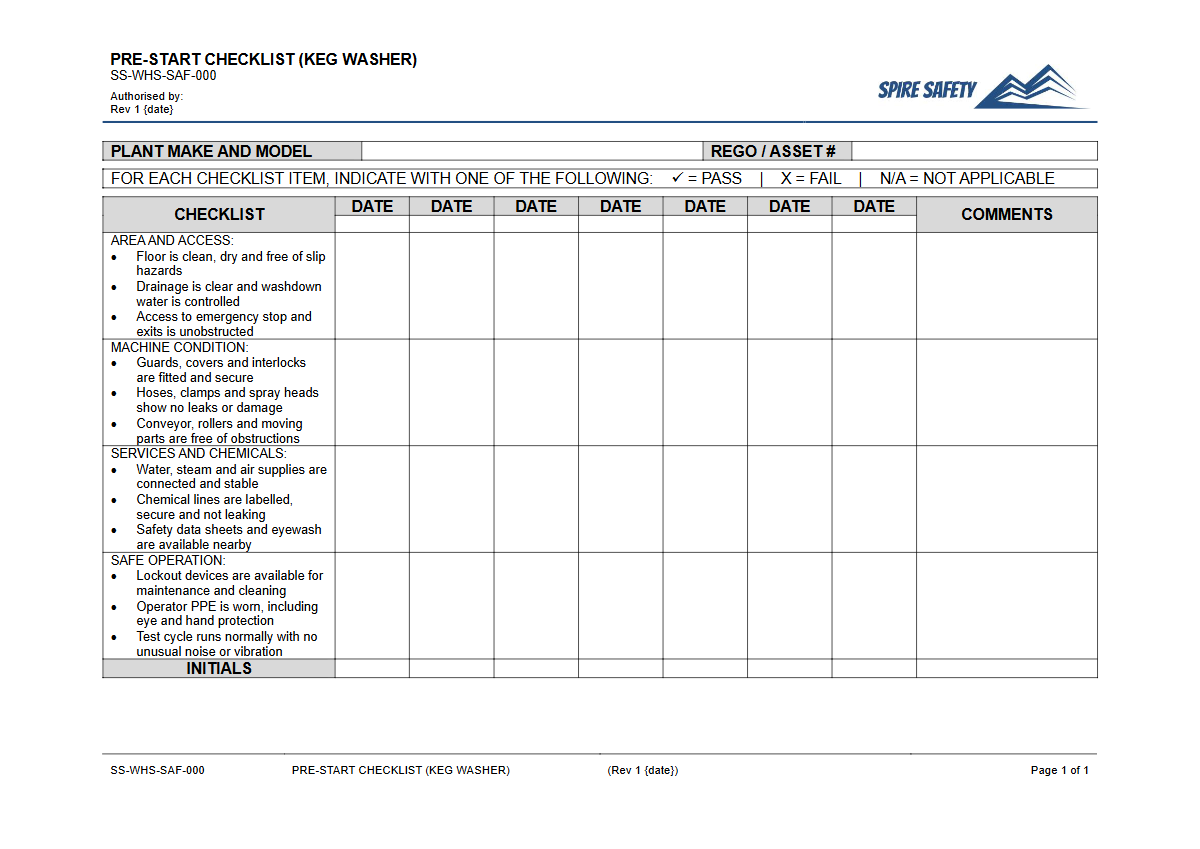
Download our free Pre-Start Checklist (Keg Washer) Template (DOCX & PDF). Formalise your brewery's daily equipment inspections to manage WHS risks effectively.
Free Pre-Start Checklist (Keg Washer) Template
DOCX • 125 KB + PDF
Updated Oct 2026
No signup required
Purpose of the Free Pre-Start Checklist (Keg Washer) Template
Operating a keg washer involves significant workplace health and safety risks, including exposure to hazardous chemicals, high-pressure water and air, hot surfaces, and moving parts. This free Pre-Start Checklist (Keg Washer) Template provides a structured framework for operators to conduct thorough inspections before use.
Regular checks help identify potential faults, leaks, or damage that could lead to injury, equipment failure, or contamination of the final product. Formalising this process is a key step in managing risks associated with plant and equipment in a brewery or beverage production environment.
By methodically verifying safety-critical components, your organisation can minimise the likelihood of incidents and demonstrate a proactive approach to WHS. These checks address hazards like chemical splashes from leaking hoses, unexpected machine movement due to faulty interlocks, or burst lines from over-pressurisation.
The principles of managing pressurised systems are comparable to those found in a Pressure Washer SOP, focusing on the integrity of hoses, nozzles, and pressure-relief devices.
Video walkthrough
How to use the Free Pre-Start Checklist (Keg Washer) Template
This template is provided as a starting point in both DOCX and PDF formats. It is designed to be adapted to the specific make and model of the keg washer used at your facility, as well as the specific chemicals (e.g., caustic, peracetic acid, sanitisers) and processes involved.
It should be integrated into your broader WHS management system and form part of the safe operating procedure for the equipment.
Customisation is Essential
Before implementation, you must review and customise this document to align with your workplace’s specific equipment and operational context. We are not familiar with your unique site conditions, so it is your responsibility to ensure the final checklist is comprehensive and suitable for your needs.
Add or remove checks based on the manufacturer’s instructions and your own risk assessments.
Key Areas to Inspect
A thorough pre-start inspection should cover several critical areas. Your customised checklist should include items such as:
- Emergency Stops: Ensure all e-stops are accessible, clearly marked, and function correctly.
- Guarding: Check that all physical guards and safety interlocks are in place and operational.
- Chemical Supply: Verify that chemical containers are correctly connected, have sufficient volume, and that all lines and fittings are free from leaks or damage.
- Hoses and Connections: Inspect all pneumatic and fluid hoses for signs of wear, abrasion, or cracking. Ensure all connections are secure.
- Pressure Gauges: Check that pressure gauges are readable and functioning, showing correct standby pressures.
- General Condition: Look for any signs of damage, loose components, or fluid leaks around the machine.
This process of itemised inspection is common across many types of machinery, and you may find similarities with other checklists, such as our Free Pre-Start Checklist (Agitator) Template, which also focuses on mechanical and system integrity before operation.
When to use it
The keg washer pre-start checklist should be completed before the first use of the equipment on any given day or shift. This ensures that the machine is safe to operate before any work commences.
Making this check a non-negotiable part of your daily safety routine, reinforced with tools like a Pre-Start Checks and Plant Maintenance Toolbox Talk, helps embed a culture of safety within the team.
Who should use it
This checklist is designed for use by trained and competent operators who are authorised to use the keg washing equipment. Supervisors or maintenance personnel may also use it to conduct periodic audits or to verify the machine's condition.
It is crucial that the person completing the checklist understands what they are checking and the potential consequences of any identified faults. Gaps found during its use may highlight the need for regular WHS compliance audits to verify that procedures are being followed correctly.
This document serves as an important record. Completed checklists should be retained as evidence that safety inspections are being consistently performed, providing valuable data for maintenance scheduling and incident investigations.
If this resource is useful, browse our complete free WHS resources library for more templates and guides.
Common mistakes
Common mistakes to avoid
- Using a generic checklist without customising it for the specific keg washer model.
- Skipping checks or ticking boxes without physically inspecting the components.
- Failing to tag out and report faulty equipment immediately.
- Insufficient training for operators on how to properly conduct the checks and understand the risks.
Legal references
Legal considerations
The following legal requirements may be relevant to this type of work.
- Work Health and Safety Act (Harmonised) — Provides the primary duties for protecting workers and other people from work health and safety risks.
- Work Health and Safety Regulations (Harmonised) — Sets out requirements supporting the management of workplace hazards and risks.
The following codes may be relevant to this type of work.
- Managing WHS Risks Code of Practice — Provides practical guidance on identifying hazards, assessing risks and applying effective controls.
- Work Health and Safety Consultation, Cooperation and Coordination Code of Practice — Provides practical guidance on consulting workers and coordinating with other duty holders.
- Managing the Work Environment and Facilities Code of Practice — Provides practical guidance on safe work environments, workplace facilities and related controls.
Did you know
Chemical Hazards
Caustic soda (sodium hydroxide), a common cleaning chemical in breweries, is highly corrosive and can cause severe burns on contact. Proper PPE and leak-free equipment are non-negotiable safety requirements.
Pressure Risks
Keg washers operate with pressurised air and water. A pinhole leak in a high-pressure line can inject fluid under the skin, causing a severe injury that requires immediate medical attention.
FAQ
Frequently asked questions
01Why is a pre-start check necessary for a keg washer?
02Can I use this template for any brand of keg washer?
03What should an operator do if a fault is found during a pre-start check?
04How does a keg washer pre-start checklist relate to a SWMS?
Share this resource
Free Pre-Start Checklist (Keg Washer) Template
Browse Categories
How To Use It
- 1Download and open in Word or PDF.
- 2Replace the placeholders with your business details.
- 3Get it reviewed by a WHS specialist before rollout.
Need it customised?
Our WHS consultants can adapt this template to your site, run a gap analysis, or audit what you already have in place.
Book a Free Consultation WHS consulting servicesor call 1300 156 382