
Free Pre-Start Checklist (Knuckle Boom) Template
Download our free Pre-Start Checklist (Knuckle Boom) Template. This structured DOCX & PDF resource helps formalise safety checks for your EWP. Start today.
Free Pre-Start Checklist (Knuckle Boom) Template
DOCX • 125 KB + PDF
Updated Oct 2026
No signup required
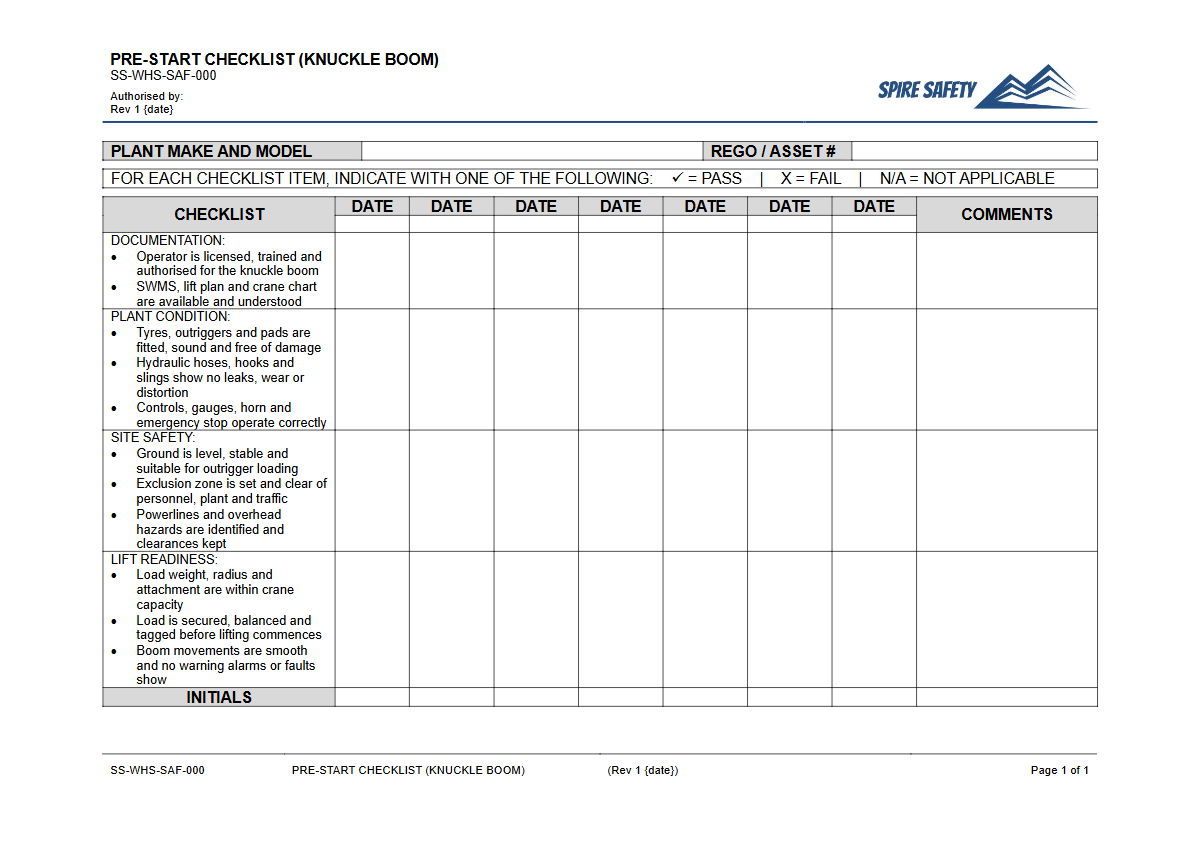
Purpose of the Free Pre-Start Checklist (Knuckle Boom) Template
A knuckle boom, a type of Elevating Work Platform (EWP), presents significant safety risks if not properly maintained and inspected. This free Pre-Start Checklist (Knuckle Boom) Template provides a structured format for operators to conduct routine visual and functional checks before operating the equipment.
Its primary purpose is to identify any faults, damage, or defects that could compromise the safe operation of the machine, helping your organisation meet its duty of care under Australian WHS laws. Systematically inspecting the equipment helps prevent incidents, protect workers from harm, and minimise costly unscheduled downtime.
Regular equipment inspections are a cornerstone of any effective plant safety program. Using a formal checklist ensures consistency and creates a documented record of the machine's condition.
For a deeper discussion with your team on this topic, our Pre-Start Checks and Plant Maintenance Toolbox Talk can help reinforce the importance of these daily routines. By formalising this process, you create a proactive safety culture where potential issues are identified and addressed before they escalate.
Knuckle booms are complex pieces of plant, often used in dynamic and high-risk environments. Establishing clear, documented safety procedures is non-negotiable.
Similar to how a free Boom Pump SOP outlines safe operational steps for another piece of heavy machinery, this pre-start checklist serves as a critical first step in the daily safe use of an EWP.
Video walkthrough
How to use the Free Pre-Start Checklist (Knuckle Boom) Template
To get started, download the template in your preferred format (DOCX or PDF). The DOCX version is fully editable, allowing for customisation to suit your specific workplace and the make and model of your knuckle boom.
The checklist is organised into logical sections, covering critical components such as engine/power systems, hydraulics, structural integrity, operator controls, emergency systems, and personal protective equipment (PPE). The operator should work through each item, physically checking the component and marking its condition.
A simple tick-box system allows for a quick but thorough inspection, with space to add comments for any items that require attention. Any 'Fail' or 'Unsatisfactory' item should render the machine unfit for use until it is inspected by a competent person and repaired.
The completed checklist should then be signed, dated, and filed according to your organisation's record-keeping procedures.
Important: This document is a template only. We have provided a solid foundation based on Australian WHS principles, but it is essential that you customise this checklist to align with the manufacturer's instructions and the specific risks present in your operational environment.
Integrating this process into your broader WHS management systems ensures that pre-start checks are not just a paperwork exercise, but a vital part of your overall risk management strategy.
When to use it
The Pre-Start Checklist for a knuckle boom must be completed before the start of each work shift or before the equipment is used for the first time on a given day. If the machine is used by multiple operators in one shift, a new check should be considered at each handover.
This routine ensures that the EWP's condition hasn't changed or deteriorated since its last operation. It is a proactive measure that complements, but does not replace, the legally required scheduled maintenance and periodic inspections performed by qualified technicians.
The findings from a pre-start check can also inform other safety processes. For instance, if a check reveals a potential new hazard related to a specific task, this information is crucial for developing or updating risk assessments.
For high-risk construction work involving mobile plant, these checks are a fundamental input for documents like a Safe Work Method Statement for Concrete Truck Operation, ensuring the equipment used is verified as safe for the task at hand.
Who should use it
This checklist should be used by a person who is trained, licensed (where required), and deemed competent to operate the specific make and model of the knuckle boom. The operator has the most direct responsibility for ensuring the machine is safe before they use it.
They are best placed to notice subtle changes in performance or condition that might indicate an underlying fault.
Supervisors and managers also have a role. They are responsible for ensuring that operators are completing the checks correctly and consistently.
They must also implement a clear process for actioning any reported defects, which includes removing the equipment from service ('tagging out') and arranging for timely repairs. If you need assistance defining roles and developing robust safety procedures for your workplace, our general WHS consulting services can provide expert guidance.
This document is one of many tools designed to improve safety outcomes in Australian workplaces. You can explore a wide range of similar documents in our free WHS resources library, covering various equipment, tasks, and safety procedures.
Common mistakes
Common mistakes to avoid
- Skipping or rushing checks to save time at the start of a shift.
- Using a generic EWP checklist that doesn't cover the specific features or controls of the knuckle boom model.
- 'Pencil-whipping' the form—ticking boxes without performing the physical and visual inspections.
- Failing to report minor issues like a slow hydraulic leak, which can escalate into a major failure.
Legal references
Legal considerations
The following legal requirements may be relevant to this type of work.
- Work Health and Safety Act (Harmonised) — Provides the primary duties for protecting workers and other people from work health and safety risks.
- Work Health and Safety Regulations (Harmonised) — Sets out requirements supporting the management of workplace hazards and risks.
The following codes may be relevant to this type of work.
- Managing WHS Risks Code of Practice — Provides practical guidance on identifying hazards, assessing risks and applying effective controls.
- Work Health and Safety Consultation, Cooperation and Coordination Code of Practice — Provides practical guidance on consulting workers and coordinating with other duty holders.
- Managing the Work Environment and Facilities Code of Practice — Provides practical guidance on safe work environments, workplace facilities and related controls.
Did you know
EWP Dangers
According to Safe Work Australia, the most common causes of fatalities involving Elevating Work Platforms (EWPs) are falls from the platform, electrocution, and platform crushing.
Tip-Over Risk
The stability of a knuckle boom is heavily dependent on the ground conditions. Operating on soft, uneven, or sloping ground is a leading cause of machine tip-overs, which can have catastrophic consequences.
FAQ
Frequently asked questions
01What is a knuckle boom pre-start checklist?
02Why are daily pre-start checks for knuckle booms important?
03Who is responsible for conducting knuckle boom pre-start checks?
04What should happen if a fault is found during a knuckle boom pre-start inspection?
Share this resource
Free Pre-Start Checklist (Knuckle Boom) Template
Browse Categories
How To Use It
- 1Download and open in Word or PDF.
- 2Replace the placeholders with your business details.
- 3Get it reviewed by a WHS specialist before rollout.
Need it customised?
Our WHS consultants can adapt this template to your site, run a gap analysis, or audit what you already have in place.
Book a Free Consultation WHS consulting servicesor call 1300 156 382